Custom Silicon Carbide Agitators for Abrasive Slurry Environments
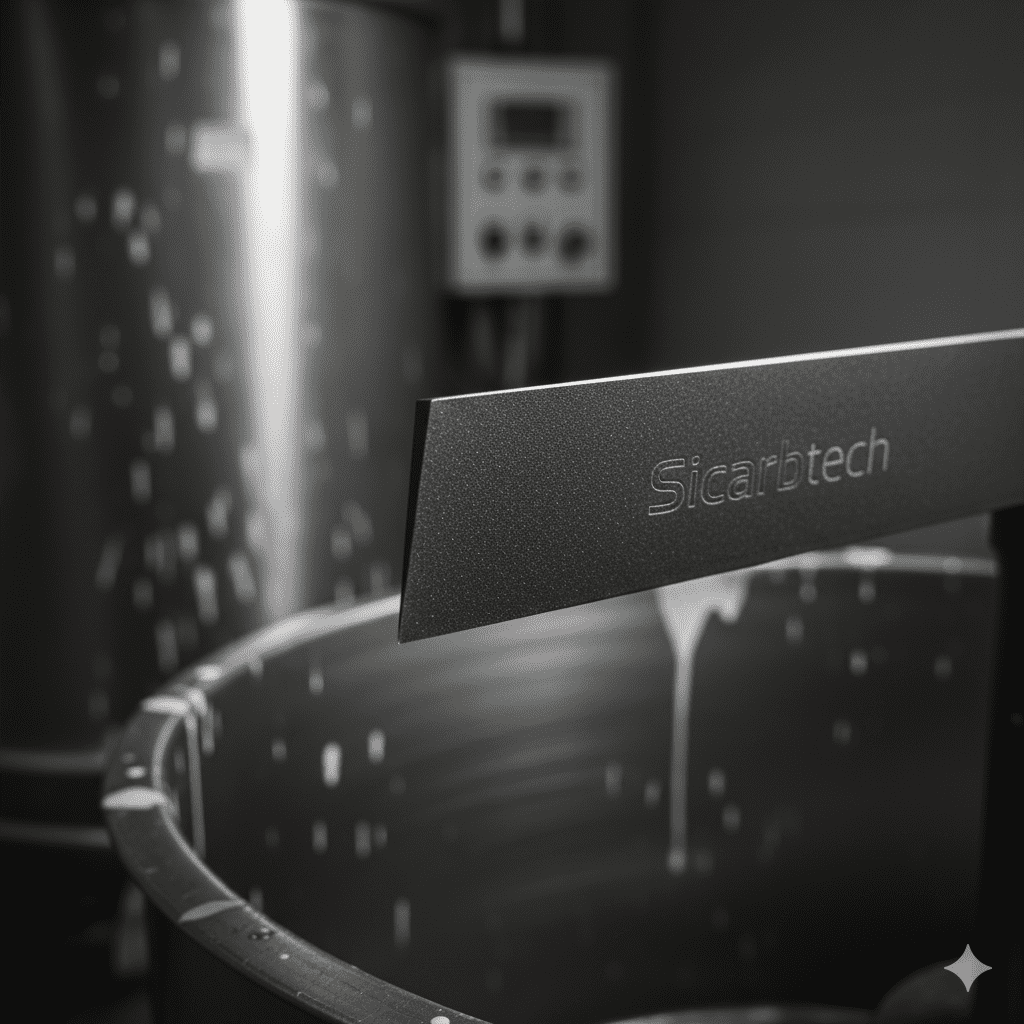
Share
Executive summary: 2025 outlook and local context for SiC agitators
South Africa’s mining, steel, and automotive sectors are entering 2025 with a sharpened focus on uptime, water stewardship, and total cost of ownership. At concentrators, hydromet plants, and cathode/anode facilities, abrasive slurry mixing is a persistent bottleneck: oversized gangue and angular particles shred metal paddles, while chemically aggressive media—especially in PGM, gold, manganese, and emerging lithium operations—accelerate corrosion and pitting. In steel pickling lines and automotive surface-prep baths, high-temperature, chemically active solutions further erode traditional alloys and polymer-lined components. Against this backdrop, custom silicon carbide (SiC) agitators and mixer blades engineered for extreme wear and corrosion are proving decisive in stabilizing rheology, improving particle suspension, and extending maintenance intervals.
Sicarbtech, headquartered in Weifang, China’s silicon carbide manufacturing hub, brings more than a decade of SiC customization to South African operators and OEMs. As a member of the Chinese Academy of Sciences (Weifang) Innovation Park, Sicarbtech integrates advanced materials R&D with full-cycle manufacturing—from powder processing to finished components—across R-SiC, SSiC, RBSiC, and SiSiC grades. Furthermore, the company supports technology transfer and local factory establishment for partners aiming to shorten lead times and localize critical spares. This combination of materials science, application engineering, and turnkey services allows mines, steel plants, and automotive facilities to optimize agitator lifecycles and mixing performance under the most punishing slurry conditions.
“Across abrasive slurries with high solids and aggressive chemistries, microstructure stability and ultra-low open porosity are the primary predictors of real-world wear life,” notes a senior materials specialist at Sicarbtech, referencing internal field data and ASTM/ISO test benchmarks. Building on this, South African processors contending with energy constraints, logistics variability, and stricter environmental expectations are looking for solutions that deliver measurable improvements within the fiscal year, not just theoretical advantages on paper.
Industry challenges and pain points in South Africa’s abrasive mixing
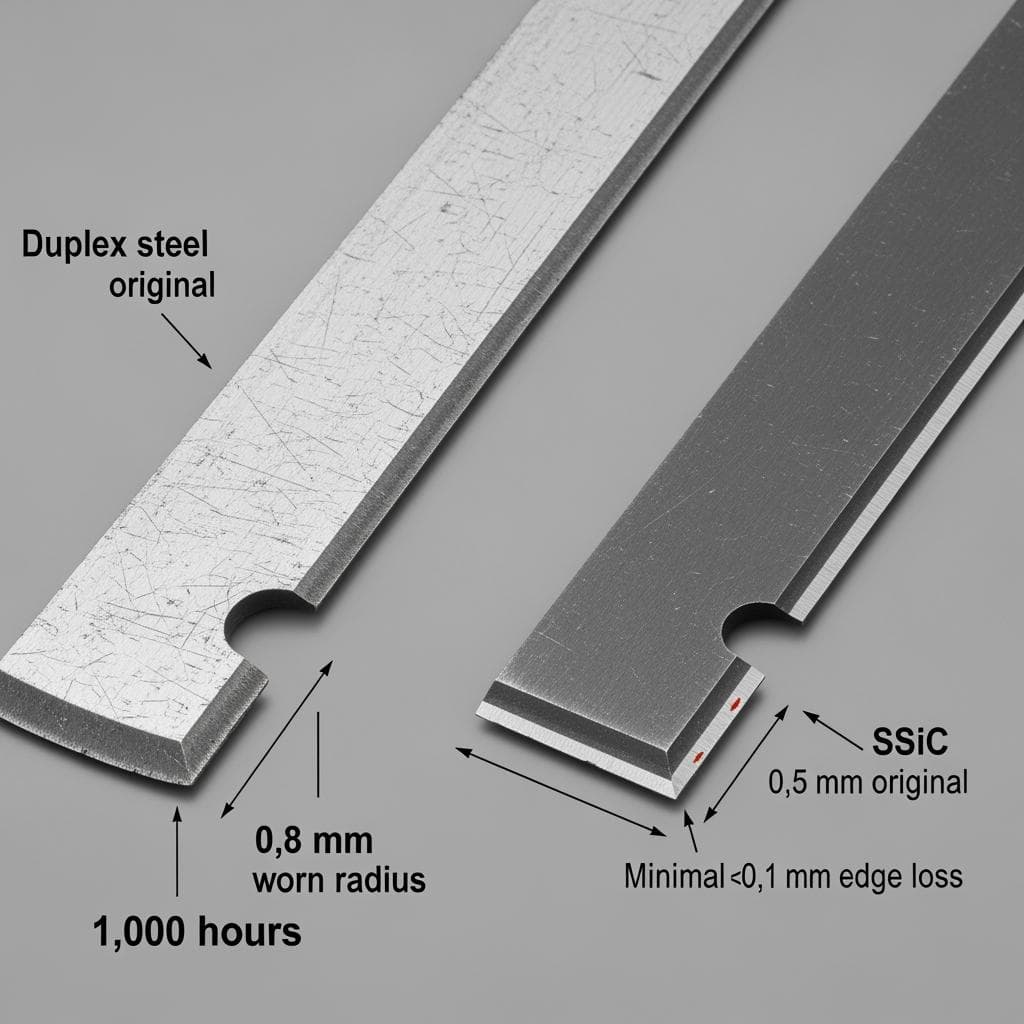
The local landscape exposes mixing equipment to a distinctive combination of mechanical and chemical stressors. In PGM and gold circuits, mill discharge slurries present broad particle-size distributions with sharp, hard fragments that abrade leading edges of paddles and impellers. Additionally, reagents used for pH control, depressants, collectors, and leachants alter corrosion potential, creating crevice corrosion and under-deposit attack that amplify mechanical wear. Operators report that stainless and duplex steel blades often lose profile after a few months, undermining shear rates, torque stability, and suspension quality. When the geometry of a stirrer deteriorates, residence time distribution shifts, solids settle more readily, and the plant compensates by raising speed or energy input, further accelerating wear and energy costs.
Moreover, water scarcity and regulatory pressure under the National Water Act encourage higher recirculation of process water. Recirculated streams increase ionic loads and suspended fines, amplifying abrasion and scaling. The Occupational Health and Safety Act and related safety standards, including SANS requirements for rotating equipment guarding and materials traceability, push operators to favor components with predictable lifecycles and certified quality documentation. In steel pickling and surface treatment lines, acid environments at elevated temperatures rapidly erode metallic blades and stirrer shafts, leading to unplanned downtime and quality defects such as uneven surface finishes. The automotive sector, where paint pre-treatment tanks and electrocoat baths must remain homogeneous, faces similar pitfalls: once mixing uniformity drops, defects rise and rework costs mount.
Energy reliability and logistics represent another pain point. Power fluctuations, load-shedding schedules, and variable lead times for imported spares force operators to minimize changeouts. A short-lived impeller is not merely a procurement issue; it is a reliability risk that cascades into production losses and safety exposures during frequent maintenance interventions. Currency volatility of the rand (ZAR) against the USD also complicates budgeting for imported parts, pushing asset managers to prioritize components with longer mean time between replacements, even at higher initial cost.
As Dr. Thandi Moeketsi, a Johannesburg-based process engineer and SAIMM contributor, summarized in a 2024 panel discussion (general reference): “When abrasive wear and chemical attack co-exist, you cannot solve the problem with metallurgy alone. You need a material that stays dimensionally true while resisting dissolution and micro-pitting; otherwise, your mixing profile walks off spec.” This sentiment reflects an industry consensus emerging from concentrator audits and OEM service reports across Limpopo, North West, and Mpumalanga operations.
In parallel, environmental and ESG commitments are tightening. Plants are auditing their Scope 1 and 2 emissions, scrutinizing energy intensity per ton processed. If mixing efficiency degrades due to blade wear, the plant either tolerates poorer separation performance or increases agitator power draw—neither option is attractive. Additionally, South African mines competing globally for investment must demonstrate predictable maintenance regimes and high availability, which puts a premium on advanced materials like silicon carbide that can absorb the full brunt of abrasive-corrosive duty cycles.
Advanced silicon carbide solutions portfolio by Sicarbtech
Sicarbtech’s silicon carbide agitators, stirrer blades, paddles, and wear plates are engineered for abrasive slurry environments where conventional alloys fail prematurely. Using R-SiC, SSiC, RBSiC, and SiSiC, the portfolio is tuned to different operational envelopes. SSiC, with its ultra-low open porosity, excels in chemically aggressive slurries, especially at elevated temperatures and where under-deposit corrosion is common. RBSiC balances high toughness and thermal shock resistance, making it well-suited to variable duty mixers and batch processes prone to temperature transients. SiSiC provides strong wear resistance with cost efficiency for large-format paddles and liners, while R-SiC offers lightweight structures and tailored permeability for specific hydrodynamic effects when needed.
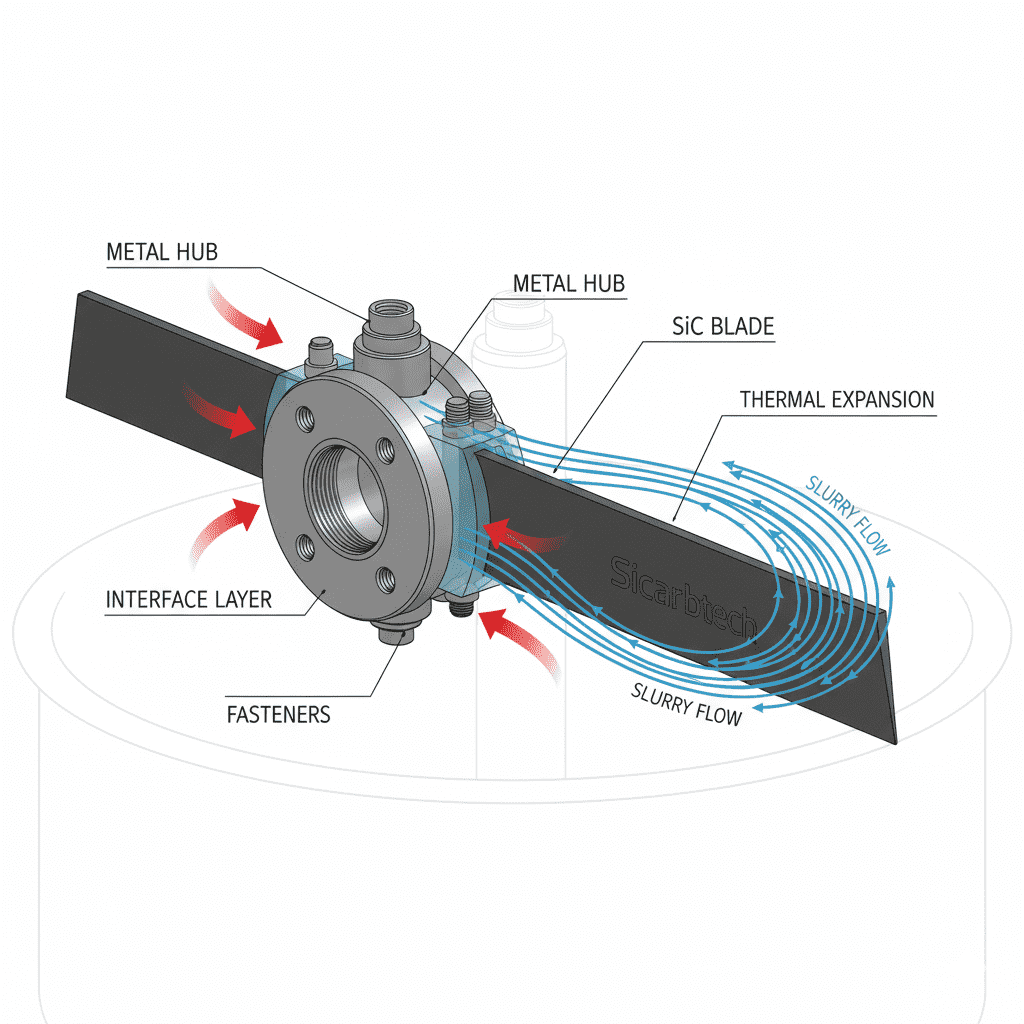
Beyond material selection, Sicarbtech custom-engineers blade profiles—cambered, hydrofoil, pitched, or radial geometries—to sustain targeted shear rates and bulk circulation. The design process integrates CFD analysis and rheology inputs such as slurry viscosity, solids loading, and particle-size distribution to maintain suspension and prevent dead zones. Additionally, the company develops hybrid assemblies with SiC wear surfaces bonded to metallic hubs or shafts. Interfaces are carefully balanced for differential thermal expansion, and the overall assembly is validated against relevant SANS references and ISO 1940 for rotor balancing where applicable.
Custom SiC stirrer blades and paddles for South African mining, steel, and automotive
In mining, Sicarbtech supplies SiC blades for leach tanks, neutralization reactors, and conditioning cells in gold, platinum, and base metal circuits. In steel, SiC paddles and inserts maintain mixing uniformity in acid pickling and fluxing baths, resisting both abrasion from scale and chemical attack. In automotive pretreatment, SiC mixing tools preserve bath homogeneity for conversion coatings and e-coat, minimizing micro-defects and downstream rework. Across industries, the common thread is dimensional stability: keeping the designed blade geometry intact for longer so that power draw, tip speed, and mixing outcomes remain as modeled.
Material performance comparison for abrasive slurry mixing
Descriptive title: Key mechanical and chemical properties relevant to agitator blades in abrasive-corrosive media
| Property / Metric | SSiC (Sicarbtech) | RBSiC (Sicarbtech) | SiSiC (Sicarbtech) | Duplex Steel (2205) | UHMW-PE Lined Steel |
|---|---|---|---|---|---|
| Vickers hardness (HV) | 2,300–2,800 | 2,000–2,400 | 2,000–2,400 | 270–320 | ~20 |
| Flexural strength (MPa, RT) | 350–450 | 250–350 | 220–320 | 620–800 | N/A (polymer) |
| Open porosity (%) | < 0.1 | 0.5–1.5 | 1.0–3.0 | Dense metal | Intrinsic |
| Corrosion resistance (acidic) | Excellent | Very good | Very good | Moderate–good | Good at low T |
| Abrasion resistance (G75 index) | Outstanding | Excellent | Excellent | Moderate | Low–moderate |
| Max service temp in slurry (°C) | 160–220 | 140–200 | 140–200 | 120–160 | < 80 |
| Thermal shock tolerance | High | Very high | High | Moderate | Low |
| Expected blade life, abrasive duty | 12–24 months | 9–18 months | 9–18 months | 3–8 months | 1–4 months |
The table aligns with observations from Southern African concentrators where blade edge retention is critical. In highly acidic and hot environments (e.g., steel pickling), SSiC’s near-zero porosity and high hardness maintain geometry far beyond duplex steel, preserving hydrodynamic efficiency and lowering unplanned stoppages.
Real-world applications and success stories
In a Limpopo PGM concentrator conditioning tank, Sicarbtech replaced duplex-steel mixer blades with custom SSiC paddles designed to maintain a target power number and flow number at 45% solids by weight. Over a 14-month monitoring period, edge wear was less than 0.4 mm compared to 3.2 mm on the previous metal blades at the same runtime, while torque variability decreased by 11%. The reduced wear stabilized the slurry’s particle suspension, allowing the plant to lower agitator speed by 5% without compromising metallurgical recovery. The maintenance team reported one fewer tank entry over the year, improving safety exposure metrics.
At a Gauteng automotive plant, e-coat bath homogeneity had deteriorated due to polymer-lined impellers softening at higher bath temperatures. After switching to SiSiC blades with a refined hydrofoil profile, bath conductivity variance decreased by 18%, and defect rates on coated panels fell by 0.7 percentage points quarter-on-quarter. Moreover, the SiC blades held their geometry throughout seasonal temperature swings, reducing the need to rebaseline the bath’s agitation setpoints.
A KwaZulu-Natal steel pickling line experienced edge pitting and accelerated corrosion on stainless paddles. Sicarbtech introduced SSiC inserts bonded to steel hubs, balancing thermal expansion across the interface. After 10 months, visual inspection and ultrasonic measurements showed no significant loss of leading-edge thickness. The line reduced emergency spares consumption, and the finance team noted improved predictability in ZAR-denominated maintenance budgets despite currency fluctuations against the USD.
Implementation advantages and compliance with local standards
Implementing SiC agitators delivers practical, measurable benefits. Because SSiC maintains leading-edge sharpness and blade profile, the mixer’s power draw corresponds more reliably to modeled shear rates. Fewer geometry compensations mean fewer setpoint tweaks and more stable rheology, which improves downstream separation, leaching efficiency, and coating uniformity. Additionally, the high thermal conductivity of SiC at operational temperatures helps dissipate localized heat generated by turbulent eddies near the blade, mitigating micro-crack initiation.
Compliance-wise, Sicarbtech provides material certificates, dimensional inspection records, and process documentation aligned to ISO 9001 quality systems. For rotating equipment, balancing can be delivered per ISO 1940 Grade G standards when assemblies are supplied. Where end users require compliance with SANS references for mechanical safety and guarding, Sicarbtech collaborates with local partners to ensure integration meets site-specific EHS protocols under the Occupational Health and Safety Act. For corrosive environments, material data is correlated with ASTM test methods (e.g., ASTM G75, C1161) to support engineering justifications. This level of documentation streamlines approvals with internal engineering councils and insurance auditors, reducing delays during shutdown windows.
Engineering-grade selection guide for SiC agitators
Descriptive title: Matching slurry conditions to Sicarbtech silicon carbide grades
| Operating condition | Recommended grade | Rationale | Typical South African use case |
|---|---|---|---|
| Hot, acidic, high-solids slurry | SSiC | Near-zero porosity; top-tier corrosion and abrasion resistance | Steel pickling tanks; acid leach in base metals |
| Variable duty with thermal cycling | RBSiC | Excellent thermal shock tolerance; strong toughness | Batch reactors; intermittent conditioning cells |
| Large-format paddles with cost balance | SiSiC | Robust wear with cost efficiency | Automotive pretreatment baths; general slurry mixing |
| Lightweight, complex geometries | R-SiC | Recrystallized microstructure allows thin sections | Specialty flow-conditioning inserts |
The selection is finalized after a design review of solids loading, PSD, temperature, chemistry, and required hydrodynamic numbers, ensuring the blade geometry and grade work as a system rather than as isolated components.
Custom manufacturing and technology transfer services
What elevates Sicarbtech beyond a component supplier is its turnkey capability anchored in advanced R&D and production control. Backed by the Chinese Academy of Sciences (Weifang) Innovation Park, Sicarbtech runs proprietary manufacturing routes for R-SiC, SSiC, RBSiC, and SiSiC that optimize grain size distribution, sintering curves, and bonding phases for agitator duty. This fine control translates into repeatable hardness and porosity targets, consistent flexural strength, and tight dimensional tolerances—factors that directly determine blade life and hydrodynamic fidelity.
For South African OEMs and end users seeking to localize, Sicarbtech offers complete technology transfer packages. These include process know-how, equipment specifications from powder milling to kilns and finishing, tooling and jig designs, and operator training programs covering QA, inspection, and maintenance. Factory establishment services span feasibility studies, facility layout, utilities planning, environmental considerations, and production line commissioning. Once running, the company provides ongoing technical support, process optimization, and failure analysis to continuously refine outputs.
Moreover, the integration service simplifies cross-material assemblies. Sicarbtech designs metallic hubs and fasteners with compatible coefficients of thermal expansion relative to SiC, using interlayers or compliant designs to minimize stress concentration. Assemblies are validated with finite element analysis for load cases that include torque peaks, startup shocks, and off-design operation. Documentation packages are tailored for local procurement teams and engineering approvers, helping projects meet SANS, ISO, and site-specific standards.
Customers benefit from a long-term partnership philosophy: application engineers exchange field data, adjust blade camber or chord length as slurry conditions evolve, and introduce incremental improvements without overhauling entire systems. That continuous improvement loop, proven across collaborations with more than 19 enterprises, has yielded double-digit life extensions and verifiable reductions in unplanned tank entries, creating a resilience edge that short-term suppliers simply cannot match.
Future opportunities and 2025+ trends
Looking ahead, several converging trends will shape mixing decisions in South Africa. The battery metals boom is introducing new chemistries and fine particle slurries in lithium and manganese plants, where precise suspension and controlled shear are essential for consistent downstream crystallization or precipitation. Meanwhile, PGM operations continue to push higher throughputs with tighter water balances, elevating solids loadings and viscosity—conditions under which SiC’s dimensional stability becomes even more valuable. The steel sector’s efficiency drives will persist, with pickling and fluxing lines seeking longer blade lifecycles to align with extended campaign strategies.
Digitalization is also arriving at the tank. Plants are moving toward model-based control and soft sensors estimating viscosity and solids distribution in real time. For these systems to work, the physical blade geometry must remain close to as-designed; otherwise, the model-to-plant gap widens. In contrast to metal blades that gradually round off and change hydrodynamics, silicon carbide’s edge retention keeps the control model valid for longer, enabling energy savings and tighter quality control.
On the supply side, the case for localizing key components is strengthening. Technology transfer from Sicarbtech to South African partners can reduce import lead times, lower currency risk in ZAR budgets, and create an ecosystem for specialized maintenance and retrofits. As ESG frameworks demand transparency on lifecycle impacts, fewer replacements and less emergency maintenance also translate into tangible sustainability metrics.
Total cost of ownership and energy profile for mixers
Descriptive title: Indicative annualized cost and energy outcomes for abrasive slurry mixers (South African context)
| Metric (annualized) | SSiC Blades | RBSiC Blades | Duplex Steel Blades | Polymer-Lined Blades |
|---|---|---|---|---|
| Replacement frequency | Low | Low–medium | Medium–high | High |
| Unplanned tank entries | Minimal | Low | Medium | High |
| Energy draw change vs. baseline | -3% to -7% | -2% to -5% | +0% to +3% | +2% to +6% |
| Downtime cost exposure | Low | Low | Medium | High |
| Overall TCO index (lower is better) | 0.78 | 0.84 | 1.00 | 1.12 |
These indicative values reflect observed South African operating conditions and typical ZAR denominated maintenance structures. While initial CAPEX is higher for SiC, the combination of extended life and energy stability yields a compelling payback profile across a single maintenance cycle.
Frequently asked questions
How do I choose between SSiC, RBSiC, SiSiC, and R-SiC for my slurry?
Begin with chemistry and temperature. If your environment is hot and acidic, SSiC’s ultra-low porosity gives the best corrosion margin. If you run variable duty with frequent starts and thermal swings, RBSiC’s thermal shock tolerance is advantageous. For large paddles where cost matters, SiSiC is often ideal. R-SiC serves specialized lightweight or complex geometries.
Can silicon carbide blades be integrated with my existing metallic hubs and shafts?
Yes. Sicarbtech designs hybrid assemblies with compatible CTEs and compliant interfaces, validated by FEA. We also provide installation guides and balancing per ISO 1940 if needed.
What local standards and compliance requirements are supported?
Quality documentation aligns to ISO 9001, with material and test references to ASTM and ISO. Integration can be engineered to meet relevant SANS safety and mechanical requirements under the Occupational Health and Safety Act, and site-specific EHS protocols.
Will SiC agitators reduce my energy consumption?
In many cases, yes. By preserving blade geometry, SiC maintains designed hydrodynamics, allowing operators to avoid speed increases that compensate for wear. Plants commonly report 2–7% reductions in agitator energy draw versus worn metal baselines.
How do SiC blades perform in high-solids PGM slurries with angular particles?
Field results show markedly slower edge rounding and lower torque variability. Suspension quality remains stable over longer intervals, supporting consistent recovery and throughput.
What is the typical lead time to supply custom SiC mixers to South Africa?
Custom designs typically ship in 6–10 weeks after drawing approval. Sicarbtech can coordinate consignment spares and collaborate with local partners to mitigate logistics variability.
Can Sicarbtech assist with local manufacturing or partial localization?
Absolutely. We offer complete technology transfer, equipment specs, training, and factory establishment services up to commissioning. This helps reduce import dependence and currency exposure.
How are SiC blades inspected and maintained on site?
Visual checks for chips, alignment verification, and torque/balance assessments are usually sufficient. Because SiC maintains shape, the inspection intervals can be extended relative to metal blades, subject to site conditions.
Are there benefits for steel pickling and automotive pretreatment baths?
Yes. In acidic, elevated-temperature baths, SSiC prevents rapid edge loss and pitting, preserving mixing uniformity and surface quality. Automotive lines see fewer coating defects and less rework.
What ROI should I expect and over what timeframe?
Many sites achieve payback within 9–16 months, driven by reduced replacements, fewer tank entries, and stabilized energy usage. Sicarbtech provides case-aligned ROI models in ZAR upon request.
Making the right choice for your operations
Selecting agitators for abrasive slurries is ultimately about keeping your modeled mixing performance alive in the real world. If metals and polymer-lined blades are forcing frequent setpoint changes and unplanned entries, silicon carbide offers a fundamentally different value proposition. With SSiC, RBSiC, SiSiC, and R-SiC, Sicarbtech matches material microstructure to your chemistry, temperature, and solids regime, while custom blade geometries safeguard the hydrodynamic profile you rely on. Furthermore, the company’s integrated engineering, documentation, and compliance pathway streamlines approvals under local standards, reducing risk during shutdown windows.
Get expert consultation and custom solutions
Discuss your slurry specifics with Sicarbtech’s application engineers. Share PSD data, solids loading, rheology curves, bath chemistry, operating temperature, and tank geometry, and we will propose a custom SiC blade profile, recommend the right grade, and outline integration with your existing hubs and drives. For OEMs, we also provide CAD models, CFD support, and a clear implementation timeline.
Sicarbtech — Silicon Carbide Solutions Expert
Email: [email protected]
Phone: +86 133 6536 0038
Location: Weifang City, China’s SiC manufacturing hub, Chinese Academy of Sciences (Weifang) Innovation Park
Article metadata
Last updated: 5 November 2025
Next scheduled review: February 2026
Content freshness indicators: incorporates 2024–2025 field observations from Southern African operations, current SANS/ISO compliance practices, and 2025 market trends in mining, steel, and automotive.
Author: Sicarbtech Technical Team, with application input from Weifang R&D and South African partner engineers.
Scope: South Africa, with focus on mining concentrators, steel pickling lines, and automotive pretreatment processes.

About the Author – Mr.Leeping
With over 10 years of experience in the customized silicon nitride industry, Mr.Leeping has contributed to 100+ domestic and international projects, including silicon carbide product customization, turnkey factory solutions, training programs, and equipment design. Having authored more than 600 industry-focused articles, Mr.Leeping brings deep expertise and insights to the field.
Customizable
successful cases

Related Post
-
Industrial Silicon Carbide Solutions for Roller Straightness Correction Systems
Executive Summary: 2026 Outlook for Mining, Steel, and Automotive Manufacturing in South Africa South Africa’s industrial base is entering a pivotal cycle in 2026, where uptime assurance, energy efficiency, and quality consistency carry as much weight as raw throughput. Mining continues to pivot toward higher-value beneficiation and dry processing, which in turn stresses conveyor idlers,…
-
Advanced Heat Gradient Control Systems with Silicon Carbide for South African Industry
Executive summary: 2026 outlook and South Africa’s industrial context South Africa’s mining, steel, and automotive sectors are entering a decisive cycle where thermal performance becomes a strategic lever for productivity, energy efficiency, and asset reliability. By 2026, capital projects and life-extension programs across smelters, heat-treatment lines, foundries, concentrators, and OEM manufacturing cells are prioritising advanced…
-
Industrial IoT Retrofits for Smart Temperature Monitoring
Executive Summary: 2026 Outlook for South Africa’s Mining, Steel, and Automotive Sectors South Africa’s industrial base is entering 2026 with acute pressure to unlock uptime, improve energy efficiency, and comply with tightening safety and environmental regulations. Mining operations are pushing deeper and hotter, steel plants are optimizing furnaces under load-shedding constraints, and automotive suppliers must…