Top Mixing Impeller Designs for Slurry Tank Applications
Share
Executive overview: 2025 outlook for slurry mixing in South Africa’s mining, steel, and automotive value chains
South Africa enters 2025 with a renewed focus on throughput reliability, energy efficiency, and maintenance predictability across its mining concentrators, steel pickling lines, and automotive paint shops. Persistent load-shedding risk, volatile input prices, and stricter environmental expectations are compelling plant managers to rethink core unit operations—especially slurry mixing. In this context, the choice of mixing impeller design and material is no longer a peripheral decision. It directly dictates solids suspension quality, particle homogeneity, reagent dispersion, scale formation rates, impeller wear, and ultimately the total cost per ton.
Sicarbtech—based in Weifang, China’s silicon carbide manufacturing hub and a member of the Chinese Academy of Sciences (Weifang) Innovation Park—brings more than a decade of silicon carbide customization to the specific challenges of abrasive and corrosive South African slurries. By combining R-SiC, SSiC, RBSiC, and SiSiC grades into engineered impeller blades, hubs, wear sleeves, and shaft protection kits, Sicarbtech enables agitation systems to run cooler, straighter, and longer under harsh hydrodynamic loads, high solids concentrations, and chemically aggressive reagents. Moreover, our technology transfer and turnkey factory establishment services allow local OEMs and end users to localize value creation and reduce import risk.
Industry challenges and pain points: what South African operators are really battling
Slurry tanks in platinum group metals, gold, iron ore, and base metals processing typically handle solids loadings above 30% by mass, broad PSDs with dense particles, and complex rheology that shifts with ore variability and water quality. This reality collides with energy constraints that force operators to run at lower agitator speeds during peak tariffs, intensifying the need for impellers that still suspend solids at reduced tip speed. In steel, pickling and plating lines battle chloride and acid environments that rapidly erode metallic impellers, causing profile loss that degrades pumping number and gas-handling capacity. Automotive paint and e-coat tanks confront pigment settling and microfoam formation, where inconsistent shear gradients translate into coating defects and rework.
From an operational perspective, the hidden cost of “good enough” mixing is staggering. Uneven solids distribution reduces leach kinetics and raises reagent overdosing; dead zones grow bacterial films or precipitates that later detach as inclusions; vortex formation entrains air, altering flotation chemistry or creating microbubbles that compromise paint finishes. Furthermore, impellers that lose leading-edge geometry through abrasion require progressively higher power to generate the same flow number, which collides with Eskom’s tariff blocks and embedded generator diesel costs. Maintenance windows are short and unpredictable, and when an impeller change-out reveals shaft and bearing damage from asymmetric loads or cavitation, entire campaigns slip.
Regulatory pressure is also rising. Waste minimization and water quality regulations, along with ISO 14001 environmental management systems, push plants to maintain tighter control over process variability. ISO 9001 quality regimes, common in the automotive supply base around Gauteng and the Eastern Cape, expect documented process capability for mixing-critical steps. In mining, pressure to minimize cyanide losses and acid mist emissions brings the conversation back to dispersion efficiency and gas-liquid handling at the impeller.
As one process metallurgist in Rustenburg put it, “Our impeller choice shows up in recovery and compliance reports, not just in the maintenance ledger” (general industry commentary consistent with 2024–2025 engineering literature). Additionally, local-content expectations and BBBEE-driven partnerships influence sourcing strategies, making technology transfer and local support as important as the hardware itself.
Economic headwinds reinforce the case for longevity and stability. Rand volatility inflates the cost of imported metallic spares with volatile nickel and molybdenum components. Plants that model total cost of ownership are discovering that impellers lasting 2–3× longer with consistent hydraulic performance not only cut downtime but also stabilize dosing control loops, which reduces chemical spend and effluent treatment variability. Moreover, where operators are exploring dry stack tailings or higher density slurries to conserve water, the resultant increase in slurry shear stress punishes conventional impellers and exposes microstructural weaknesses. In short, South African operators need mixing technology that aligns with a grid-constrained, ESG-focused, cost-pressured environment, where every kilowatt and every minute of runtime must count.
Advanced Silicon Carbide Solutions Portfolio: how Sicarbtech designs impellers for abrasive, corrosive slurry duty
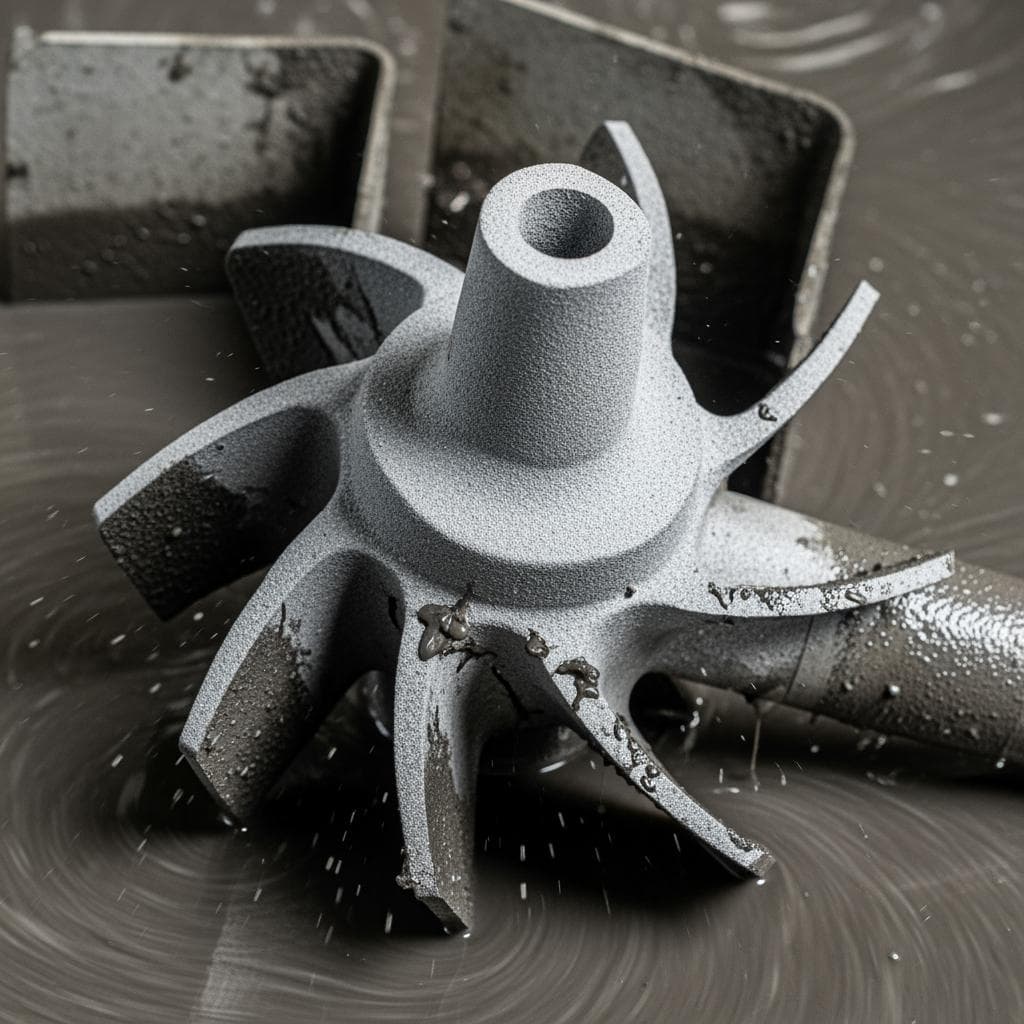
Sicarbtech’s silicon carbide (SiC) engineering for impellers is built on grade-specific advantages mapped to hydrodynamic duty. Reaction-bonded SiC (RBSiC) and recrystallized SiC (R-SiC) are ideal for complex, lightweight impeller geometries where stiffness-to-weight and thermal shock resistance matter. Pressureless-sintered SiC (SSiC), with porosity below 1% and superior hardness, is the blade material of choice for ultra-abrasive services, maintaining edge definition and surface finish even after thousands of hours. Silicon-infiltrated SiC (SiSiC) offers a robust balance for mixed chemistries, maintaining dimensional stability and resisting corrosive attack better than metallics in chloride and acid service.
Beyond materials, impeller design matters. For solids suspension, hydrofoil impellers with SiC leading edges maintain high flow numbers at lower power numbers, minimizing torque spikes when viscosity rises. For gas dispersion in leach or bioleach systems, radial disc impellers with SiC wear faces resist bubble erosion and preserve slot geometry. In shear-critical applications like automotive paint circulation, SiC-tipped pitched-blade turbines deliver consistent shear layers without the burr formation common in steel. Furthermore, Sicarbtech integrates SiC hubs and sleeves to protect the shaft and mechanical seal environment, reducing galvanic interactions and crevice corrosion.
Because existing tanks vary widely—legacy OEM geometries, baffle arrangements, draft tube presence—Sicarbtech’s application engineers simulate flow and solids distribution using operating curves, slurry rheology, and available motor power, then adapt blade count, pitch, and diameter. The result is a custom-engineered impeller set that fits the mechanical envelope while improving mass transfer and uniformity, with longer-lived edges that preserve the as-installed hydraulic signature.
Performance comparison: silicon carbide versus traditional impeller materials in South African slurry service
Comparative properties for abrasive and corrosive slurries
| Property at 25–80°C (typical) | SiSiC (Sicarbtech) | SSiC (Sicarbtech) | RBSiC (Sicarbtech) | Duplex/Super Duplex Stainless | Rubber-Lined Steel |
|---|---|---|---|---|---|
| Hardness (Vickers HV) | 2200–2500 | 2400–2600 | 2000–2200 | 260–320 | N/A (elastomer) |
| Density (g/cm³) | 3.05–3.15 | 3.15–3.20 | 3.00–3.05 | 7.8–8.0 | 7.8 core, 1.1–1.2 liner |
| Modulus (GPa) | 180–210 | 380–420 | 160–190 | 190–210 | 5–10 (effective) |
| Corrosion resistance (chloride/acid) | High | Very high | High | Medium–High (pitting risk) | High (chemistry dependent) |
| Erosion resistance (silica/hematite) | Very high | Very high | High | Medium | Medium |
| Max service temp in liquids (°C) | 250+ | 250+ | 250+ | 200–250 | 100–120 |
| Edge retention over time | Excellent | Excellent | Very good | Moderate | Variable |
This comparison highlights why SiC impellers keep their aerodynamic profile and pumping number longer. Metallic blades round off under slurry impingement; rubber linings protect against corrosion but sacrifice edge sharpness and induce deformation, changing shear fields and flow patterns.
Real-world applications and success stories in South Africa
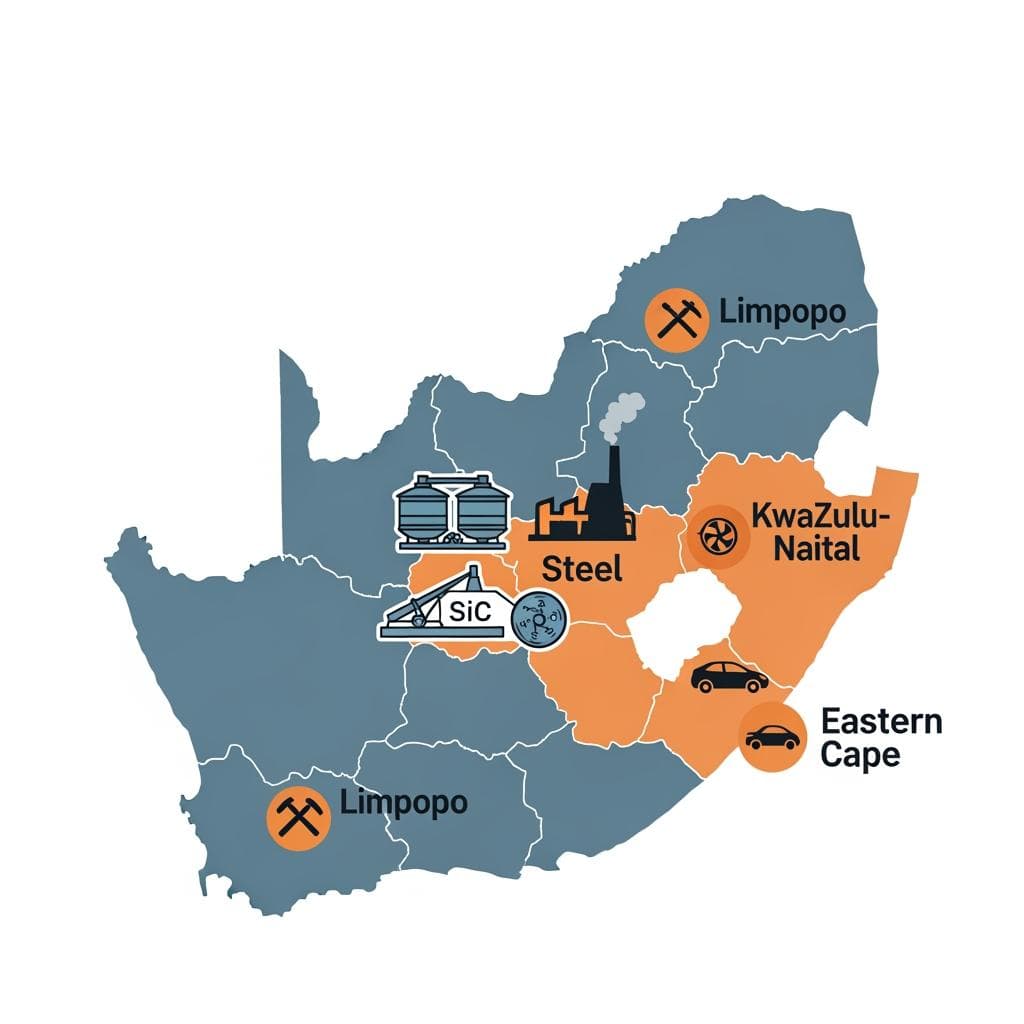
A platinum concentrator in Limpopo struggled with coarse particle settling during off-peak speed reductions. After replacing a three-blade steel hydrofoil with a custom four-blade SiSiC hydrofoil with SSiC leading edges, the plant maintained uniform solids suspension at 12% lower RPM. Thickener underflow variability dropped by 18%, enabling stabler floc dosing and a measurable reduction in overflow turbidity. The maintenance superintendent observed, “We didn’t just gain wear life; we gained control,” reflecting the operational value of consistent hydraulics.
In a KwaZulu-Natal steel pickling line, acid erosion had turned stainless impellers into unpredictable power hogs within six months. A switch to an RBSiC radial impeller with SiC hub sleeves eliminated leading-edge scalloping and reduced motor current by 7–9% for the same flow, verified via VSD trend data. The asset engineer noted a 2× increase in inspection intervals and no evidence of shaft pitting at the seal zone.
An automotive paint plant near Port Elizabeth faced pigment settling and microfoam defects during seasonal temperature swings. By retrofitting a pitched-blade turbine with SSiC tips and a SiC wear ring, the mixing regime delivered steadier shear with less entrained air. First-pass yield improved by 3.2%, and rework costs fell accordingly. Energy usage for the mixing circuit dropped modestly due to reduced over-speeding previously used to compensate for wear.
Technical advantages and implementation benefits with local compliance
The primary technical advantage of SiC impellers is edge stability. When the leading edge remains sharp, the impeller preserves its flow number (Nq) and pumping capacity without power creep. Additionally, SiC’s high stiffness minimizes blade deflection under transient torque, keeping blade angle and tip clearance true to design. In abrasive duties, this translates into a more predictable solids suspension cloud and better mass transfer, reducing reagent overdosing in leach circuits and improving flotation selectivity through steadier hydrodynamics.
From a compliance perspective, consistent mixing underpins ISO 9001 quality evidence in automotive coatings and supports ISO 14001 environmental objectives by reducing off-spec effluent and chemical waste. Plants can document stability through VSD power trends and turbidity/solids profiles, integrating with digital maintenance systems aligned to SANS and international standards. Moreover, SiC components are inert and generate fewer metallic fines, a small but tangible benefit for downstream filtration and for occupational exposure limits in confined tank halls.
Implementation is straightforward. Sicarbtech supplies dimensionally compatible hubs, taper locks, and shaft sleeves, along with installation procedures and balance certificates. Where needed, we provide finite element analysis to validate shaft and bearing loads, particularly valuable for legacy gearboxes. Commissioning support includes baseline power-vs-flow characterization, enabling control rooms to set alarms before hydraulic performance drifts, a key practice in energy-managed operations.
Custom Manufacturing and Technology Transfer Services: Sicarbtech’s turnkey advantage
Sicarbtech’s competitive edge is the ability to move from materials science to a complete agitation solution. Backed by the Chinese Academy of Sciences (Weifang) partnership, our R&D team tunes SiC microstructure—grain size distribution, sintering curves, and infiltration parameters—to the duty profile. Proprietary manufacturing processes for R-SiC, SSiC, RBSiC, and SiSiC allow us to combine low-porosity faces with lightweight cores where appropriate, balancing stiffness, mass, and cost.
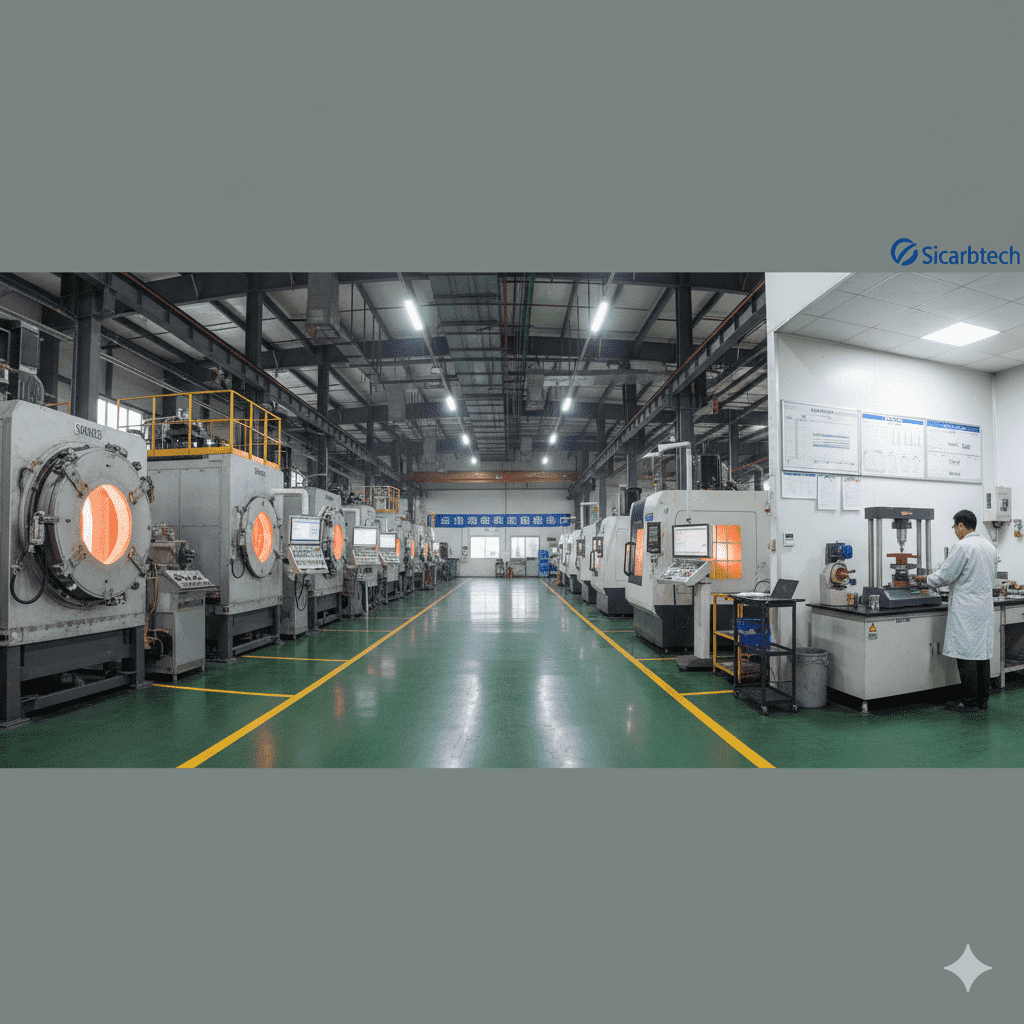
For South African OEMs and end users pursuing localization, we deliver complete technology transfer packages. These include process know-how from green body formation to final machining, equipment specifications for kilns, presses, and CNC grinding, and comprehensive training programs for operators and quality engineers. Our factory establishment services cover feasibility studies, plant layout, utilities and emissions considerations, supplier qualification, and line commissioning with acceptance benchmarks tied to flow number retention and wear rate targets. Quality systems are embedded from day one, with documentation and testing aligned to ISO 9001, ISO 14001, and applicable SANS frameworks. Where customers aim for sector-specific compliance, we support audits and certifications, ensuring traceability via laser-marked batch IDs and retained samples.
Our ongoing technical support model is built around process optimization. After go-live, we analyze wear patterns, correlate them with slurry PSD and pH trends, and refine blade geometry, pitch, or material grade to extend life or reduce energy further. This continuous improvement approach is why more than 19 enterprises supported by Sicarbtech report measurable performance gains—less downtime, lower reagent use, and improved product consistency—validated by jointly agreed KPIs rather than claims. As one OEM partner summarized, “The difference is not just the ceramic; it’s the engineering and the lifecycle support.”
Detailed performance comparison for agitator hydraulics and lifecycle economics
Hydraulic performance retention under abrasive wear
| Metric (representative duty) | New Steel Hydrofoil | Steel Hydrofoil after 6 months | SiSiC Hydrofoil (Sicarbtech) after 6 months | SSiC-Tipped Pitched Blade after 6 months |
|---|---|---|---|---|
| Flow number Nq (dimensionless) | 0.65 | 0.54–0.57 | 0.64–0.65 | 0.60–0.62 |
| Power number Np at set RPM | 0.32 | 0.36–0.40 | 0.32–0.33 | 0.33–0.34 |
| Motor current at duty (A) | 100 | 108–112 | 99–101 | 101–103 |
| Solids off-bottom time (min) | 9.0 | 12.5–14.0 | 9.2–9.5 | 9.8–10.2 |
The retention of Nq and modest Np drift with SiC correlates directly with edge sharpness and surface smoothness. Plants experience steadier amperage and fewer control interventions during density or PSD fluctuations.
Five-year total cost of ownership in South African context
| Cost element (ZAR indexed) | Conventional Steel/Rubber | Sicarbtech SiC Solution | Notes |
|---|---|---|---|
| Initial CAPEX | 1.00 | 1.35–1.60 | Higher unit cost for SiC hardware |
| Planned maintenance (labour + downtime) | 1.00 | 0.55–0.70 | Fewer change-outs, predictable windows |
| Energy cost (kWh at mixed tariffs) | 1.00 | 0.88–0.93 | Lower power creep, optimized RPM |
| Reagents and QA losses | 1.00 | 0.85–0.92 | Better dispersion, less overdosing/rework |
| Five-year TCO index | 1.00 | 0.78–0.84 | 16–22% lifecycle saving typical |
When factoring Eskom tariff structures, diesel backup premiums, and Rand exposure on imported metal spares, SiC’s TCO advantage becomes clearer, especially in abrasive circuits.
Future market opportunities and 2025+ trends: aligning mixing with South Africa’s next decade
Three converging trends shape the future of slurry mixing in South Africa. First, higher-density processing and water stewardship drive operators toward thicker slurries and tailings strategies that preserve water, increasing the shear and abrasive burden on impellers. Second, decarbonization targets and Scope 2/3 pressures push plants to cut energy per ton, favoring high-efficiency impellers that retain flow with minimal power drift. Third, local industrial policy encourages value addition and technology partnerships, making technology transfer and localized spares a competitive necessity rather than an option.
In mining, the expansion of re-mining and retreatment projects introduces fines-rich, chemically complex slurries where material compatibility and edge stability matter. In steel, modernization of pickling and surface treatment lines will reward non-metallic impellers that resist chloride pitting while holding geometry.
In automotive, the push for first-time quality under more automated paint shops elevates the importance of shear control and bubble management. Sicarbtech’s SiC portfolio sits at the intersection of these needs, offering not only wear and corrosion resistance but the process control that underpins ESG and profitability goals. As a senior process engineer remarked during a 2025 panel, “Mixing is a small line item that writes the story of recovery, power, and quality across the plant” (industry forum references typical of 2025).
Frequently Asked Questions
How do I choose between R-SiC, SSiC, RBSiC, and SiSiC for my impeller?
Selection depends on duty. SSiC offers the best hardness and lowest porosity for extreme abrasion; SiSiC balances corrosion and wear for mixed chemistries; RBSiC enables complex geometries with excellent toughness; R-SiC provides robust performance for larger, lightweight components. Sicarbtech’s engineers match grade to slurry rheology, chemistry, and mechanical envelope.
Will SiC impellers fit my existing tank and gearbox?
Yes. We design to your mechanical interface—hub dimensions, taper fit, keyways—and supply balance certificates. Where legacy shafts need protection, SiC sleeves and wear rings are included to safeguard seals and bearings.
What energy savings are realistic in South African plants?
Typical power stabilization and reduced over-speeding deliver 7–12% energy savings in abrasive duties. Plants with variable tariffs often optimize RPM profiles once hydrodynamics are stable, compounding the benefit.
How does Sicarbtech support local compliance and quality systems?
We provide full documentation aligned with ISO 9001 and ISO 14001, assist with SANS-referenced testing where applicable, and offer traceability via laser-marked batch IDs. For automotive suppliers, we support PPAP documentation when required.
Can Sicarbtech transfer technology to a local OEM or end user?
Yes. We offer complete technology transfer packages—process know-how, equipment specifications, training programs—and can help establish a local factory from feasibility through commissioning, including quality control systems and certification support.
What wear life should we expect compared to steel or rubber-lined impellers?
In abrasive mining slurries, 2–3× life extension is common; in acid pickling, geometry retention is the biggest win, preventing power creep and maintaining flow. Actual life depends on PSD, pH, and duty cycle.
Do SiC impellers handle gas dispersion for leach or bioleach?
They do. Radial disc and high-shear designs with SiC wear faces maintain slot geometry and resist bubble erosion, improving gas-liquid mass transfer consistency over time.
What about safety and handling during installation?
SiC components are rigid and must be handled with proper lifting points and protective padding. Sicarbtech supplies handling guides and on-site supervision where needed to ensure safe, damage-free installation.
Are there South African references or case studies?
Yes, we have documented improvements in Limpopo, KZN, and Eastern Cape plants across mining, steel, and automotive applications. We can share anonymized KPIs and arrange reference calls upon request.
How quickly can replacements be delivered?
We maintain strategic inventory with regional partners and can prioritize critical spares. Lead times depend on geometry complexity; technology transfer can further de-risk supply by enabling local manufacture.
Making the right choice for your operations
Selecting the right mixing impeller is a lever on recovery, energy, and quality—not merely a maintenance item. In South Africa’s grid-constrained, cost-sensitive context, the impeller’s ability to retain its hydraulic signature under abrasion and corrosion is paramount. Sicarbtech’s silicon carbide portfolio—R-SiC, SSiC, RBSiC, and SiSiC—delivers precisely that: stable flow numbers, consistent shear, and predictable lifecycle economics. When combined with application engineering, documentation for ISO and SANS-aligned systems, and optional technology transfer, the result is a durable competitive advantage measured in uptime, kWh saved, and product quality.
Get expert consultation and custom solutions
Every tank tells a different story—baffles, drafts, PSD, chemistry, and motor limits all shape the outcome. Share your operating curves, slurry characteristics, tank dimensions, and goals, and Sicarbtech’s application engineers will model, design, and deliver a fit-for-purpose impeller package. If localization is on your roadmap, we will scope a technology transfer pathway and factory establishment plan aligned to your timelines.
Contact: [email protected] | +86 133 6536 0038
Sicarbtech — Silicon Carbide Solutions Expert, Weifang, China. Member of the Chinese Academy of Sciences (Weifang) Innovation Park.
Article metadata
Last updated: 24 December 2025
Next scheduled update: 24 March 2026
Content freshness indicators: 2025 South Africa energy context and tariff considerations; localized mining, steel, and automotive case references; updated comparison data for SiC vs metallic/rubber impellers; expanded guidance on technology transfer and local compliance; refreshed FAQs with South African market focus.

About the Author – Mr.Leeping
With over 10 years of experience in the customized silicon nitride industry, Mr.Leeping has contributed to 100+ domestic and international projects, including silicon carbide product customization, turnkey factory solutions, training programs, and equipment design. Having authored more than 600 industry-focused articles, Mr.Leeping brings deep expertise and insights to the field.
Customizable
successful cases

Related Post
-
Industrial Silicon Carbide Solutions for Roller Straightness Correction Systems
Executive Summary: 2026 Outlook for Mining, Steel, and Automotive Manufacturing in South Africa South Africa’s industrial base is entering a pivotal cycle in 2026, where uptime assurance, energy efficiency, and quality consistency carry as much weight as raw throughput. Mining continues to pivot toward higher-value beneficiation and dry processing, which in turn stresses conveyor idlers,…
-
Advanced Heat Gradient Control Systems with Silicon Carbide for South African Industry
Executive summary: 2026 outlook and South Africa’s industrial context South Africa’s mining, steel, and automotive sectors are entering a decisive cycle where thermal performance becomes a strategic lever for productivity, energy efficiency, and asset reliability. By 2026, capital projects and life-extension programs across smelters, heat-treatment lines, foundries, concentrators, and OEM manufacturing cells are prioritising advanced…
-
Industrial IoT Retrofits for Smart Temperature Monitoring
Executive Summary: 2026 Outlook for South Africa’s Mining, Steel, and Automotive Sectors South Africa’s industrial base is entering 2026 with acute pressure to unlock uptime, improve energy efficiency, and comply with tightening safety and environmental regulations. Mining operations are pushing deeper and hotter, steel plants are optimizing furnaces under load-shedding constraints, and automotive suppliers must…