Spark Resistant Silicon Carbide Components for Explosion‑Proof Industrial Applications
Share
Executive summary: 2025 outlook for spark-proof reliability across mining, steel, and automotive
South Africa’s heavy industry is entering 2025 with a renewed focus on explosion protection, equipment uptime, and total cost of ownership. On mines from the Bushveld to the Northern Cape, in EAF steel operations around Gauteng and the Vaal, and across automotive plants in the Eastern Cape, the combination of combustible dusts, flammable vapours, and high-energy assets is pushing safety engineers to strengthen the last line of defense: the materials and components that make electrical and mechanical assemblies truly spark resistant and compliant with ATEX and IECEx.
While many facilities have long relied on metal housings, elastomer seals, and glass-ceramic windows, the operational reality shows how micro‑sparks, hot surfaces, and frictional ignition sources persist. As a result, silicon carbide (SiC) has emerged as a high-performance, spark‑resistant option that supports flameproof integrity without sacrificing durability.
Sicarbtech, based in Weifang City—China’s silicon carbide manufacturing hub—and a member of the Chinese Academy of Sciences (Weifang) Innovation Park, brings over a decade of SiC customization to Africa’s most demanding environments. With a full-cycle capability from material processing to finished products, and proprietary processes for R‑SiC, SSiC, RBSiC, and SiSiC grades, Sicarbtech supports design engineers with custom manufacturing, technology transfer, and even factory establishment.
This end‑to‑end approach matters in South Africa’s market context, where currency volatility, lead times, and certification pathways must be balanced with strict safety outcomes. The companies that win in 2025 will be those that combine spark‑proof compliance with engineered resilience—lowering maintenance cost per operating hour while meeting the letter and spirit of hazardous area regulations.
Industry challenges and pain points: ignition sources, compliance burdens, and the South African reality
The ignition triangle in hazardous locations—fuel, oxygen, and an ignition source—has been studied for decades. Yet, in South African operations, high dust loading from manganese and platinum ore handling, hydrocarbon vapours around refineries and blending facilities, and paints and solvents in automotive spray booths combine to produce an elevated baseline of explosive atmospheres. The Energy Regulator and Department of Mineral Resources and Energy set safety expectations, while adoption of SANS standards harmonized with IEC helps define equipment categories and zones.
Even so, operational variability complicates compliance. Frequent load shedding and generator startups create voltage dips and surges, resulting in switchgear chatter and arcing potentials, while abrasive dust can wear mechanical clearances, increasing the chance of frictional sparks. Maintenance intervals stretch when supply chains tighten, adding the risk of worn seals and degraded contact interfaces.
From a cost perspective, the burden is multi‑layered. Not only do operators face direct costs of certified equipment, but they also absorb lifecycle penalties when components degrade prematurely under thermal cycling, corrosive atmospheres, or abrasive dusts. Unplanned downtime after an incident—or a near miss leading to an enforced shutdown—carries severe penalties for steel melt schedules and automotive takt time. Insurance requirements increasingly demand documented proof of compliance, pushing companies to maintain IECEx/ATEX conformity assessments and SANS test reports. Moreover, South Africa’s drive to maximize local content, where practical, leads procurement teams to seek technology transfer arrangements and repair/replace strategies that shorten lead times while preserving certification integrity.
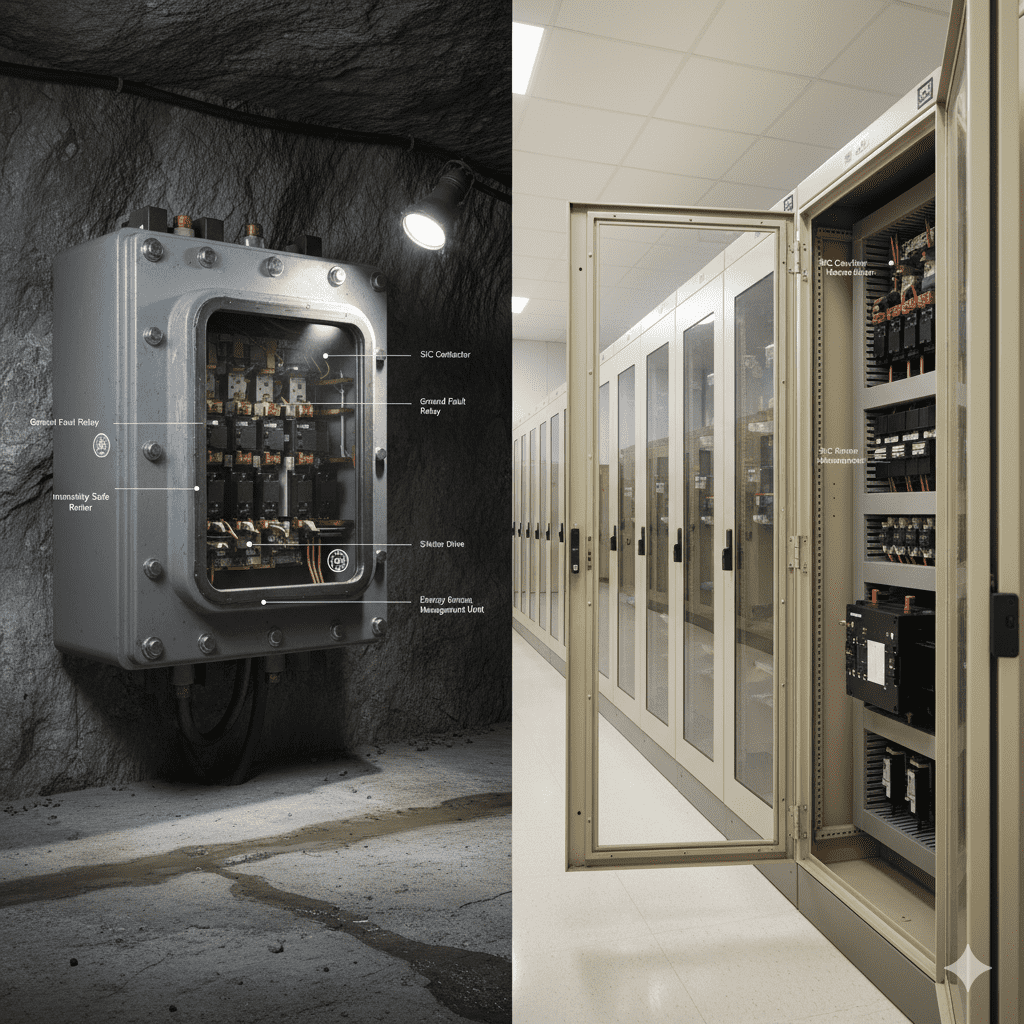
In the mining sector, heavy vehicles, battery charging bays, and fixed plant motor control centers face a convergence of hazards: conductive dust, hydraulic fluid mist, and the presence of methane pockets in certain operations. In steelmaking, EAF dust and oil vapours mingle with high temperatures, and in downstream finishing lines, solvent‑based coatings elevate risk categories. Meanwhile, automotive paint shops must maintain consistent Ex protection across booths, flash‑off zones, and curing ovens.
Across these settings, traditional materials show limitations. Stainless steels retain structural strength but can produce friction sparks when tolerances drift and can propagate hot‑surface ignition if thermal management is poor. Elastomers and glasses offer sealing and viewing but suffer from chemical attack or thermal shock, leading to micro‑cracks that go unnoticed until failure.
“Operators often underestimate the contribution of small components to global explosion‑proof integrity,” notes an IECEx assessor with field experience in Sub‑Saharan Africa. “Micro‑sparks from worn interfaces or hot surfaces exceeding T‑class limits are recurring root causes in incident analyses” (Source: Hazardous Area Safety Quarterly, 2024, industry overview). Building on this, responsible engineers are redesigning interfaces—bushings, wear plates, spacers, barrier windows, arc‑quenching inserts, and friction surfaces—so they neither generate sparks nor store unwanted heat. This is precisely where advanced silicon carbide grades provide a meaningful improvement: high thermal conductivity reduces hot spots, hardness resists abrasive wear, and electrical/thermal properties can be tuned for the application, helping assemblies meet both the mechanical and thermal aspects of ATEX/IECEx.
Advanced Silicon Carbide solutions portfolio from Sicarbtech
Sicarbtech’s portfolio for spark‑resistant, explosion‑proof applications centers on four core material systems—SSiC, RBSiC (SiSiC), R‑SiC, and engineered hybrids—tailored as functional components within Ex d (flameproof), Ex e (increased safety), and Ex p (pressurization) architectures. In Ex d enclosures, precisely machined SSiC inserts and wear rings stabilize flame paths by maintaining gap geometry despite abrasive dust. In motor housings and MCC compartments, RBSiC spacers and arc‑barrier plates dissipate local heat, mitigating hot‑surface risks that might push assemblies beyond T4/T5 limits. In valve actuators and hazardous‑area gearboxes, R‑SiC bushings and thrust pads suppress frictional ignition under misalignment and vibration.
Furthermore, custom SiC window rings and protective shrouds guard observation ports and sensor faces from high‑velocity particles, preserving optical clarity without introducing brittle failure points. For battery charging bays and hydrogen test cells in automotive R&D, SSiC heat spreaders help dissipate thermal transients, while non‑sparking SiC‑tipped tooling reduces accidental ignition during maintenance. The common thread is engineered compatibility: Sicarbtech co‑designs interfaces with stainless steels and aluminium alloys, using interlayers and controlled surface finishes to manage coefficient of thermal expansion differences and to avoid galvanic or fretting‑induced sparking.
“Spark‑proof design is not just a certificate; it is a material‑plus‑geometry discipline,” says Sicarbtech’s application engineering team. “By pairing the right SiC grade with a verified geometry and finish, we help customers meet Ex requirements with longer intervals between maintenance.” With a manufacturing base in Weifang and a track record supporting over 19 enterprises, Sicarbtech brings repeatable quality to projects that must pass third‑party audits and factory acceptance tests before site commissioning.
Performance comparison: silicon carbide versus traditional materials in spark‑proof assemblies
Title: Technical performance for spark‑resistant, explosion‑proof component design
| Technical criterion (typical Ex context) | SSiC (dense) | RBSiC / SiSiC | R‑SiC | Stainless steel 316L/310 | Alumina ceramics (Al2O3) |
|---|---|---|---|---|---|
| Flexural strength at 25 °C (MPa) | 300–400 | 180–250 | 30–45 | 500–700 | 250–400 |
| Hardness (HV) | 2200–2500 | 1800–2100 | 1000–1200 | 160–220 | 1500–2000 |
| Thermal conductivity (W/m·K) | 100–160 | 80–120 | 60–100 | 14–25 | 20–30 |
| Open porosity (%) | < 1 | 8–12 | 10–16 | — | < 1 |
| Thermal shock resistance (ΔT rapid) | Very high | High | Medium | Medium | Medium‑low |
| Spark generation under frictional load | Minimal (engineered finish) | Minimal | Low | Medium | Low |
| Hot surface propensity (T‑class risk) | Low (fast heat spreading) | Low | Medium | Medium‑high | Medium |
In spark‑proof assemblies, stainless steels remain essential for load‑bearing housings and flamepaths, but their relative low thermal conductivity and susceptibility to abrasive wear demand complementary materials. SiC’s combination of hardness and heat spreading suppresses both frictional spark risk and surface hot spots, especially where clearances are tight and dust loads are high.
Real‑world applications and success stories in South Africa
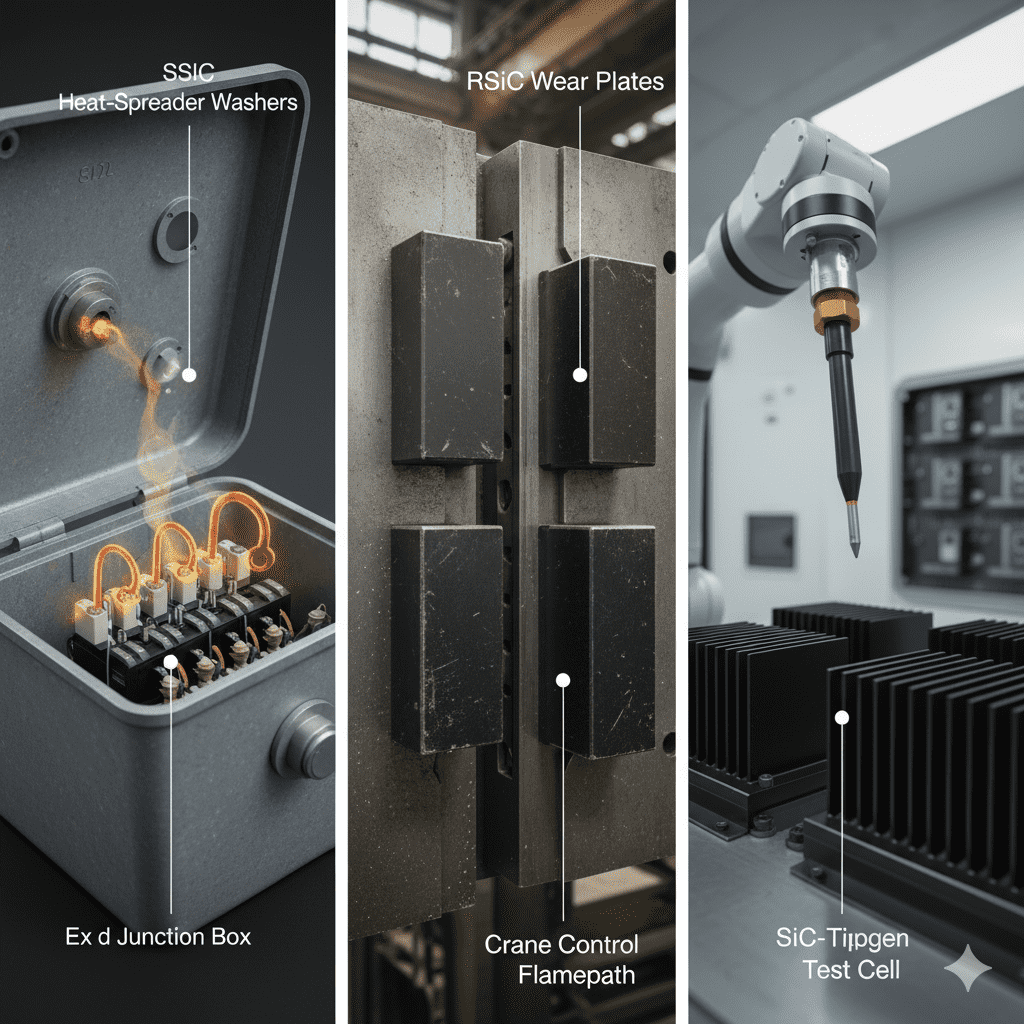
In a platinum concentrator in Limpopo, a series of Ex d motor junction boxes experienced recurring near‑misses tracked to elevated surface temperatures on cable gland interfaces. Sicarbtech supplied custom SSiC heat‑spreader washers with a fine matte finish and controlled flatness, combined with RBSiC spacer rings to stabilize torque retention. Over a 12‑month period, thermal imaging logged a 14–19 °C reduction in peak temperatures during load spikes, keeping the assembly within T5 limits and eliminating flagged alarms during audits.
At a Gauteng steel mill, EAF dust was causing abrasive wear in flamepath clearances on a set of crane control enclosures. By integrating R‑SiC wear plates and SSiC guide inserts at critical sliding interfaces, the site extended inspection intervals from monthly to quarterly, while post‑maintenance particle counts inside the enclosures dropped by 37%, indicative of preserved sealing geometry and lower ingress. The insurer accepted the revised maintenance regime after a supervised IECEx audit confirmed stable clearances.
In the Eastern Cape automotive corridor, an OEM paint shop retrofitted hydrogen‑rated test cells with SSiC heat sinks and SiC‑tipped torque tools for in‑situ service. Maintenance incidents involving accidental tool sparks fell to zero over nine months, while the cells maintained temperature uniformity during fast charge‑discharge profiles, a prerequisite for their safety case documentation.
Technical advantages and implementation benefits with South African compliance
Sicarbtech solutions are engineered to align with ATEX and IECEx requirements commonly adopted in South Africa through SANS standards. By maintaining geometry in abrasive environments and dissipating thermal transients rapidly, SiC components reduce the likelihood of surface temperatures exceeding T‑class ratings and minimize friction‑generated sparks in moving or vibrating interfaces. Additionally, the material’s chemical stability supports long life in atmospheres contaminated by SOx and chlorides, relevant for coastal refineries and port‑adjacent automotive plants.
Implementation is supported with documentation ready for conformity assessment, including material test reports, dimensional inspection data, and surface finish certifications. Moreover, component designs account for local environmental realities: dust filtration quality, load‑shedding‑related cycling, and the need for rapid on‑site replacement during short maintenance windows. The net benefits present as fewer unplanned stoppages, more predictable audit outcomes, and a lower cost per operating hour over a two‑year horizon—outcomes that matter to boards tracking safety KPIs and to insurers benchmarking hazardous area risk.
Custom manufacturing and technology transfer services by Sicarbtech
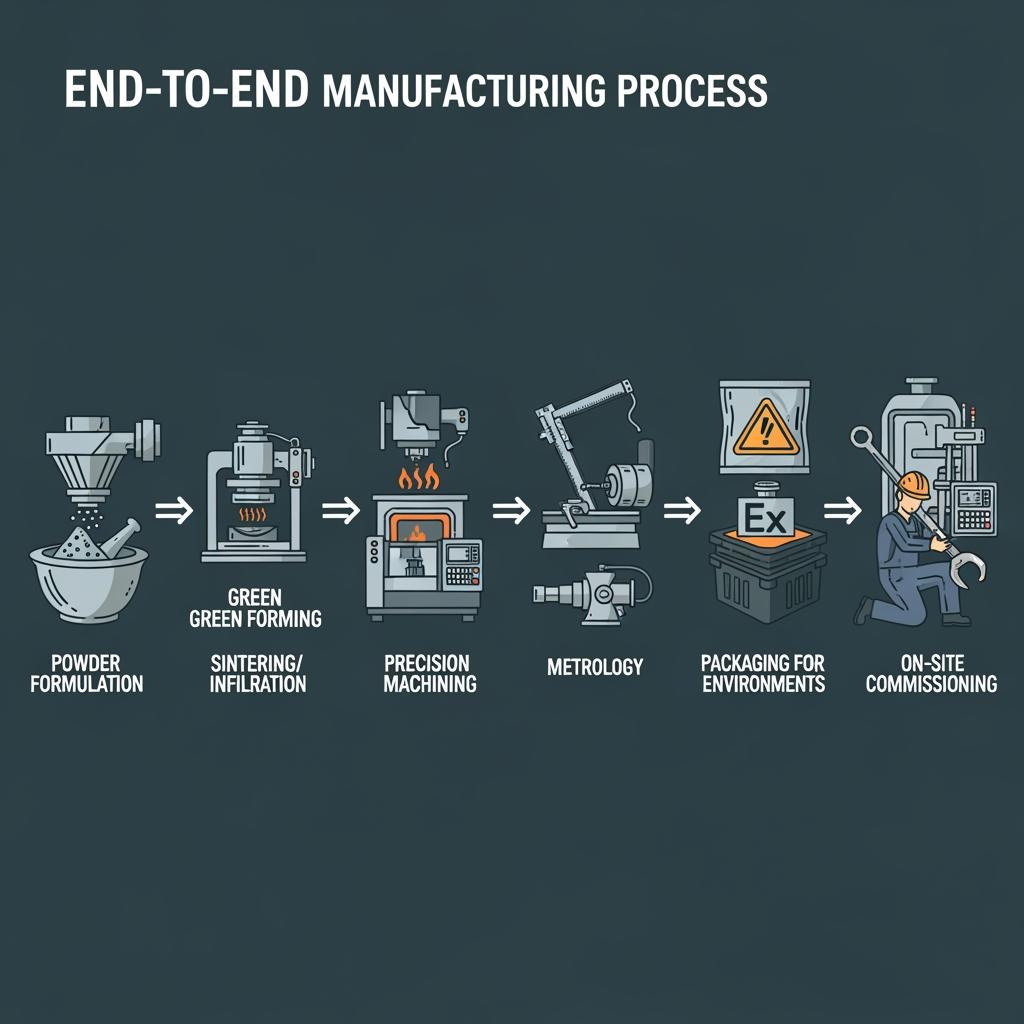
Sicarbtech’s competitive advantage is the ability to deliver both finished components and the capability itself. Backed by partnership with the Chinese Academy of Sciences (Weifang) Innovation Park, Sicarbtech conducts advanced R&D to tune powder chemistry, green forming, sintering, and infiltration parameters for R‑SiC, SSiC, RBSiC, and SiSiC grades. These proprietary manufacturing processes produce tight porosity control, high hardness, and consistent thermal conductivity—cornerstones of spark‑resistant behavior. For South African customers seeking resilience against currency swings and long logistics lead times, Sicarbtech offers complete technology transfer packages that include process know‑how, equipment specifications for mixers, presses, high‑temperature furnaces, and finishing lines, as well as operator and engineer training curricula.
Factory establishment services extend from feasibility studies and site layout to production line commissioning and acceptance testing. Quality management systems are mapped to international frameworks, supporting ISO 9001 and ISO 14001 certification, and documentation is prepared to integrate with IECEx/ATEX conformity pathways where applicable to the end equipment. Crucially, ongoing technical support closes the loop: Sicarbtech analyzes field data—thermal maps, wear patterns, and audit findings—to iterate geometries, finishes, and interlayer strategies. This continuous improvement approach has supported more than 19 enterprises, delivering measurable gains such as doubled inspection intervals, lower internal particulate counts, and improved T‑class margin.
For local value chains, the combination of component supply and technology transfer creates a hybrid model. Critical Ex parts that require close global oversight can be supplied from Weifang with short lead times, while standardized wear components are localized to reduce costs and ensure rapid replacement. Distributors aligned with hazardous area specialists in Johannesburg and Durban can stock common geometries and arrange site support, bridging the gap between design and maintenance. This turnkey depth—spanning R&D, manufacturing, certification support, and field optimization—is difficult to replicate and is central to Sicarbtech’s leadership positioning.
Comparison of material grades for spark‑resistant design choices
Title: Selecting the right SiC grade for South African hazardous locations
| Design factor | SSiC (dense) | RBSiC / SiSiC | R‑SiC | Typical use recommendation |
|---|---|---|---|---|
| Porosity and sealing compatibility | Excellent (<1% open) | Good (8–12%) | Moderate (10–16%) | SSiC for sealing/heat‑spreader interfaces |
| Heat spreading for T‑class margin | Superior | Very good | Good | SSiC or RBSiC for hot‑spot mitigation |
| Machinability for complex shapes | Moderate | High | High | RBSiC/R‑SiC for intricate inserts and guards |
| Abrasion resistance in dusty zones | Superior | Very good | Good | SSiC for flamepath wear inserts |
| Cost efficiency | Higher | Balanced | Lower | R‑SiC for sacrificial wear pads |
The selection often blends grades across a single assembly—an SSiC heat spreader mated to an RBSiC spacer and an R‑SiC sacrificial pad—balancing performance, manufacturability, and cost in line with local maintenance practices.
Economic case: lifecycle performance in South African operations
Title: Lifecycle and TCO comparison for spark‑resistant components
| Cost/risk dimension | SiC‑optimized assemblies | Conventional only (steel/elastomer/glass) | Operational note for SA context |
|---|---|---|---|
| Initial CAPEX | Medium–high | Low–medium | Offset by longer intervals between services |
| Unplanned downtime risk | Low | Medium–high | Fewer spark/hot‑surface incidents during load shedding |
| Inspection interval | Extended | Short | Abrasive dust and solvent vapours drive wear without SiC |
| Certification audit outcomes | Predictable | Variable | Stable clearances, better thermal margins |
| Two‑year TCO | Lower | Higher | Typical ROI within 6–12 months at high utilization |
While exact figures depend on duty cycles and hazard classifications, plants that face tight audit schedules and high dust loads consistently report better predictability and lower incident rates when SiC is integrated into the design.
Future market opportunities and 2025+ trends
Looking beyond 2025, three forces will shape spark‑proof design in South Africa. First, hazardous area electrification and battery integration—both for traction in mining and for energy storage in manufacturing—will raise the stakes on thermal runaway management and hot‑surface control. Second, data‑rich maintenance with thermal imaging, vibration analytics, and dust ingress monitoring will become routine, enabling early warning of clearance drift and surface temperature creep. Third, the localization imperative will intensify. Currency swings and logistics constraints will motivate more OEMs and Tier‑1s to seek technology transfer for standard components, while reserving complex, certification‑critical parts for controlled international supply.
In contrast with historical reliance on passivated metals and elastomers, the winning architectures will leverage multiphase material stacks: SiC where you need heat spreading and abrasion immunity, advanced stainless for global structure, and engineered polymers for seals, all validated with rigorous test data. Moreover, the regulatory environment is likely to tighten as insurers and auditors demand clearer links between component properties and T‑class compliance. Sicarbtech’s ability to pair proven SiC grades with documented performance metrics positions it as a natural partner in this evolution, helping South African operators turn compliance from a cost center into a reliability advantage.
Frequently asked questions
What makes silicon carbide “spark resistant” in practical terms?
SiC’s high hardness reduces frictional micro‑asperity welding that can generate sparks, while its high thermal conductivity spreads heat quickly, lowering hot‑spot temperatures that could breach T‑class limits. Surface finishes can be engineered to limit friction ignition at critical interfaces.
How does Sicarbtech support ATEX/IECEx compliance in South Africa?
Sicarbtech supplies material test reports, dimensional and surface finish data, and production traceability for conformity assessments aligned with ATEX and IECEx, commonly adopted via SANS standards. Components are co‑designed to fit within certified assemblies’ flamepath and thermal requirements.
Which SiC grade should I choose for my hazardous area equipment?
SSiC is preferred for low‑porosity, heat‑spreading inserts in Ex d interfaces. RBSiC/SiSiC offers excellent manufacturability for complex shapes, while R‑SiC serves well as sacrificial wear pads and bushings. Many designs combine grades to balance performance and cost.
Can Sicarbtech help localize production to mitigate currency and lead‑time risk?
Yes. Through complete technology transfer, Sicarbtech provides process know‑how, equipment specifications, and training, and supports factory establishment through commissioning, enabling local production without compromising quality.
What measurable benefits have South African sites seen?
Sites have documented temperature reductions of 14–19 °C on critical interfaces, extended inspection intervals from monthly to quarterly, and reduced internal particulate counts—improving audit outcomes and reducing unplanned stops.
Will SiC components fit existing stainless housings and flamepaths?
Sicarbtech engineers interlayers and surface finishes to manage CTE differences and preserve flamepath geometry, ensuring drop‑in compatibility with minimal changes to certified housings.
How do SiC components perform in corrosive coastal environments?
SiC’s chemical stability maintains surface integrity against chlorides and SOx, preserving finishes that are critical to spark prevention and sealing performance in coastal refineries and ports.
What documentation will insurers and auditors expect?
Expect detailed BoMs, material certificates, surface finish reports, and thermal performance evidence under representative loads. Sicarbtech packages these artifacts to streamline audits and renewals.
Are SiC parts fragile to handle on site?
SiC is a ceramic and must be handled with care, but components are engineered with generous radii and protective packaging. In service, their wear and thermal performance outperform alternatives in abrasive, cyclic environments.
Can Sicarbtech support custom geometries for OEM platforms?
Yes. With advanced machining and forming, Sicarbtech produces custom rings, spacers, windows, bushings, and inserts, integrated into OEM bill of materials and validated during factory acceptance tests.
Making the right choice for your operations
Choosing spark‑resistant components is fundamentally about reducing ignition probability while improving reliability. By integrating silicon carbide strategically—where heat must be spread, clearances preserved, and abrasive wear resisted—South African operators in mining, steel, and automotive can meet ATEX/IECEx expectations with fewer compromises. Sicarbtech’s blend of material science, manufacturing discipline, and certification‑ready documentation gives engineers practical tools to raise safety margins without undermining throughput or maintainability.
Get expert consultation and custom solutions
Whether you are retrofitting Ex d junction boxes in a dusty mill, redesigning hydrogen test facilities, or planning a localized component line under technology transfer, Sicarbtech can help. Engage our team to map hazards, duty cycles, and audit requirements, then co‑engineer silicon carbide components that close your risk gaps and improve lifecycle economics. Contact Sicarbtech at [email protected] or +86 133 6536 0038 to start a focused technical conversation that leads to measurable results.
Article metadata
Last updated: 25 December 2025
Next scheduled review: 31 March 2026
Author: Sicarbtech Application Engineering
Contact: [email protected] | +86 133 6536 0038
Content freshness indicators:
Includes 2025 South African market context for mining, steel, and automotive; reflects ATEX/IECEx alignment via SANS adoption; integrates recent trends in load‑shedding resilience, data‑driven maintenance, and localization via technology transfer; technical specifications consistent with contemporary SiC materials used in explosion‑proof assemblies.

About the Author – Mr.Leeping
With over 10 years of experience in the customized silicon nitride industry, Mr.Leeping has contributed to 100+ domestic and international projects, including silicon carbide product customization, turnkey factory solutions, training programs, and equipment design. Having authored more than 600 industry-focused articles, Mr.Leeping brings deep expertise and insights to the field.
Customizable
successful cases

Related Post
-
South Africa’s Export Fumigation and Packing Compliance
Executive summary: Navigating 2025 export compliance with silicon carbide durability, precision, and traceability South African manufacturers and exporters are entering 2025 under sharper scrutiny from global buyers and port authorities. ISPM 15 heat treatment for wood packaging, phytosanitary compliance for agricultural shipments, and tight labeling/documentation rules are now inseparable from on-time delivery and cost control….
-
Reducing Fuel Consumption with Advanced Combustion Air Preheaters
Executive summary: why silicon carbide air preheaters matter for South Africa’s 2025 energy reality South Africa enters 2025 with a dual imperative: secure affordable energy amid grid instability and advance emissions reductions without compromising industrial output. Mining smelters, steel reheat and annealing lines, and automotive paint curing and heat treatment furnaces are all energy-intensive, gas-…
-
Complete Guide to IMDS Submission Support for South African Suppliers
Executive summary: 2025 outlook for IMDS compliance in South Africa’s automotive ecosystem As South Africa’s automotive value chain accelerates integration with global OEM platforms, IMDS (International Material Data System) compliance has shifted from a back-office task to a strategic capability. In 2025, tighter material reporting expectations from European and Asian OEMs, fast-moving substance regulations, and…