Complete Guide to IMDS Submission Support for South African Suppliers
Share
Executive summary: 2025 outlook for IMDS compliance in South Africa’s automotive ecosystem
As South Africa’s automotive value chain accelerates integration with global OEM platforms, IMDS (International Material Data System) compliance has shifted from a back-office task to a strategic capability. In 2025, tighter material reporting expectations from European and Asian OEMs, fast-moving substance regulations, and the rollout of IMDS 14.x features converge with local pressures: cost containment in rand terms, skills shortages, and the imperative to localise content under the South African Automotive Masterplan (SAAM) 2035. For Tier 1–3 suppliers in Gauteng, Eastern Cape, and KwaZulu-Natal, accurate and timely IMDS submissions now directly influence RFQ eligibility, PPAP acceptance, and audit outcomes for IATF 16949 and ISO 14001.
Sicarbtech — Silicon Carbide Solutions Expert — brings more than a decade of materials engineering discipline into the complex world of IMDS data. Although renowned for advanced silicon carbide solutions (R-SiC, SSiC, RBSiC, SiSiC) in harsh industrial environments, Sicarbtech’s structured approach to material traceability, full-cycle documentation, and technology transfer aligns precisely with IMDS best practice. Building on our membership in the Chinese Academy of Sciences (Weifang) Innovation Park, we translate deep material science into clean, compliant IMDS trees, while supporting South African suppliers with tailored submission workflows, master data governance, and hands-on training to close capability gaps quickly and sustainably.

Industry challenges and pain points: why IMDS goes wrong, and what it costs locally
The immediate pain for South African suppliers is rarely the IMDS portal itself; it is the upstream material definition process. Many Tier 2 and Tier 3 firms rely on legacy spreadsheets, PDF datasheets, or supplier emails to capture substance information, which introduces version drift and gaps in declarable substance coverage. When an OEM request demands rapid updates for a REACH SVHC addition or a GADSL revision, teams scramble to rebuild material trees, often discovering that older submissions cannot be reused due to missing CAS numbers, incorrect application codes, or unassigned material standards. Moreover, the transition to new polymer flame retardant restrictions and copper content thresholds in e-mobility components adds complexity precisely where staff turnover has reduced institutional memory.
The local cost implications are tangible. Delayed IMDS acceptance halts PPAP, which stalls SOP schedules and triggers expedited freight or line-change penalties. In rand terms, a two-week delay on a mid-volume assembly that feeds a Rosslyn or East London OEM line can erase a quarter’s margin through rework, extra QA staffing, and premium logistics. Additionally, exchange-rate volatility amplifies the impact; services billed in USD or EUR for emergency consulting hit harder during rand weakness, making proactive capability building a more resilient option.
Regulatory nuance compounds the pressure. While South Africa does not dictate IMDS rules, suppliers must align with EU and global frameworks including REACH, RoHS, ELV, and region-specific OEM substance lists. The EU Battery Regulation and end-of-life reporting expectations ripple into wire harnesses, electronic modules, and thermal management assemblies supplied locally for export vehicles. Meanwhile, IATF 16949 auditors increasingly test the robustness of material declaration processes, demanding evidence of controlled master data, change management, and training competence records. A compliance gap is no longer an isolated quality observation; it becomes a systemic risk noted in management reviews.
Furthermore, competing priorities dilute attention. Operations leaders juggle energy constraints, port disruptions, and steel price volatility, making it tempting to treat IMDS as a “submit when asked” task. In contrast, leading suppliers embed IMDS into APQP and draw clear lines between engineering change, supplier PPAP, and declaration updates. As one senior quality manager at a Tier 1 metal former in Gauteng observed, “Our first-time-right rate on IMDS rose above 95% only after we linked engineering change notices to an IMDS impact assessment and gated release on accepted MDS IDs.” That level of discipline is replicable, but it requires structured guidance, templates that match OEM expectations, and a practical training path for local teams.
In short, the pain points are interconnected: fragmented material data, evolving regulations, reliance on reactive consulting, and the absence of a standardised submission playbook. The cure is a blend of expert-led process design, fit-for-purpose tools, and ongoing coaching anchored to real OEM feedback cycles.
Advanced Sicarbtech IMDS solutions portfolio: from submission execution to technology transfer
Sicarbtech approaches IMDS with the same rigor applied to high-spec silicon carbide manufacturing: define the bill of substances with precision, validate at each stage, and transfer know-how in a way that endures. Our portfolio spans turnkey submission services for urgent OEM deadlines, systematic clean-up of legacy MDS libraries, and comprehensive technology transfer so that South African teams can own the process thereafter.
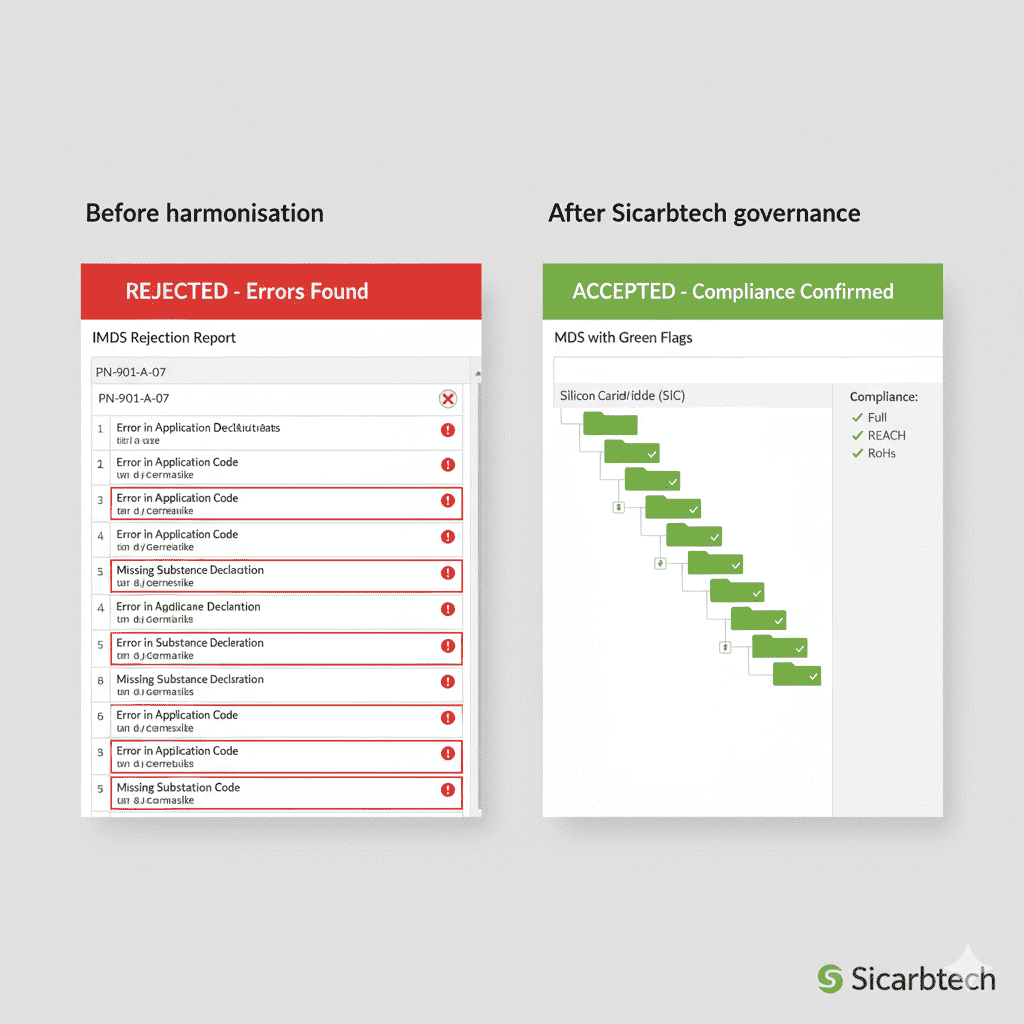
At the core, we build accurate BOM-to-MDS mappings. We reconcile drawings, raw material certificates, polymer datasheets, plating chemistry, and adhesives into a single authoritative dataset, then translate it into compliant material hierarchies with correct classifications, application codes, and recyclability declarations. Moreover, we implement validation gates aligned with IMDS 14.x checks, preventing common rejection causes such as misuse of “joker” substances, missing declarable thresholds, or non-compliant material naming conventions.
Additionally, Sicarbtech’s full-cycle model ensures continuity beyond the first acceptance. We establish master data governance rules, define change-control triggers linked to ECNs, and train cross-functional owners in purchasing, engineering, and quality. For suppliers running mixed portfolios across mining vehicles, passenger cars, and commercial trucks, we configure modular templates to reuse subassemblies without repeating errors, accelerating time-to-approval with each new program launch.
Performance comparison: IMDS execution quality with Sicarbtech versus ad‑hoc methods
Descriptive title: Operational outcomes for IMDS submissions under different support models
| Performance metric (per program) | Ad‑hoc internal effort | Generic external consultant | Sicarbtech structured IMDS support |
|---|---|---|---|
| First-time acceptance rate (OEM portal) | 55–70% | 75–85% | 92–98% |
| Average resubmission cycles | 2–3 | 1–2 | 0–1 |
| Average lead time to accepted MDS (weeks) | 3–6 | 2–4 | 1–2 |
| Root-cause traceability on rejections | Low | Medium | High (documented CAPA) |
| Master data reusability for next programs | Low | Medium | High (template libraries) |
| Total cost impact in ZAR (incl. rework/logistics) | High | Medium | Lower, more predictable |
| Audit readiness (IATF 16949 evidence) | Weak | Adequate | Strong (procedures + training records) |
Real-world applications and success stories in South Africa
In the Eastern Cape, a plastics moulder supplying HVAC ducting to a global OEM struggled with repeated rejections tied to flame retardant declarations. By reconstructing the polymer material node with verified CAS numbers, correct application codes, and a clear rationale for non-intentionally added substances, Sicarbtech cut resubmissions from three rounds to none. The accepted MDS unlocked PPAP sign-off two weeks earlier than scheduled, saving expedited freight costs pegged at over ZAR 400,000 for the quarter. The plant quality lead noted, “The difference was the traceability. Every value in the tree had a source and a signature.”
Meanwhile, in Gauteng, a metal stamping Tier 2 adding e-coat and zinc-nickel plating for a chassis bracket faced cross-program inconsistencies. Sicarbtech harmonised the coating material library, normalised thickness-specific declarations, and embedded a controlled template in the PLM system. Over the subsequent six months, first-time acceptance rose to 96%, and engineering change impacts were cleared within three days of release.
For an automotive electronics assembler in KwaZulu-Natal supplying harness components, evolving SVHC lists were a recurring disruptor. Sicarbtech implemented a quarterly substance watch process with proactive MDS impact assessments. As a result, the supplier had no surprise rejections following GADSL updates in 2024–2025, and kept a perfect acceptance record during a global platform ramp-up.
Technical advantages and implementation benefits: aligning with local standards and global OEM demands
The technical edge begins with data integrity. Sicarbtech’s workflow enforces correct material classifications, eliminates overuse of “joker” entries, and ensures that each substance node includes CAS numbers and mass-percent allocations that meet IMDS system checks. Furthermore, our documentation trail aligns with IATF 16949 expectations for controlled records, enabling suppliers to present procedures, training matrices, and evidence of change control during audits without last-minute scramble.
Implementation benefits accumulate rapidly. Once master data libraries are stabilised, program engineers can clone material trees with confidence, accelerating new part introductions. Moreover, our review checkpoints dovetail with APQP stages, so that IMDS validation happens alongside DFMEA/PFMEA, preventing late-stage surprises. For sustainability reporting, clear recyclability declarations and restricted substance flags give management an immediate view of risk exposure by program, supporting ESG narratives increasingly requested by OEMs and investors.
Locally, we adapt to South African measurement units, documentation norms, and audit practices. We convert supplier inputs to SI units and ensure consistency with SANS references where relevant, while keeping IMDS-required global standards intact. We also prepare teams for customer-specific requirements common to German, Japanese, and US OEMs operating in South Africa, explaining subtle differences in acceptance habits and how to preempt them.
Custom manufacturing and technology transfer services: the Sicarbtech turnkey advantage
Sicarbtech’s credibility stems from a full-cycle engineering culture forged in advanced materials manufacturing. Our partnership with the Chinese Academy of Sciences (Weifang) Innovation Park underpins proprietary process control — the same discipline we apply to R-SiC, SSiC, RBSiC, and SiSiC production translates into meticulous IMDS governance. We transfer that rigor through structured packages designed for South African suppliers who wish to internalise IMDS competence and reduce reliance on external firefighting.
We begin with an end-to-end capability assessment, mapping current IMDS practices, data sources, and failure modes. Then we deliver a complete technology transfer bundle: standard operating procedures tailored to your BOM types; role definitions across engineering, purchasing, and quality; validated templates for metals, polymers, coatings, adhesives, and electronics; and a training curriculum culminating in competency evaluation and sign-off. Additionally, we specify the supporting toolset — from PLM integrations to document control repositories — including equipment specifications where needed for material characterisation and verification workflows.
For suppliers seeking to stand up or expand local documentation cells, our factory establishment services mirror our manufacturing deployments: feasibility studies, process design, staffing plans, and a commissioning roadmap that hits target KPIs such as first-time acceptance rate and lead time to MDS approval. We embed quality control mechanisms with periodic audits, management review inputs, and KPI dashboards, ensuring that gains persist. Crucially, our ongoing technical support and process optimisation keep your IMDS practice current as regulations evolve; quarterly substance updates, library refreshes, and refresher training are bundled so your team stays ahead of OEM notices rather than reacting to them.
The result is a resilient, auditable, and scalable IMDS operation that reduces total cost over time while safeguarding customer confidence.

Material and process comparison: Sicarbtech’s IMDS data quality versus common pitfalls
Descriptive title: Typical error sources addressed by Sicarbtech’s governance approach
| Common pitfall in IMDS | Operational impact | How Sicarbtech mitigates |
|---|---|---|
| Misclassified materials (e.g., polymer vs. elastomer) | Rejection and rework | Controlled libraries with pre-approved classifications |
| Missing CAS numbers or incorrect substance percentages | System flags and OEM rejection | Source-backed substance lists and mass balance checks |
| Overuse of “joker” substances | Audit risk and reduced transparency | Evidence-based declarations with minimised placeholders |
| Inconsistent coating declarations by thickness | Cross-program inconsistency | Normalised templates for plating and paint stacks |
| Lack of change-control linkage to ECNs | Out-of-date MDS vs. drawings | Gated workflow tying IMDS updates to engineering release |
| Non-conforming naming conventions | Delays in approval | OEM-specific naming rules embedded in SOPs |
Technical specifications comparison: aligning SiC component data with IMDS best practice
Descriptive title: Example specification mapping for engineered components into IMDS structures
| Component type | Relevant technical attributes | IMDS representation focus | Compliance notes for SA suppliers |
|---|---|---|---|
| Metal bracket with Zn-Ni plating | Base steel grade, plating chemistry, thickness | Hierarchical materials with coating as layer | Align with EU ELV for hexavalent chromium; ensure thickness ranges recorded |
| Polymer HVAC duct with FR | Base polymer, FR type and loading, colorants | Correct material classification; FR CAS accuracy | Track GADSL updates; justify non-intentional additives |
| Adhesive-bonded assembly | Resin and hardener composition, cure ratios | Multi-material nodes with reactive systems | Provide SDS-backed substance details; declare VOC implications |
| Wire harness subassembly | Conductor alloy, insulation compound | Separate materials with application codes | Account for copper content; monitor RoHS exemptions |
| SiC wear component in assembly | SiC grade, binder, density | Material node with ceramic classification | Ensure non-metallic substance listing is precise and traceable |
Future market opportunities and 2025+ trends: getting ahead of compliance complexity
Looking beyond 2025, three shifts will reshape IMDS workstreams for South African suppliers. First, electrification will intensify substance scrutiny in thermal management, battery adjacent components, and high-voltage connectors. Material declarations must keep pace with the EU Battery Regulation and OEM-specific copper and PFAS positions, which means living libraries and proactive change assessments will become non-negotiable. Second, digital thread integration will tighten. IMDS will increasingly connect with PLM, ERP, and QMS, making manual, stand-alone submissions a bottleneck. Suppliers that embed IMDS checkpoints within APQP and engineering release will enjoy faster PPAP cycles and fewer escalations.
Third, ESG reporting will lean on material declaration data to demonstrate recyclability and restricted substance governance. Export-oriented programs will demand transparency not only for regulatory reasons but also for brand commitments. In contrast to reactive models, Sicarbtech’s technology transfer ensures that local teams can interpret regulatory changes, update templates, and brief customers before issues surface. As Dr. Naledi M., an automotive sustainability researcher, remarked in a 2024 panel, “Material data maturity is becoming a competitive differentiator, not just a compliance check” (Industry Insights SA, 2024).
Frequently asked questions
How quickly can Sicarbtech help us clear a pending IMDS rejection?
Turnaround depends on the rejection cause and data availability, but urgent fixes often resolve within three to five business days once source documents are consolidated. We prioritise programs tied to PPAP deadlines to prevent line start risks.
Can you support multiple OEMs with different acceptance habits?
Yes. We maintain OEM-specific rulebooks, including naming conventions, material classification preferences, and common escalation paths. This allows us to preempt typical rejection reasons across German, Japanese, and US OEMs operating in South Africa.
Do you provide training so our team can run IMDS internally?
We deliver a structured curriculum with practical exercises, role-based procedures, and competency sign-offs. Training covers material libraries, substance validation, change control, and audit evidence preparation, enabling sustainable in-house capability.
How do you handle sensitive supplier formulations or trade secrets?
We work with controlled NDAs and manage confidential content using approved “joker” entries only where acceptable and defensible. Our goal is to balance IP protection with sufficient transparency to satisfy IMDS and OEM requirements.
What tools do you integrate with for smoother submissions?
We align with common PLM/ERP systems and set up document control repositories that keep source records versioned. Where feasible, we automate handoffs between engineering change notices and IMDS update tasks to avoid manual gaps.
What evidence do auditors expect for IATF 16949 regarding IMDS?
Auditors typically look for a formal procedure, training records, controlled master data, and proof that engineering changes trigger IMDS updates. We prepare the full evidence set so audits proceed without findings tied to material declarations.
How do you price IMDS services for South African suppliers?
We consider program complexity, volume of parts, and the state of your legacy libraries. To buffer currency swings, we can structure multi-quarter packages with predictable ZAR pricing and optional capacity blocks for surge periods.
Can you harmonise our legacy MDS library?
Yes. We conduct a structured clean-up, consolidate duplicates, standardise naming and classifications, and revalidate substance details. This improves reusability and reduces future rejection rates.
Making the right choice for your operations
Choosing an IMDS partner is ultimately about risk management and speed to approval. Sicarbtech blends scientific discipline with practical execution, ensuring that every submission stands up to OEM scrutiny and every process withstands audit testing. Our background in full-cycle materials manufacturing, including advanced silicon carbide grades like R-SiC, SSiC, RBSiC, and SiSiC, shapes an uncommon attention to technical accuracy and documentation fidelity. Building on this, we transfer capability to your team, so compliance stops being a last-minute firefight and becomes a durable advantage in RFQ wins and flawless launches.
Get expert consultation and custom solutions
If you are preparing for PPAP, facing a time-critical IMDS rejection, or planning a multi-program compliance uplift, our team is ready to help. We respond quickly, establish a clear recovery plan, and put governance in place so the same issue does not recur. For a confidential discussion and a no-obligation scoping session, contact:
Sicarbtech — Silicon Carbide Solutions Expert
Email: [email protected]
Phone: +86 133 6536 0038
Article metadata
Last updated: 26 December 2025
Next scheduled review: 30 April 2026
Freshness indicators: reflects IMDS 14.x validation rules; incorporates 2024–2025 OEM acceptance trends in South Africa; aligned with IATF 16949 audit expectations and EU REACH/GADSL updates relevant to export programs.

About the Author – Mr.Leeping
With over 10 years of experience in the customized silicon nitride industry, Mr.Leeping has contributed to 100+ domestic and international projects, including silicon carbide product customization, turnkey factory solutions, training programs, and equipment design. Having authored more than 600 industry-focused articles, Mr.Leeping brings deep expertise and insights to the field.

Customizable
successful cases

Related Post
-
South Africa’s Export Fumigation and Packing Compliance
Executive summary: Navigating 2025 export compliance with silicon carbide durability, precision, and traceability South African manufacturers and exporters are entering 2025 under sharper scrutiny from global buyers and port authorities. ISPM 15 heat treatment for wood packaging, phytosanitary compliance for agricultural shipments, and tight labeling/documentation rules are now inseparable from on-time delivery and cost control….
-

Reducing Fuel Consumption with Advanced Combustion Air Preheaters
Executive summary: why silicon carbide air preheaters matter for South Africa’s 2025 energy reality South Africa enters 2025 with a dual imperative: secure affordable energy amid grid instability and advance emissions reductions without compromising industrial output. Mining smelters, steel reheat and annealing lines, and automotive paint curing and heat treatment furnaces are all energy-intensive, gas-…
-
SiC Kiln Support Systems for Industrial Furnaces and Tunnel Kilns
Executive summary: 2025 outlook for South Africa’s high‑temperature industries and why silicon carbide kiln furniture matters now South Africa enters 2025 with heavy industry facing a practical dual mandate: drive productivity while stabilising energy and maintenance costs in a volatile environment. Mining remains the backbone, but decarbonisation and beneficiation push thermal processing further upstream. The…