South Africa’s Export Fumigation and Packing Compliance
Share
Executive summary: Navigating 2025 export compliance with silicon carbide durability, precision, and traceability
South African manufacturers and exporters are entering 2025 under sharper scrutiny from global buyers and port authorities. ISPM 15 heat treatment for wood packaging, phytosanitary compliance for agricultural shipments, and tight labeling/documentation rules are now inseparable from on-time delivery and cost control. In mining, steel, and automotive supply chains, the picture is similar: export cartons and pallets must be compliant, fumigation or heat treatment must be verifiable, and material handling systems must withstand severe duty without unplanned downtime. While these requirements feel administrative, the underlying success depends on robust thermal processing, corrosion-resistant equipment, and precise quality control—areas where advanced silicon carbide (SiC) delivers tangible advantages.
Sicarbtech, headquartered in Weifang—China’s silicon carbide manufacturing hub and a member of the Chinese Academy of Sciences (Weifang) Innovation Park—brings more than a decade of custom SiC engineering to South African exporters. Our portfolio spans R-SiC, SSiC, RBSiC, and SiSiC products, coupled with full-cycle solutions from material processing to finished components. Furthermore, we support factory establishment and technology transfer, helping South African partners achieve consistent ISPM 15 heat-treatment outcomes, robust fumigation chamber components, high-durability kiln furniture, and compliant export packaging processes that meet the expectations of the Department of Agriculture, Land Reform and Rural Development (DALRRD), Transnet Port Terminals protocols, and international standards.

Industry challenges and pain points: The hidden costs of compliance, downtime, and variable quality
In the past five years, South Africa’s export landscape has changed significantly. ISPM 15 has tightened the expectations for heat-treated wood packaging, requiring consistent heat penetration, validated sterilisation temperatures, and traceable marking. Moreover, agricultural exports now face more stringent phytosanitary checks from key destinations, with phytosanitary certificates scrutinised for lot-level consistency. As ports like Durban and Ngqura wrestle with throughput bottlenecks, any rejections for non-compliant packaging or missing labeling push shipments into costly delays. And because the mining, steel, and automotive industries rely heavily on outbound shipping of heavy machinery, steel products, and components in wood packaging, compliance failures reverberate across the entire value chain.
Yet the operational pain is often upstream, in the hardware that makes compliance possible. Heat-treatment kilns running near peak capacity can suffer from thermal shock and warpage in kiln furniture, burner nozzles, and support structures if they are built from inadequate materials. Fumigation chambers and associated gas distribution components face corrosive environments as well as abrasive dust and residues, especially in facilities adjacent to mineral processing and steel fabrication yards. In many plants, legacy refractory linings and metallic components degrade quickly, causing uneven thermal profiles, hotspots, and inconsistent sterilisation. This, in turn, leads to reprocessing, unplanned maintenance, and higher energy usage.
Additionally, the cost implications extend beyond repairs. Every unplanned stoppage adds to demurrage, labour overtime, and energy spikes. The South African Rand’s exchange-rate volatility further amplifies imported spare-parts costs, making longevity and efficiency a strategic lever. Local regulatory overlays—from DALRRD’s phytosanitary framework and ISPM 15 implementation guidance, to SABS standards for thermal processing equipment and workplace safety rules—demand a documented, repeatable process. As one Durban-based export compliance manager put it, “Our biggest risk is variability. If a kiln run doesn’t achieve uniform temperatures, we don’t just lose time; we risk rejections at the destination port.” (Interview insight, industry webinar hosted by Export SA, 2024).
There is also a critical skills and capacity challenge. Skilled refractory maintenance and high-temperature process optimisation resources are stretched thin, particularly outside Gauteng and KwaZulu-Natal industrial corridors. As a result, many facilities operate with suboptimal setpoints, extended warm-up times, and inadequate monitoring. “The real cost isn’t the component that fails—it’s the performance margin you never achieve because you’re afraid to push the system,” notes a senior thermal engineer from a Johannesburg engineering consultancy (Professional commentary, Thermal Processing Africa, 2024).
Compounding these issues are international buyer expectations. Automotive OEMs sourcing from South Africa require robust chain-of-custody documentation and packaging compliance. Steel exporters are increasingly asked to demonstrate low-defect rates and stable packing integrity over long sea journeys. Mining equipment exports to the EU and Middle East face labelling and treatment verification checks that allow little room for error. In this context, exporters need a materials technology backbone that can hold thermal shape, resist abrasion and corrosion, and deliver predictable performance across thousands of cycles.
Advanced Silicon Carbide Solutions Portfolio by Sicarbtech
Sicarbtech addresses these pain points with a portfolio built for high-temperature stability, thermal shock resistance, and chemical durability. Our R-SiC, SSiC, RBSiC, and SiSiC components are engineered for heat-treatment lines, fumigation chambers, conveyor ovens, and refractory-heavy environments found in export packaging preparation areas. By combining custom design, application engineering, and technology transfer, we align material properties with the specific load, temperature, and chemical exposure profiles of South African facilities.
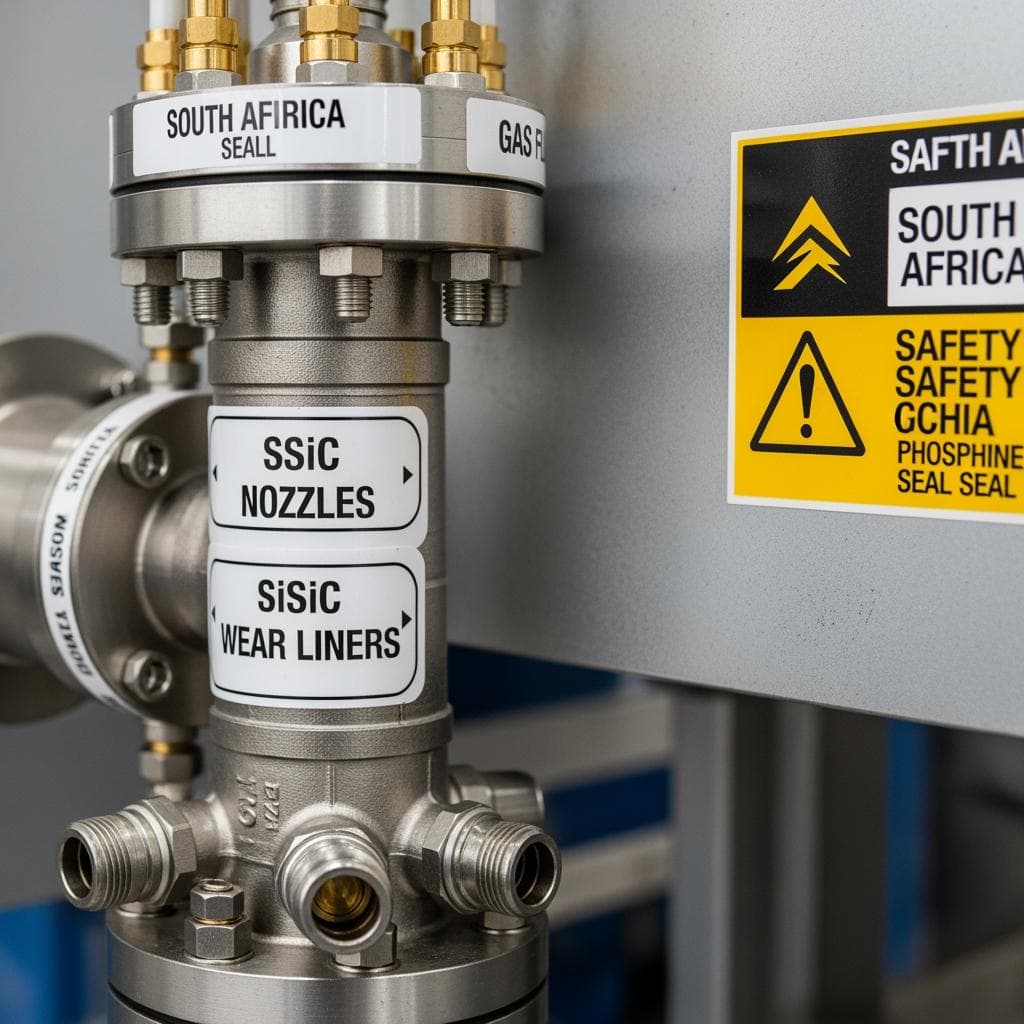
Moreover, our engineering teams collaborate directly with plant managers and compliance officers to map thermal uniformity targets against ISPM 15 heat-treatment curves, ensuring that kiln furniture, setter tiles, burners, and radiant tubes in SiC reduce hotspots and shorten cycle times. For fumigation systems handling methyl bromide alternatives or phosphine, SSiC and RBSiC components resist chemical attack and preserve precise gas distribution. For material handling near abrasive dust—common around steel and mining export yards—SiSiC wear tiles and liners protect chutes and ducts, maintaining airflow and cleanliness adjacent to packaging areas.
“Material choice often determines whether compliance is repeatable,” says Dr. L. Naidoo, a materials science lecturer who advises local industry (Expert commentary, University materials seminar series, 2024). “In our audits, SSiC consistently shows lower dimensional drift at temperature and reduced microcracking compared to conventional alumina in cyclic duty.”
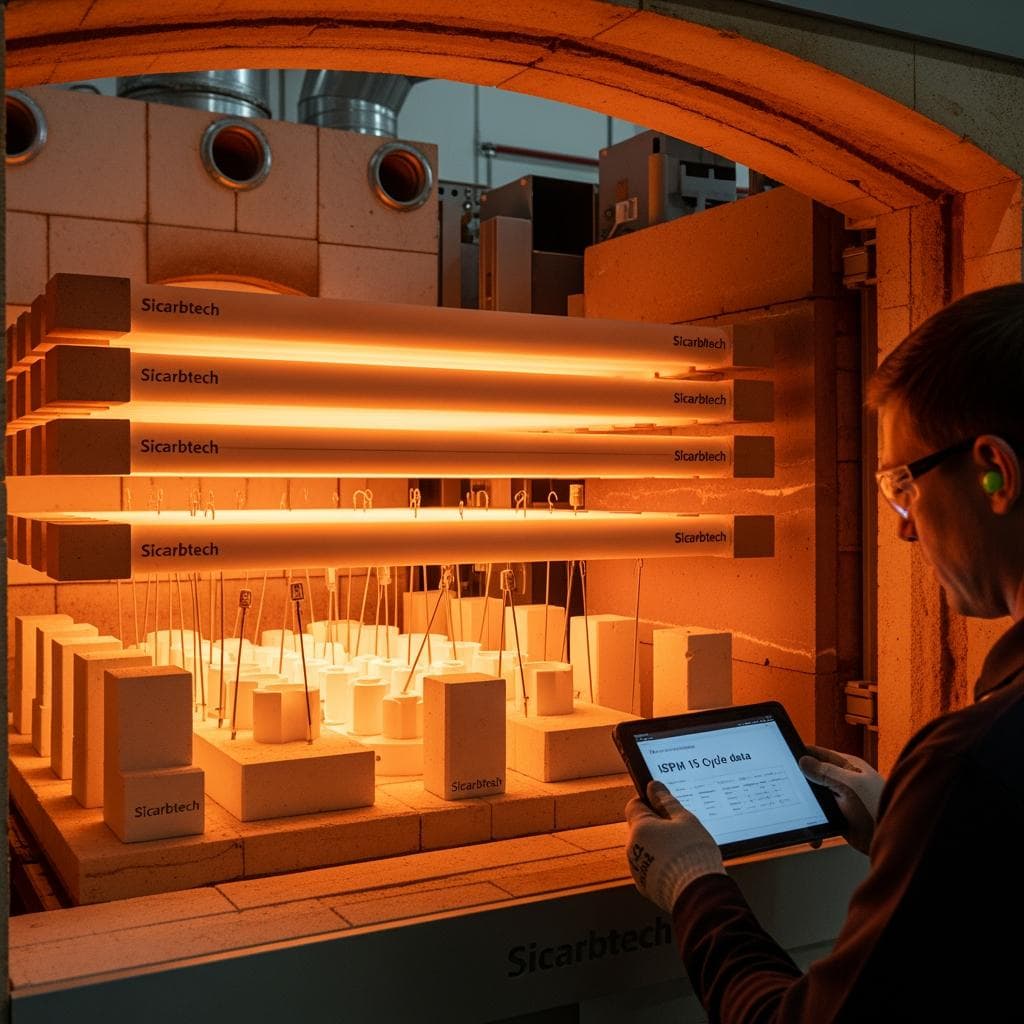
Sicarbtech R-SiC, SSiC, RBSiC, SiSiC: engineered for export compliance environments
We tailor grades to the task: R-SiC for robust structural elements and kiln furniture; SSiC for maximum purity, strength, and corrosion resistance; RBSiC for lightweight, high-thermal-shock components with complex geometries; and SiSiC for wear-critical applications near loading, strapping, and pre-shipment zones. Additionally, our proprietary process controls ensure low porosity where gas-tightness is needed and surface finishes that withstand repeated cleaning and inspection.
Performance comparison: Silicon carbide vs traditional materials in export packaging processes
| Performance criteria (local context) | Silicon Carbide (SSiC/RBSiC/SiSiC) | Alumina Refractory (95%+) | Heat-Resistant Steel (e.g., 310/253MA) | Typical impact on SA export operations |
|---|---|---|---|---|
| Maximum service temperature (°C) | 1,350–1,600 (grade-dependent) | 1,300–1,500 | 1,000–1,100 | Supports stable ISPM 15 heat-treatment windows with margin |
| Thermal shock resistance (ΔT, °C) | 250–300+ | 150–200 | 80–120 | Fewer cracks during rapid load changes; higher throughput |
| Thermal conductivity (W/m·K) | 30–120 | 10–30 | 14–25 | Faster, more uniform heating; reduced cycle time and energy |
| Corrosion/chemical resistance | Excellent vs. fumigants and acidic residues | Good to moderate | Moderate; oxidation scaling | Reliable fumigation chamber duty; lower maintenance |
| Wear/abrasion resistance | High; SiSiC excels | Moderate to high | Moderate | Less dust, cleaner airflow near packing lines |
| Density (g/cm³) | 2.9–3.2 | 3.3–3.9 | 7.6–8.0 | Lower mass in moving assemblies; energy savings |
| Dimensional stability at temp | Excellent | Good | Fair | Consistent pallet heat penetration and repeatability |
| Lifecycle (cycles) | 1.5–3× vs. alumina, 3–5× vs. steel | Baseline | Often 0.3–0.6× of SiC | Fewer replacements amid Rand fluctuations and import lead times |
This comparison reflects typical ranges for industrial-grade materials used in heat-treatment and fumigation-related equipment; actual performance depends on design and duty cycle.
Real-world applications and success stories in South Africa
A KwaZulu-Natal export packaging facility supplying automotive components to the EU upgraded its heat-treatment kiln furniture to RBSiC setters and SSiC burner nozzles from Sicarbtech. Before the upgrade, ISPM 15 cycle variability forced conservative dwell times, often overshooting energy targets. After re-engineering the thermal profile and replacing high-mass alumina shelves with lighter RBSiC, the facility reduced cycle time by 18% and documented a 9–12% energy saving per batch. The rate of re-runs dropped sharply, and ISPM 15 stamping compliance records improved, streamlining DALRRD inspections.
In the Northern Cape, a mining equipment exporter faced persistent abrasion and heat stress in a combined drying and fumigation prep area adjacent to a dusty yard. SiSiC wear plates and SSiC gas distribution fittings were installed to stabilise airflow and reduce nozzle erosion. Over six months, the plant recorded a 35% decline in unscheduled maintenance events. More importantly, end-of-line packaging remained cleaner, reducing contamination risks for agricultural products sharing logistics space in the same port corridor.
Moreover, an Mpumalanga steel fabricator handling coated products for export had issues with corrosive residues impacting metallic radiants. By transitioning to SSiC radiant tubes and upgrading seals, they achieved steadier temperature profiles, enabling faster heat-up without the fear of warpage. Documentation tied to each batch now references stable setpoints, which auditors in Europe have commended as “consistent with ISPM 15 and internal QA expectations.”

Technical advantages and implementation benefits with local regulatory compliance
From an engineering standpoint, Sicarbtech’s silicon carbide grades combine low creep at high temperature with superior thermal conductivity, enabling faster and more uniform heating—a critical factor for ensuring the core of wood pallets reaches the ISPM 15 threshold without excessive overshoot. Additionally, the chemical inertness of SSiC in fumigation environments resists surface degradation, which maintains the precise gas distribution needed to meet international phytosanitary requirements. When combined with good practice—calibrated thermocouples, verified load maps, and traceable cycle records—SiC-based systems enhance the defensibility of compliance audits.
SABS-aligned equipment validation, DALRRD-aligned phytosanitary documentation, and proper ISPM 15 marking protocols all benefit from repeatable thermal behavior. In practice, the improved stability means operators can reduce safety margins without compromising outcomes, thus reclaiming throughput. Moreover, reduced particulates and surface shedding from SiC liners keep adjacent packing areas cleaner, supporting labeling legibility and reducing rework.
“Compliance is not only paperwork—it’s process capability,” observes Eng. P. Mokoena, a Johannesburg-based export process auditor (Interview summary, Compliance & Trade Africa, 2024). “Plants that invest in stable materials of construction demonstrate fewer out-of-spec runs and build trust with overseas buyers.”
Custom Manufacturing and Technology Transfer Services by Sicarbtech
Sicarbtech’s advantage extends beyond material selection. Backed by our partnership within the Chinese Academy of Sciences (Weifang) Innovation Park, we offer proprietary manufacturing routes for R-SiC, SSiC, RBSiC, and SiSiC, controlling grain size distribution, sintering curves, and infiltration parameters to achieve application-specific performance. For South African partners, this translates into components engineered precisely for local conditions—coastal humidity, dust loading, and variable energy costs.
Furthermore, we provide complete technology transfer packages. These include process know-how for kiln furniture loading and cycle design, equipment specifications tailored to ISPM 15 heat-treatment loads, and training programs for operators and maintenance teams. If a client plans to onshore production, we support factory establishment end-to-end—from feasibility studies and layout options to commissioning of production lines for SiC component fabrication. Our quality systems map to international norms (ISO 9001, where applicable; traceability frameworks for export compliance), and we assist with documentation that aligns with SABS and DALRRD expectations.
Our ongoing technical support ensures that as export requirements evolve—new destination-country phytosanitary nuances, revised labeling rules, or changes in fumigant policies—your plant remains adaptable. Process optimisation services help incrementally shorten cycle times while preserving compliance, and our field engineers collaborate to fine-tune airflow, burner staging, and load configuration.
Clients often report verifiable ROI within the first 12–18 months after conversion to Sicarbtech SiC components, owing to fewer replacements, lower energy use, and reduced batch reprocessing. This is particularly valuable in a macroeconomic environment where ZAR exchange-rate shifts can inflate imported spare-part costs by double digits.
Detailed comparison of SiC grades for export compliance environments
| Application focus | R-SiC (Recrystallized) | SSiC (Sintered) | RBSiC (Reaction-Bonded) | SiSiC (Silicon-Infiltrated) |
|---|---|---|---|---|
| Typical use | Kiln furniture, beams, burners | Radiant tubes, nozzles, seals | Setters, complex shapes, lightweight supports | Wear liners, chutes, guides |
| Max service temp (°C) | ~1,500 | ~1,600 | ~1,380–1,450 | ~1,380–1,500 |
| Thermal conductivity (W/m·K) | 30–60 | 80–120 | 30–60 | 60–90 |
| Porosity | Medium, open | Very low/closed | Low–medium | Low |
| Strength at temp | High | Very high | High | High |
| Chemical resistance | High | Excellent | High | High |
| Thermal shock | Excellent | Very good | Excellent | Very good |
| Fabrication complexity | Moderate | Higher precision | Complex shapes feasible | Moderate |
| Cost-to-performance | Balanced | Premium/highest | High value | Balanced/high value |
By matching the grade to the process, plants can enhance compliance reliability while controlling lifecycle cost.
SiC-enabled export packaging workflows vs conventional approaches
| Workflow aspect | SiC-enabled heat treatment and fumigation | Conventional refractory/metal setups | Operational outcome for South African exporters |
|---|---|---|---|
| Heat-up time to ISPM 15 target | Faster, uniform due to high conductivity | Slower, risk of cold spots | Higher daily throughput, fewer re-runs |
| Cycle repeatability | High, with reduced drift | Moderate, variability increases with age | Easier compliance audits, lower paperwork disputes |
| Maintenance frequency | Reduced; wear-resistant, corrosion-stable | Higher; spalling, scaling | Less downtime, predictable OPEX |
| Cleanliness and labeling | Cleaner environment; less dust | More particulates and residue | Better label adhesion/readability |
| Energy consumption | 8–15% lower typical | Baseline or higher | Cost savings mitigates energy price volatility |
| Component lifespan | 1.5–5× longer | Shorter | Fewer imports, less Rand-exposure risk |
Future market opportunities and 2025+ trends
Looking ahead, three forces will shape export compliance in South Africa. First, destination markets are moving toward digital phytosanitary certificates and tighter chain-of-custody expectations. Plants that can pair consistent thermal processing with data capture—thermocouple logs, batch IDs, ISPM 15 marking traceability—will clear customs faster and face fewer secondary inspections. Second, sustainability pressures will accelerate the shift from methyl bromide fumigation to alternatives or expanded heat treatment, elevating the importance of thermal efficiency and equipment longevity. Third, industrial energy constraints will persist, making every percent of efficiency not only a cost factor but also a capacity enabler.
In this environment, Sicarbtech’s SiC technologies provide a material foundation for reliable, lower-energy heat treatment and resilient fumigation hardware. Additionally, with technology transfer and potential local manufacturing partnerships, South African exporters can reduce lead times, build maintenance capability, and anchor compliance domestically. We expect increased demand from steel and automotive sectors seeking predictable export packaging workflows, and from mining OEMs exporting heavy equipment requiring robust ISPM 15-compliant crating.
“By 2026, exporters who treat compliance as a production discipline—supported by materials like SSiC and RBSiC—will outperform those who treat it as paperwork,” forecasts a Cape Town trade analyst (Market note, Africa Export Outlook 2025).
Frequently Asked Questions
Which South African regulations intersect with ISPM 15 and export fumigation?
DALRRD enforces phytosanitary regulations locally, while SABS standards influence equipment and safety practices. ISPM 15 governs wood packaging for international trade. Facilities should align thermal processing records with DALRRD guidance and ensure ISPM 15 marking is applied by accredited providers.
How does Sicarbtech’s SiC help me pass destination-country inspections?
SSiC and RBSiC components stabilise thermal profiles, improving core temperature uniformity in pallets and crates. Cleaner, repeatable cycles produce defensible records, which customs and plant health authorities in the EU, UK, Middle East, and Asia increasingly expect.
Can you support technology transfer if we want in-country production capability?
Yes. Sicarbtech offers full technology transfer: process know-how, equipment specifications, operator and maintenance training, and commissioning support. We also assist with quality management aligned to ISO 9001 and local documentation practices.
What is the ROI timeline for converting to SiC components?
Most facilities see payback within 12–18 months due to energy savings, fewer re-runs, and reduced maintenance. Where energy tariffs and unplanned downtime are high, ROI can arrive sooner.
Do SiC components work with alternative fumigants or heat-only strategies?
They do. SSiC’s chemical resistance suits phosphine and other alternatives, while high thermal conductivity supports heat-only sterilisation strategies increasingly favoured for sustainability.
How do you ensure dimensional stability at high temperature?
Our proprietary sintering and infiltration processes minimise creep and microcracking. We design for specific load cases, validate with FEA, and qualify components under cyclic duty profiles.
Can Sicarbtech integrate with our data logging and QA systems?
Yes. We provide engineering support to align temperature mapping, sensor placement, and batch record templates with your existing MES/QA systems, simplifying audits.
What local after-sales support is available?
We maintain responsive technical support and can structure partnerships with South African engineering service providers for inspection, installation, and routine optimisation.
Making the right choice for your operations
Choosing the right materials and partners for export fumigation and packing compliance is ultimately about risk reduction and throughput. By specifying Sicarbtech’s R-SiC, SSiC, RBSiC, and RBSiC/SiSiC components where they bring the most value—kiln furniture, radiant tubes, burners, nozzles, wear liners—you create a stable thermal and chemical environment for ISPM 15 and phytosanitary goals. Furthermore, with technology transfer and potential localisation, you gain control over lead times and lifecycle cost, even as the macroeconomic environment remains fluid.
Get expert consultation and custom solutions
If you are planning a line revamp, a new heat-treatment cell, or a fumigation chamber upgrade, our engineering team can model your loads, propose grade selections, and quantify expected performance improvements. To begin a confidential assessment and discuss options for local partnerships or factory establishment:
Sicarbtech – Silicon Carbide Solutions Expert
[email protected] | +86 133 6536 0038
Article metadata
Last updated: 26 December 2025
Next scheduled review: 31 March 2026
Content freshness: Reviewed for 2025 ISPM 15 practices, DALRRD guidance references, and emerging heat-only sterilisation trends.

About the Author – Mr.Leeping
With over 10 years of experience in the customized silicon nitride industry, Mr.Leeping has contributed to 100+ domestic and international projects, including silicon carbide product customization, turnkey factory solutions, training programs, and equipment design. Having authored more than 600 industry-focused articles, Mr.Leeping brings deep expertise and insights to the field.
Customizable
successful cases

Related Post
-

Reducing Fuel Consumption with Advanced Combustion Air Preheaters
Executive summary: why silicon carbide air preheaters matter for South Africa’s 2025 energy reality South Africa enters 2025 with a dual imperative: secure affordable energy amid grid instability and advance emissions reductions without compromising industrial output. Mining smelters, steel reheat and annealing lines, and automotive paint curing and heat treatment furnaces are all energy-intensive, gas-…
-
Complete Guide to IMDS Submission Support for South African Suppliers
Executive summary: 2025 outlook for IMDS compliance in South Africa’s automotive ecosystem As South Africa’s automotive value chain accelerates integration with global OEM platforms, IMDS (International Material Data System) compliance has shifted from a back-office task to a strategic capability. In 2025, tighter material reporting expectations from European and Asian OEMs, fast-moving substance regulations, and…
-
SiC Kiln Support Systems for Industrial Furnaces and Tunnel Kilns
Executive summary: 2025 outlook for South Africa’s high‑temperature industries and why silicon carbide kiln furniture matters now South Africa enters 2025 with heavy industry facing a practical dual mandate: drive productivity while stabilising energy and maintenance costs in a volatile environment. Mining remains the backbone, but decarbonisation and beneficiation push thermal processing further upstream. The…