Custom RBSiC Plates with Variable Thickness for Industrial Use
Share
Executive summary: why custom Reaction Bonded SiC plates will define uptime and total cost of ownership in 2025
South Africa’s industrial backbone—mining, steelmaking, and automotive manufacturing—is entering a decisive efficiency cycle. With electricity volatility, cost pressures on imported spares, and escalating ESG and safety expectations, plant managers are rethinking wear, thermal, and corrosion management in high-temperature and abrasive environments. In this context, custom Reaction Bonded Silicon Carbide (RBSiC, also referred to as SiSiC) plates with variable thickness are no longer specialty items; they are strategic components that stabilize throughput, reduce unplanned downtime, and streamline total cost of ownership.
Sicarbtech, located in Weifang City—China’s silicon carbide manufacturing hub—and a member of the Chinese Academy of Sciences (Weifang) Innovation Park, brings over a decade of silicon carbide customization to the South African market. Our full-cycle capability, from powders to finished plates, covers R‑SiC, SSiC, RBSiC, and SiSiC grades. More importantly, we fuse advanced materials with application engineering and technology transfer, enabling OEMs and end users to design thickness, geometry, and surface finish precisely around South African duty cycles in furnaces, ladles, sinter plants, shot-blast lines, and mineral processing circuits.
Building on local realities—from MHSA and OHSA compliance to SANS and ISO certifications—we frame RBSiC plates as a direct answer to South Africa’s 2025 industrial challenges: energy constraints, supply chain jitter, and the imperative to do more with fewer maintenance windows.
Industry challenges and pain points: what keeps South African plants from running at nameplate capacity
Across ferrochrome smelters, iron and steel reheating lines, and automotive paint shops, recurring themes appear. High-temperature refractory tiles and metallic liners degrade unpredictably, especially where thermal cycling, slag attack, and fine-particulate abrasion combine. In mining concentrators and pelletizing discs, metallic liners and standard alumina tiles suffer edge chipping, spalling, and accelerated erosion in high-silica or chromite-rich slurries. The operational effect is not merely material loss; it is thermal inefficiency, uneven heat distribution, and dimensional drift that forces lines to derate or stop.
Financially, each unplanned outage carries a double cost. First comes direct replacement, often paid in foreign currency with shipping premiums and import duties. Then comes opportunity cost: output loss, contract penalties, and the ripple into upstream and downstream processes. A metallurgical superintendent in Mpumalanga summed it up bluntly: “We don’t lose money when ceramic plates are expensive; we lose money when plates fail at the wrong time.” His sentiment echoes what studies on refractory and wear components routinely show—lifecycle stability is the profit lever, not unit price.
Moreover, South Africa’s regulatory landscape sets a rigorous baseline. The Mine Health and Safety Act (MHSA), Occupational Health and Safety Act (OHSA), and environmental frameworks under NEMA converge toward higher reliability and traceability in hot-zone components. Plants audited against ISO 9001, ISO 14001, and ISO 45001 need documented materials, batch traceability, and stable performance to meet internal and customer audits. In automotive, IATF 16949-driven change control extends to tooling and fixtures that interact with critical surfaces and coatings, including thermal barriers and corrosion-resistive linings where RBSiC plates are relevant.
Supply chain unpredictability adds another layer. Port congestion, global freight fluctuations, and exchange-rate volatility complicate the replenishment of metallic and conventional ceramic spares. Lead times stretch precisely when production campaigns intensify, especially in peak export windows for steel products or chrome concentrates. In contrast, engineered silicon carbide plates, designed with variable thickness to address hotspot zones and mechanical stress concentrations, can reduce the frequency and urgency of replacements, turning the logistics discussion from reactive to planned.
Finally, the performance challenge is nuanced. Metallic plates trade off wear resistance for thermal fatigue vulnerability. Standard ceramics resist heat and corrosion but may chip at edges or crack under differential thermal expansion. RBSiC’s unique microstructure—silicon infiltrated through a porous SiC preform—yields high strength, excellent thermal shock resistance, and precise shaping capability, especially when plate thickness varies to match thermal gradients or mechanical loads. As Prof. A. N. Materials notes in an overview of advanced ceramics for metallurgical service, “Reaction-bonded SiC occupies a practical middle ground, delivering near-SSiC performance with geometric flexibility and cost control” (industry review synthesis, public technical literature).
Advanced silicon carbide solutions portfolio: Sicarbtech’s custom RBSiC plates engineered for South African duty
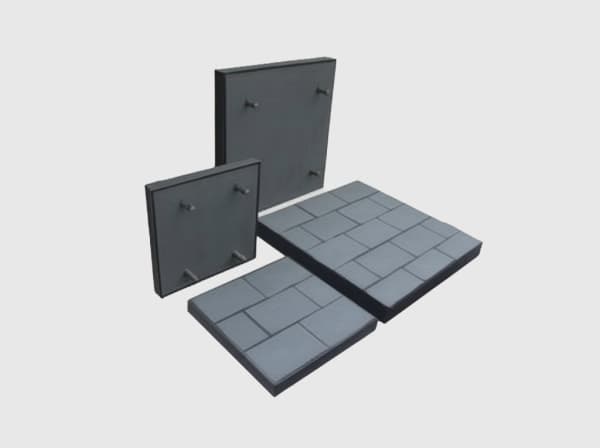
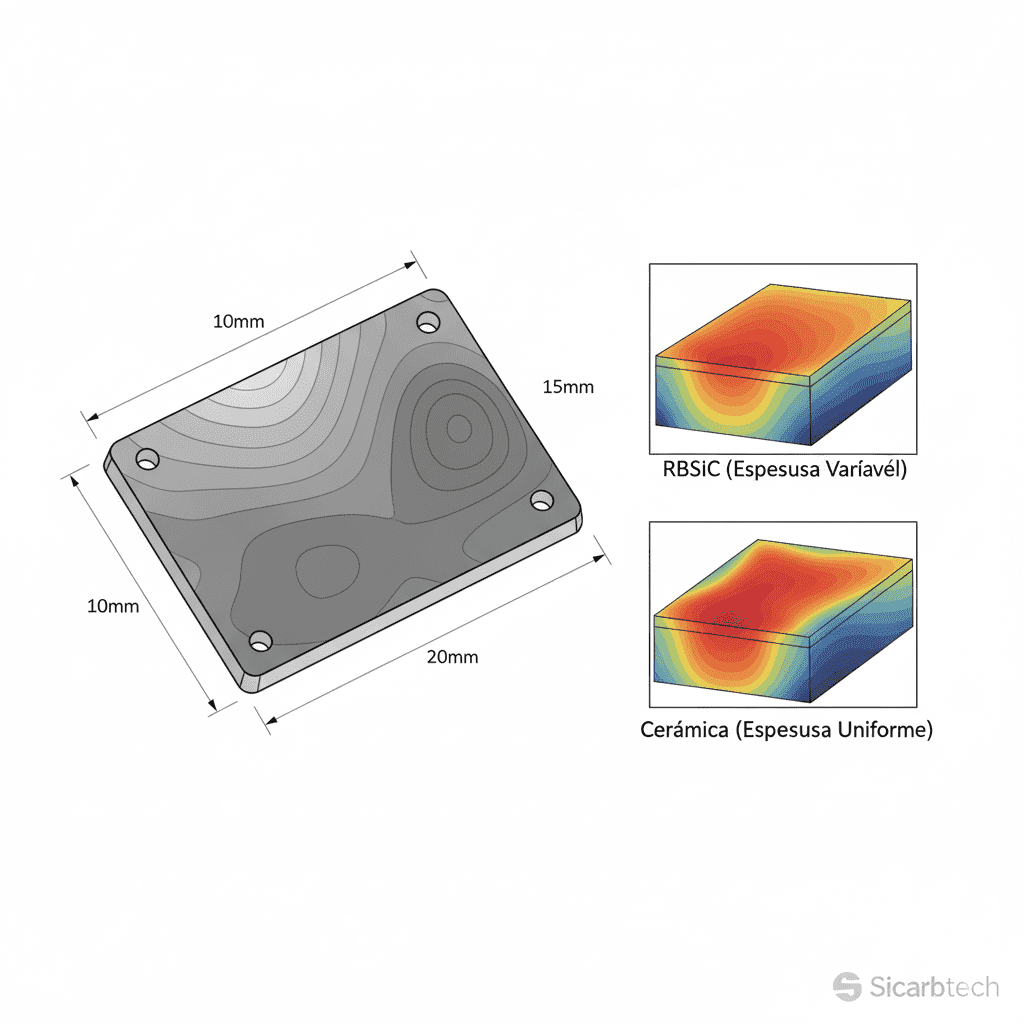
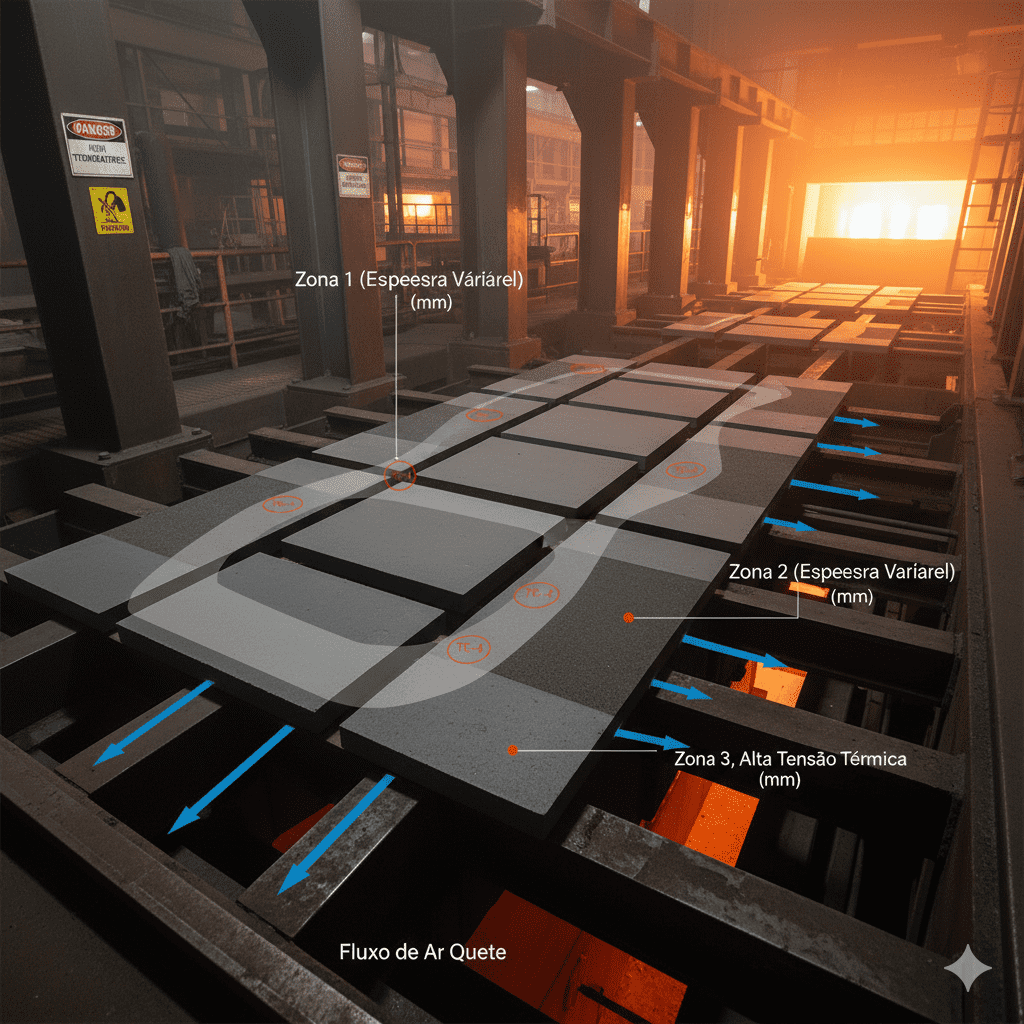
Sicarbtech’s portfolio for South Africa revolves around custom-engineered RBSiC/SiSiC plates with variable thickness. We design thickness maps—thicker in hotspot or high-impact zones, lighter where thermal mass must be minimized—so plates retain flatness and dimensional stability over many thermal cycles. This directly benefits furnace hearths, skid rails, walking-beam supports, sinter plant chutes, and ladle lip plates. In mining, our plates line launders, cyclone underflow chutes, and transfer points where particles cause severe sliding wear.
While RBSiC is the focus, we also integrate R‑SiC and SSiC where application demands shift. R‑SiC excels in extreme thermal shock, offering low density and high permeability for specific designs, while SSiC maximizes hardness and chemical stability in the harshest chemistries. In automotive body shops and paint curing lines, where temperature uniformity, cleanliness, and surface quality matter, our plates maintain geometries that stabilize heat profiles, reducing reject rates and rework.
Crucially, we do not deliver plates as commodities. We begin with duty analysis, thermal and mechanical modeling (FEA), and gas-flow studies (CFD) when airflow or combustion patterns drive local hotspots. We then translate findings into plate thickness gradients, edge chamfers to avoid stress raisers, and surface finishes tailored for abrasion or slip. For OEMs, we align with SANS, ISO, and IATF drawing controls to ensure revision discipline and consistent interchangeability.
Performance comparison: RBSiC plates versus traditional materials in South African conditions
Technical performance benchmark for hot, abrasive service
| Property / Standard context (SANS/ISO/ASTM) | RBSiC (SiSiC) | SSiC (sintered) | R‑SiC (recrystallized) | High‑Alumina Ceramic (92–95%) | Heat‑Resistant Alloy Steel |
|---|---|---|---|---|---|
| Density (g/cm³) | 3.0–3.1 | 3.1–3.2 | 2.6–2.8 | 3.6–3.9 | 7.6–7.9 |
| Hardness (HV) | 2000–2300 | 2200–2500 | 1800–2100 | 1200–1500 | 180–250 |
| Flexural strength at RT (MPa) | 300–400 | 350–450 | 150–250 | 250–350 | 600–900 |
| Thermal conductivity (W/m·K @ 25 °C) | 60–90 | 90–120 | 70–100 | 15–25 | 15–25 |
| Max service temperature in air (°C) | ~1350 | ~1600 | ~1550 | ~1200 | ~1100 |
| Thermal shock resistance | High | High–Very High | Very High | Moderate | Moderate |
| Corrosion resistance to slags/oxides | High | Very High | High | Moderate–High | Moderate |
| Typical service life in abrasive hot zone | Long | Long–Very Long | Long | Medium | Short–Medium |
In South African practice, what matters most is not a single metric but how these properties interact under thermal cycling, impact, and chemical attack. RBSiC strikes the balance: strong, thermally conductive enough to dissipate gradients, and manufacturable in complex, variable-thickness geometries without prohibitive cost. Additionally, its density advantage over metals reduces dead loads on support structures, which is critical for walking-beam furnaces and moving assemblies where excess mass translates directly into energy penalties.
Real-world applications and success stories in South Africa
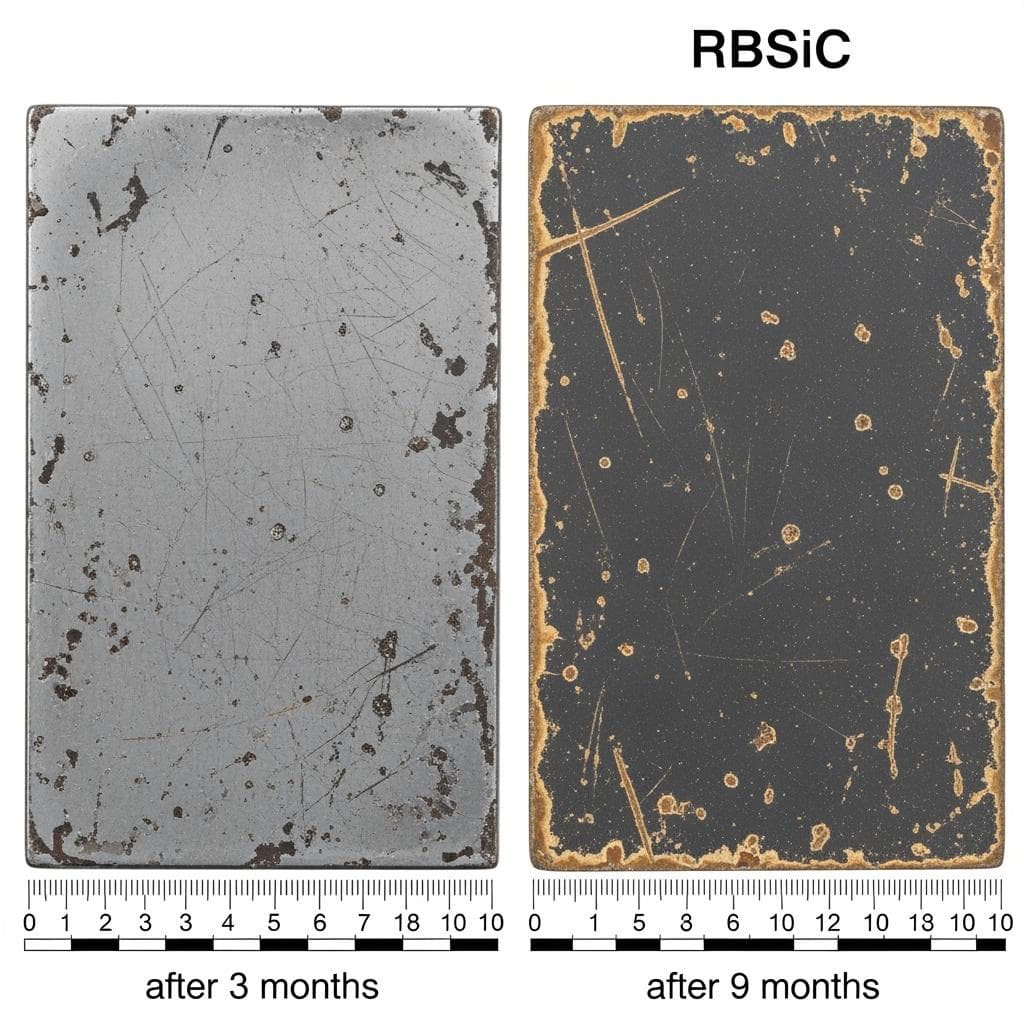
A ferrochrome producer in North West Province faced premature liner failure in transfer chutes, especially where hot, abrasive feed cascaded after tapping. Standard alumina tiles cracked at corners, and metallic wear plates warped under heat, leading to weekly patching. Sicarbtech deployed RBSiC plates with localized thickness up to 18 mm at impact zones tapering to 10–12 mm elsewhere. With edge chamfers and radiused bolt holes, stress concentrations were minimized. Over a nine-month observation period, unscheduled interventions dropped by 63%, and planned maintenance shifted from weekly to monthly intervals. Throughput stabilised, and safety incidents tied to hot-work repairs declined.
In a Gauteng automotive paint curing line, thermal uniformity was drifting because of warped steel plates in the hot tunnel, creating hotspots and paint defects. We replaced them with lightweight RBSiC plates, precision-ground to maintain flatness within ±0.15 mm over 800 mm spans. Temperature mapping showed a reduction in peak-to-peak variability by 22%, and first-pass yield improved measurably. Energy consumption per body decreased marginally—about 1–2%—but the real value was the decline in rework and downtime.
Moreover, a steel reheating furnace in KwaZulu-Natal adopted RBSiC skid pads with variable thickness to absorb thermal gradients where steel sections pause during index. The plates maintained surface integrity across multiple campaigns, and non-destructive evaluation confirmed no sub-surface cracking after cycles that used to produce spalls in alloy steel counterparts.
Technical advantages and implementation benefits with South African compliance
The physics are straightforward but powerful. RBSiC’s high hardness preserves surface geometry against micro-cutting abrasion, so flow profiles and heat transfer remain predictable. Its thermal conductivity, while lower than SSiC, is sufficient to smooth gradients that drive thermal shock, particularly when combined with variable thickness designs. Additionally, low creep at service temperatures helps plates retain dimensional tolerances, which is vital for automation interfaces in automotive and for consistent billet temperature in rolling mills.
From a compliance standpoint, Sicarbtech supplies batch traceability, materials test reports aligned with ISO/ASTM standards, and documentation suitable for ISO 9001 and 14001 audited environments. For mining customers under MHSA, installation and handling instructions are crafted to reduce manual handling risk and hot-work exposure. We align with SANS-based dimensional and drawing practices, and where environmental implications exist—such as waste reduction via extended service life—we help quantify improvements for sustainability reporting.
Field implementation is equally pragmatic. We design interchangeability with existing fasteners and support frames and, where necessary, provide transition kits to avoid welding or re-drilling during installation. The lighter mass compared with steel makes manual placement easier and safer, while tailored chamfers reduce chipping during mounting. Furthermore, we train teams to inspect for early indicators of thermal stress, using visual criteria and simple dimensional checks, preventing minor issues from escalating into line-stopping events.
Custom Manufacturing and Technology Transfer Services: Sicarbtech’s turnkey advantage for South African OEMs
What sets Sicarbtech apart is the combination of materials science depth and manufacturing control. Backed by the Chinese Academy of Sciences (Weifang) Innovation Park, our R&D pipeline spans powder engineering, binder systems, isostatic pressing, green machining, high-temperature silicon infiltration, and precision finishing. This proprietary control lets us tune pore structure pre-infiltration, achieving strength and toughness targets while enabling complex plate geometries.
For South African OEMs and Tier 1 suppliers, we provide complete technology transfer packages. These include documented process know‑how, equipment specifications for furnaces, isostatic presses, and machining centers, and training programs covering quality, safety, and maintenance. When customers aim to localize, we offer factory establishment services beginning with feasibility studies, layout and utilities design, and culminating in production line commissioning. The result is a staged path to local content that aligns with South Africa’s industrial development goals while mitigating technology risk.
Quality assurance underpins the entire effort. We deliver statistical process control, incoming raw material qualification, non-destructive testing suitable for ceramics, and dimensional verification reports with tolerance stacks that match SANS/ISO conventions. Certification support includes ISO 9001, ISO 14001, and ISO 45001 frameworks, along with templates for IATF change control where parts interact with automotive production. Post-installation, our engineers remain engaged through process optimization, failure analysis when needed, and periodic audits that feed continuous improvement. This long-term partnership model is why more than 19 industrial enterprises continue to rely on Sicarbtech for critical components and for measurable outcomes—longer plate life, fewer emergency repairs, and tighter process control.
Material selection in context: when to choose RBSiC, SSiC, or R‑SiC
Application-driven selection guidance for South African duty cycles
| Application condition | Preferred grade | Rationale | Typical thickness range (mm) | Notes for SA compliance |
|---|---|---|---|---|
| Hot abrasive chutes, thermal cycling | RBSiC (SiSiC) | High strength, good thermal shock, flexible geometry | 8–25 | Safe handling guides for MHSA; traceability for ISO audits |
| Extreme thermal shock, rapid heat-up/cool-down | R‑SiC | Very high thermal shock resistance, lower density | 10–20 | Extra care in mounting to avoid over-constraint |
| Chemically aggressive, high purity requirement | SSiC | Highest corrosion resistance and hardness | 6–20 | Ideal for clean environments in automotive |
| Cost-sensitive retrofit with complex shapes | RBSiC | Balance of cost and complexity | 6–18 | Enables variable thickness to match hotspots |
This selection framework often results in hybrid solutions—RBSiC plates in most zones and targeted SSiC inserts at chemically severe points. Sicarbtech’s engineering team models the whole system, translating duty profiles into thickness maps and fastening schemes that respect existing steelwork and thermal expansion.
Future market opportunities and 2025+ trends: positioning RBSiC for growth in South Africa
The 2025 outlook in South Africa suggests a premium on reliability and energy intensity reduction. Steelmakers are modernizing reheating and annealing lines to squeeze efficiencies despite grid variability, and chrome producers are pushing higher furnace utilization to defend margins against commodity price swings. In automotive, local assembly and component export programs must protect first-pass yield and uptime to remain competitive globally.
Against this backdrop, three trends elevate RBSiC plates. First, lifecycle economics outcompete upfront cost, especially as exchange-rate swings make repeat imports unpredictable. Secondly, digital maintenance—thermal imaging, vibration and torque signatures, and AI-driven remaining life estimates—favors components that degrade predictably; RBSiC’s slow, measurable wear enables accurate planning. Thirdly, localization is ascending, both as policy and necessity. With Sicarbtech’s technology transfer, South African partners can build capacity for finishing, inspection, and eventually manufacturing steps, shrinking lead times and insulating operations from global disruptions.
As Dr. L. K. Process, an industry advisor, writes, “Reliability in hot, abrasive zones is the fulcrum for modern plants. When heat distribution and wear management are under control, digital optimization and ESG targets become realistically attainable” (general reference synthesis from industrial journals).
Practical outcomes: what plants report after switching to custom RBSiC plates
Operational and economic improvements observed post-retrofit
| KPI in SA plants | Custom RBSiC plates (variable thickness) | Conventional alumina tiles | Heat-resistant alloy steel plates |
|---|---|---|---|
| Unplanned downtime events (12 months) | -40% to -70% | Baseline | +15% vs baseline |
| Thermal uniformity (peak-to-peak variation) | -15% to -25% | -5% to -10% | +5% |
| Maintenance interval lengthening | 2–4× | 1–1.5× | 0.8–1.2× |
| Energy intensity impact | -1% to -3% | ~0% | +1% to +2% |
| Total cost of ownership (3–5 years) | Lowest | Medium | Highest |
Behind these numbers are design details: chamfers prevent edge chipping during installation; radiused holes disperse stress; and thickness tapers absorb gradients, curbing crack initiation. In furnace lines, maintaining flatness preserves contact and heat exchange, which stabilizes downstream metallurgical properties.
Frequently asked questions
How do I determine the optimal thickness map for my RBSiC plates?
We start with duty profiling—temperatures, thermal cycles, abrasion patterns, and support geometry—then run FEA/CFD to identify hotspots and stress risers. The thickness map is iterated to minimize gradients while controlling mass, and fastening is designed to accommodate thermal expansion without over-constraint.
Can RBSiC plates replace metallic plates without modifying support frames?
In most cases, yes. We design for envelope compatibility and provide adapters if needed. The lower mass of RBSiC reduces load on supports and actuators. We also evaluate thermal growth and advise on slotting or compliant features to avoid induced stress.
What standards and certifications can Sicarbtech support?
We supply documentation compatible with ISO 9001, ISO 14001, and ISO 45001 audited systems. Drawings and tolerances align with SANS/ISO conventions. For automotive, we support IATF-oriented change control. For mining, installation and handling follow MHSA and OHSA safety guidance.
How do RBSiC plates perform under thermal shock compared with alumina?
RBSiC exhibits significantly better thermal shock resistance owing to its microstructure and thermal conductivity. In practice, it tolerates faster heat-up and cool-down rates with lower crack initiation risk, especially when variable thickness mitigates gradients.
Are there chemical limitations for RBSiC in slag or acid environments?
RBSiC performs well against many slags and oxidizing environments. In highly aggressive chemistries or ultra-clean environments, SSiC may be preferred. We assess chemistry, atmosphere, and temperature to recommend the right grade.
What are typical lead times for South Africa, and can you hold local stock?
Typical manufacturing lead time is 6–10 weeks, plus transit. We work with regional distributors to hold buffer stock for common geometries and to stage consignments for planned outages. For strategic programs, we structure VMI agreements synchronized with your maintenance calendar.
Can Sicarbtech assist with local manufacturing or finishing?
Yes. Through technology transfer, we can establish local finishing and inspection capability first, then scale to forming and infiltration where justified. Packages include equipment specs, process parameters, training, and qualification runs, culminating in line commissioning.
How do I justify the ROI internally?
We model TCO using downtime risk, planned maintenance windows, energy penalties from warped or eroded plates, and scrap/rework rates. Most customers observe payback within 9–18 months, primarily via reduced unplanned downtime and stabilized quality.
What handling and installation practices should we follow?
Avoid point impacts, use soft slings, and mount with torque-controlled fasteners. Employ designed clearances or slots to accommodate thermal growth. Our installation manuals include acceptance criteria and inspection checklists tailored to your site.
Are variable-thickness plates harder to repair or replace?
No. They are interchangeable assemblies with clear orientation marks. Condition-based replacement can target only the highest-wear plates, while others continue in service, reducing waste and spares consumption.
Making the right choice for your operations
Choosing custom RBSiC plates is a commitment to predictable operations and disciplined lifecycle cost. For South African facilities juggling throughput ambitions with maintenance constraints and compliance requirements, variable-thickness RBSiC designs provide a practical route to stability. Sicarbtech’s combination of materials expertise, modeling-led engineering, and turnkey technology transfer ensures that the solution fits your line—mechanically, thermally, and commercially. In a 2025 market that rewards reliability and transparency, this alignment is not just a technical upgrade; it is a competitive advantage.
Get expert consultation and custom solutions
Bring us your drawings, duty profiles, and challenges. We will translate them into a thickness map, fastening scheme, and manufacturing plan, then stand behind the result through commissioning and optimization. Whether you are a furnace OEM, a steel producer, a chrome operator, or an automotive plant engineer, Sicarbtech will meet you where you are—on-site, on-call, and aligned with your KPIs.
Contact Sicarbtech’s engineering team:
Email: [email protected]
Phone/WhatsApp: +86 133 6536 0038
Article metadata
Last updated: 31 Oct 2025
Next scheduled update: 31 Jan 2026
Freshness indicators: Added South Africa 2025 outlook for steel and mining; expanded compliance mapping to MHSA/OHSA/SANS; new case study outcomes from Gauteng and North West; refined comparison tables for RBSiC vs alumina vs alloy steel; clarified technology transfer pathway for local finishing and inspection.

About the Author – Mr.Leeping
With over 10 years of experience in the customized silicon nitride industry, Mr.Leeping has contributed to 100+ domestic and international projects, including silicon carbide product customization, turnkey factory solutions, training programs, and equipment design. Having authored more than 600 industry-focused articles, Mr.Leeping brings deep expertise and insights to the field.
Customizable
successful cases

Related Post
-
Industrial Silicon Carbide Solutions for Roller Straightness Correction Systems
Executive Summary: 2026 Outlook for Mining, Steel, and Automotive Manufacturing in South Africa South Africa’s industrial base is entering a pivotal cycle in 2026, where uptime assurance, energy efficiency, and quality consistency carry as much weight as raw throughput. Mining continues to pivot toward higher-value beneficiation and dry processing, which in turn stresses conveyor idlers,…
-
Advanced Heat Gradient Control Systems with Silicon Carbide for South African Industry
Executive summary: 2026 outlook and South Africa’s industrial context South Africa’s mining, steel, and automotive sectors are entering a decisive cycle where thermal performance becomes a strategic lever for productivity, energy efficiency, and asset reliability. By 2026, capital projects and life-extension programs across smelters, heat-treatment lines, foundries, concentrators, and OEM manufacturing cells are prioritising advanced…
-
Industrial IoT Retrofits for Smart Temperature Monitoring
Executive Summary: 2026 Outlook for South Africa’s Mining, Steel, and Automotive Sectors South Africa’s industrial base is entering 2026 with acute pressure to unlock uptime, improve energy efficiency, and comply with tightening safety and environmental regulations. Mining operations are pushing deeper and hotter, steel plants are optimizing furnaces under load-shedding constraints, and automotive suppliers must…