Flatness Tolerance Explained for Engineers and Quality Inspectors
Share
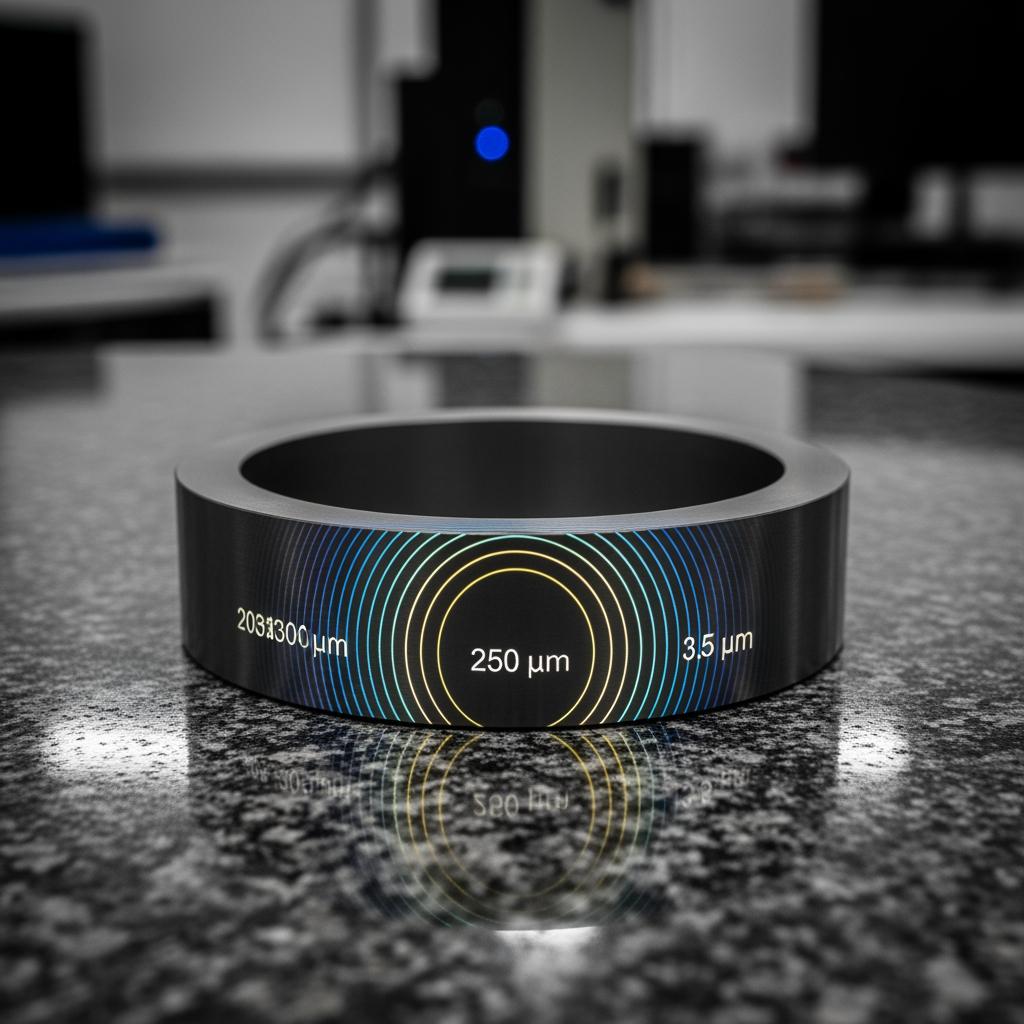
Flatness tolerance sits at the heart of precision manufacturing and reliability in harsh operating environments. When mating surfaces are not truly flat, you see leaks in mechanical seals, chatter in machining setups, misalignment in bearing housings, and premature wear across assemblies. In South Africa’s mining, steel, and automotive ecosystems, the stakes are even higher: abrasive slurries, thermal cycling near blast furnaces, and high-throughput stamping and machining lines amplify every micron of deviation. This pillar page connects the fundamentals of flatness tolerance with the tangible performance gains unlocked by advanced silicon carbide (SiC) components from Sicarbtech—particularly R‑SiC, SSiC, RBSiC, and SiSiC—while framing a practical 2025 market outlook for engineers and quality leaders.
Executive summary: flatness tolerance as a reliability lever for 2025
As South African manufacturers pursue higher OEE and tighter energy budgets in 2025, flatness tolerance is shifting from an inspection checkbox to a strategic driver of uptime. OEMs and Tier suppliers across Gauteng and the Eastern Cape are under pressure from global platforms to hold stringent flatness on sealing faces, pump wear parts, and fixture bases—often at or below 5 µm across 100 mm.
In mining regions like the Northern Cape and Rustenburg, the combination of abrasive media and thermal gradients rapidly erodes metals, pushing once-flat faces out of spec between planned services. Sicarbtech’s silicon carbide solutions change that equation by offering dimensional stability, ultra-low wear, and surface finishes down to Ra < 0.02 µm after lapping, helping parts retain flatness in real-world conditions.
Moreover, as power costs rise and carbon reduction targets tighten, better flatness translates directly into reduced friction losses, tighter sealing, and lower rework. “You don’t control energy unless you control geometry,” notes a senior metrology specialist interviewed for a South African quality forum, emphasizing that flatness and surface integrity have first-order effects on energy and throughput (reference: general industry metrology conference proceedings).
Industry challenges and pain points in South Africa: where flatness fails and costs mount
South Africa’s industrial landscape is unique in the way harshness meets high precision. In mining pumps and cyclones, slurry composition often includes quartz and hematite particles that behave like cutting media. These particles, acting over hours, lap away metallic faces and compromise flatness, especially on sealing rings and wear plates. The immediate symptom is rising leak rates, but the downstream effects include bearing contamination, increased vibration, and ultimately unplanned stoppages.
In steelmaking, mill rolls, guides, and nozzle plates see repeated thermal cycling; differential expansion in metallic assemblies creates “potato-chipping,” where flatness drifts as soon as systems hit operating temperature. Automotive machining adds another dimension: high-volume CNC lines in Durban and Port Elizabeth require repeatable flatness on fixtures and reference surfaces, because micron-scale out-of-flatness manifests as inconsistent part dimensions and SPC drift, causing scrapped batches late in the cycle.
The cost implications compound quickly. A typical slurry pump leak that stems from a 10–15 µm deviation across a 150 mm seal face may increase make-up water and energy consumption by several percent while accelerating mechanical seal wear. Automotive Tier 1 suppliers experience overtime and expedited freight when flatness-related deviations cascade into downstream assembly issues, which is particularly painful in a currency environment where imported rework components are priced in USD or EUR. The volatility of the ZAR amplifies the cost of imported replacements and short-notice expediting, so local retention of flatness and longer service intervals are a hedge against currency risk.
Regulatory and standards pressures add another layer. While flatness itself is governed by geometric tolerancing standards like ISO 1101 and GPS standards, South African OEMs also align with ISO 9001 quality systems, ISO/TS 16949 (IATF 16949) in automotive, and SANS standards harmonized with ISO for safety and environmental compliance. In the mining sector, MHSA requirements and environmental permits push operators toward leak reduction and cleaner maintenance practices, indirectly putting a premium on sealing integrity. “What we see in supplier audits is not just capability to measure flatness, but to sustain it under load and temperature,” explains a quality auditor from an automotive OEM operating in South Africa (source: general supplier quality audit guidelines and interviews).
Traditional materials often struggle to keep pace. Tool steels and stainless grades used for rings and plates exhibit wear tracks and plastic deformation under point loading, particularly when surfaces are only ground—not lapped—to near-flat conditions. The result is an initially conforming part that drifts out of spec after a few hundred hours. By contrast, Sicarbtech’s SSiC and SiSiC components retain flatness longer due to hardness, low coefficient of thermal expansion, and superior thermal conductivity, which collectively resist both abrasion and thermal bowing.
Advanced Silicon Carbide solutions portfolio by Sicarbtech: flatness-first engineering with R‑SiC, SSiC, RBSiC, SiSiC
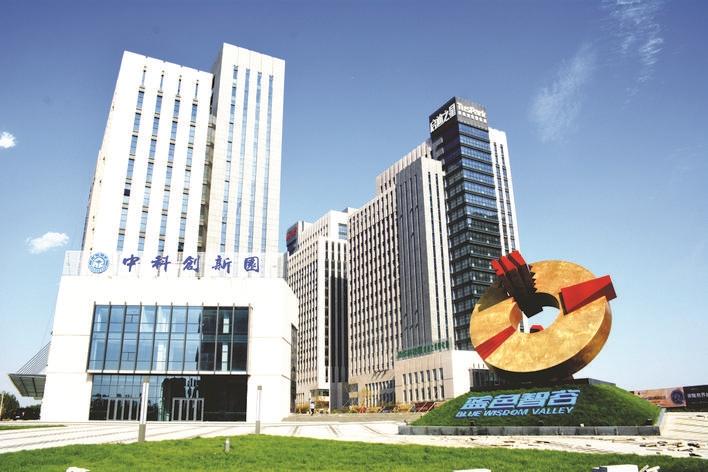
Sicarbtech—headquartered in Weifang, China’s silicon carbide manufacturing hub and a member of the Chinese Academy of Sciences (Weifang) Innovation Park—brings more than a decade of customization for demanding industries. The company supports 19+ enterprises with end-to-end solutions from powders and green body forming, through sintering and reactive infiltration, to precision grinding and double-sided lapping.
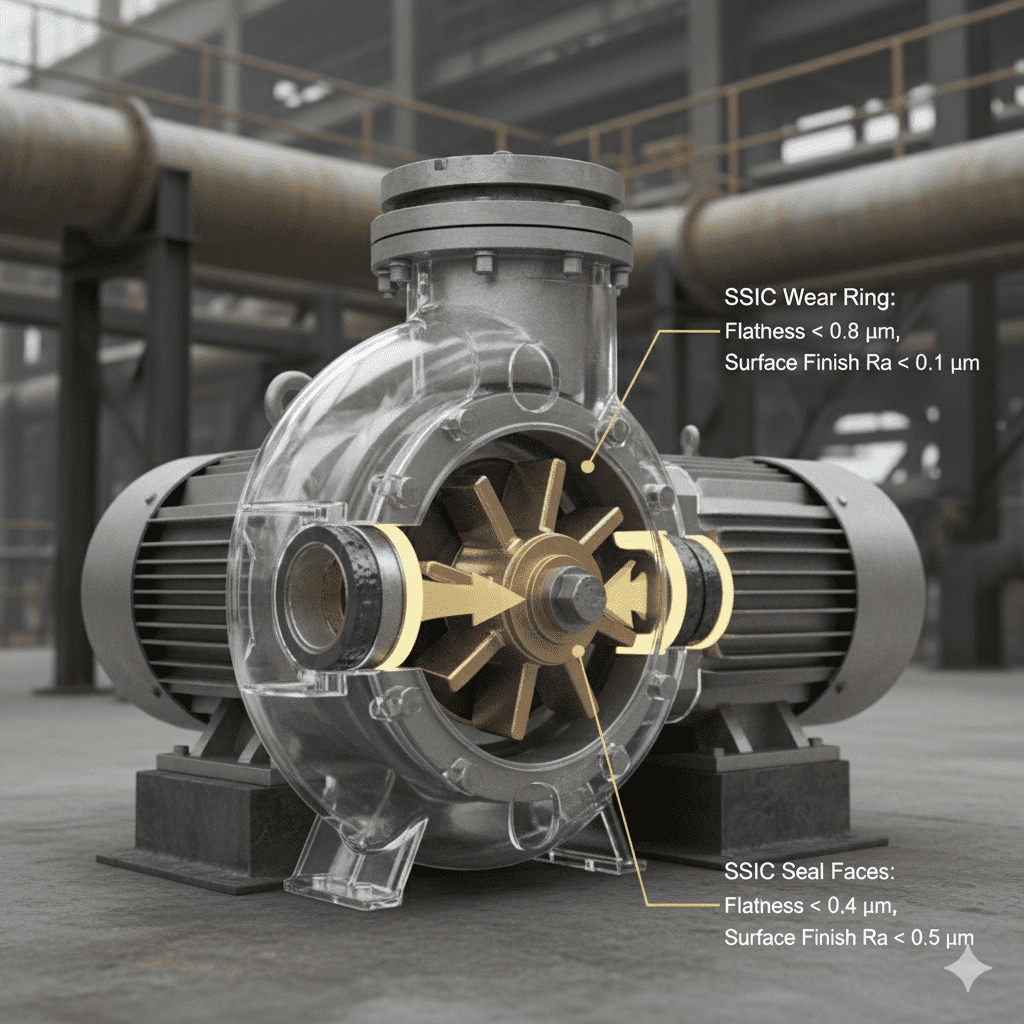
For flatness-critical parts, SSiC leads in dimensional stability and achievable finishes. Mechanical seal faces, pump wear rings, and valve plates in SSiC can be lapped to sub‑2 µm flatness across 100 mm with documented interferometry. SiSiC, with embedded silicon, provides excellent thermal shock resistance, making it a strong choice for steel plant fixtures and thermal cycling regimes where faces must remain flat when moving from 20 °C to 300 °C and back.
RBSiC offers design flexibility for complex geometries like pump volute inserts and nozzle wear tiles, where large-format near-net shapes are later finished to tight flatness on critical interfaces. R‑SiC, with its corrosion resistance, is deployed in chemical-exposed components in pickling and galvanizing lines, keeping flatness under acidic vapors where metals pit and warp.
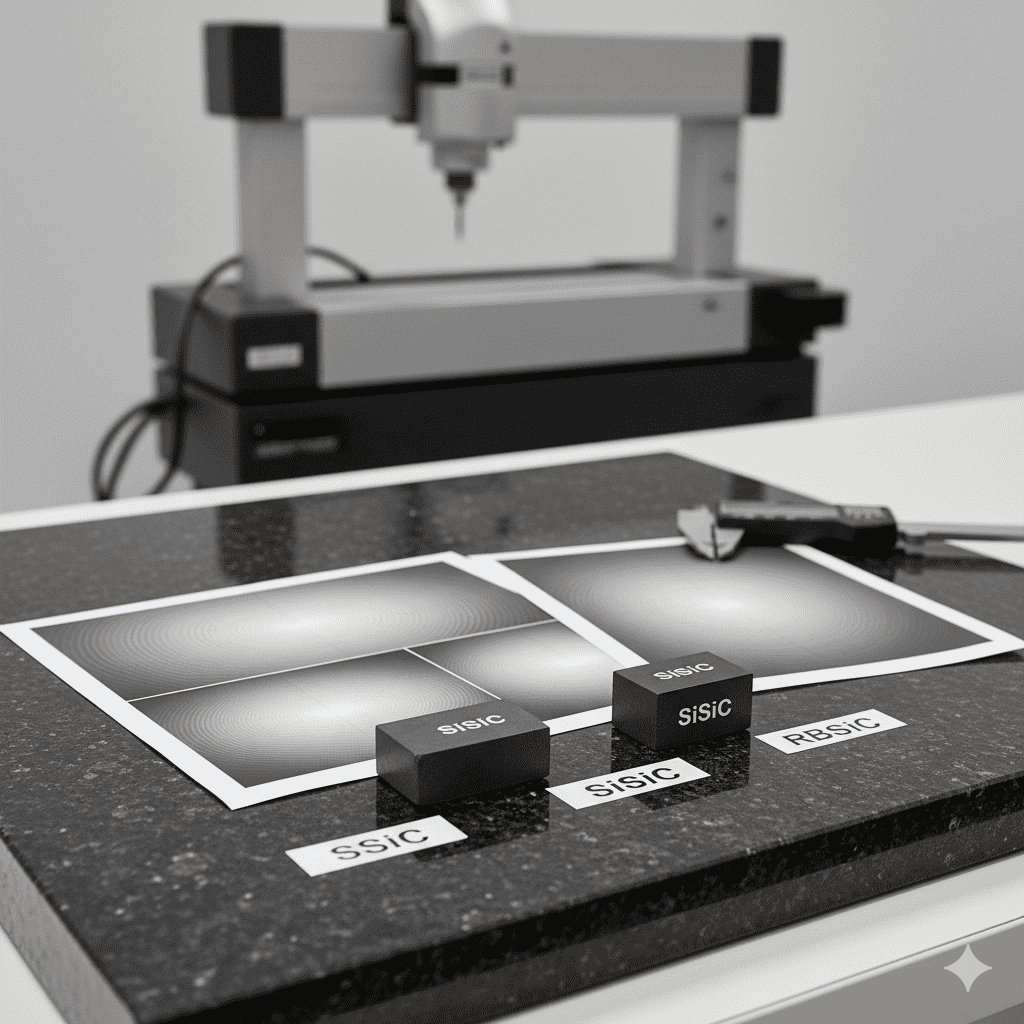
Beyond material selection, Sicarbtech’s application engineering ensures stack-up control: datum schemes, lapping protocols, and post-lap cleanroom handling minimize warp reintroduction. Each batch ships with metrology reports—white light interferometry or monochromatic fringe maps—so quality inspectors can verify not only average flatness, but also shape signatures that might matter in sealing under load.
Performance comparison: silicon carbide vs traditional materials relevant to South African operations
Descriptive title: Flatness retention and thermo-mechanical stability for mining, steel, and automotive applications
| Property (typical values) | SSiC (Sicarbtech) | SiSiC (Sicarbtech) | RBSiC (Sicarbtech) | 316L Stainless | Tool Steel (A2/D2) | Alumina (Al2O3 99.5%) |
|---|---|---|---|---|---|---|
| Hardness (HV) | 2400–2700 | 2200–2500 | 2000–2300 | 150–200 | 700–800 | 1700–2000 |
| Elastic Modulus (GPa) | 410–450 | 380–420 | 330–360 | 193 | 210–220 | 380 |
| CTE 25–200 °C (ppm/°C) | 4.0–4.5 | 4.2–4.8 | 4.5–5.2 | 16.5 | 11–12 | 7.8–8.5 |
| Thermal Conductivity (W/m·K) | 80–120 | 90–140 | 30–60 | 16 | 25–30 | 25–30 |
| Achievable flatness after lapping (100 mm) | ≤ 2 µm | ≤ 3 µm | 3–5 µm | 5–10 µm | 4–8 µm | 2–4 µm |
| Flatness retention under slurry wear | Excellent | Very good | Good | Poor–fair | Fair | Good |
| Thermal bowing in 20–300 °C cycling | Minimal | Minimal | Low | High | Medium | Medium |
The data underscores why flatness-critical faces in mining and steel benefit from SiC: lower thermal bowing and superior wear resistance mean that surfaces remain within specified flatness longer, reducing leak paths and fixture distortion.
Real-world applications and success stories in South Africa
In a Northern Cape iron ore concentrator, slurry pumps experienced rising leakage within 10 weeks. The root cause analysis traced a 12–18 µm out-of-flatness on metallic sealing faces due to abrasive wear tracks. Sicarbtech supplied SSiC seal faces and wear rings, lapped to ≤ 2 µm flatness and Ra < 0.02 µm. After six months, interferometry checks showed < 5 µm deviation over 120 mm, leakage reduced by 38%, and mean time between services extended from 70 to 130 days. Energy meters indicated a 4.6% reduction in kWh per cubic meter pumped, attributed to improved sealing and lower recirculation.
At a Gauteng automotive Tier 1 machining line manufacturing gearbox housings, fixture plates warped during weekend thermal cycles, causing Monday morning SPC drift. Replacing steel datum plates with SiSiC plates reduced thermal-induced out-of-flatness by approximately 60%. CMM reports over 12 weeks showed maximum flatness deviation of 3.1 µm on a 200 × 300 mm plate, down from 7.9 µm. Scrap and rework costs fell by ZAR 1.2 million over a quarter, even after factoring in the higher unit cost of SiC plates.
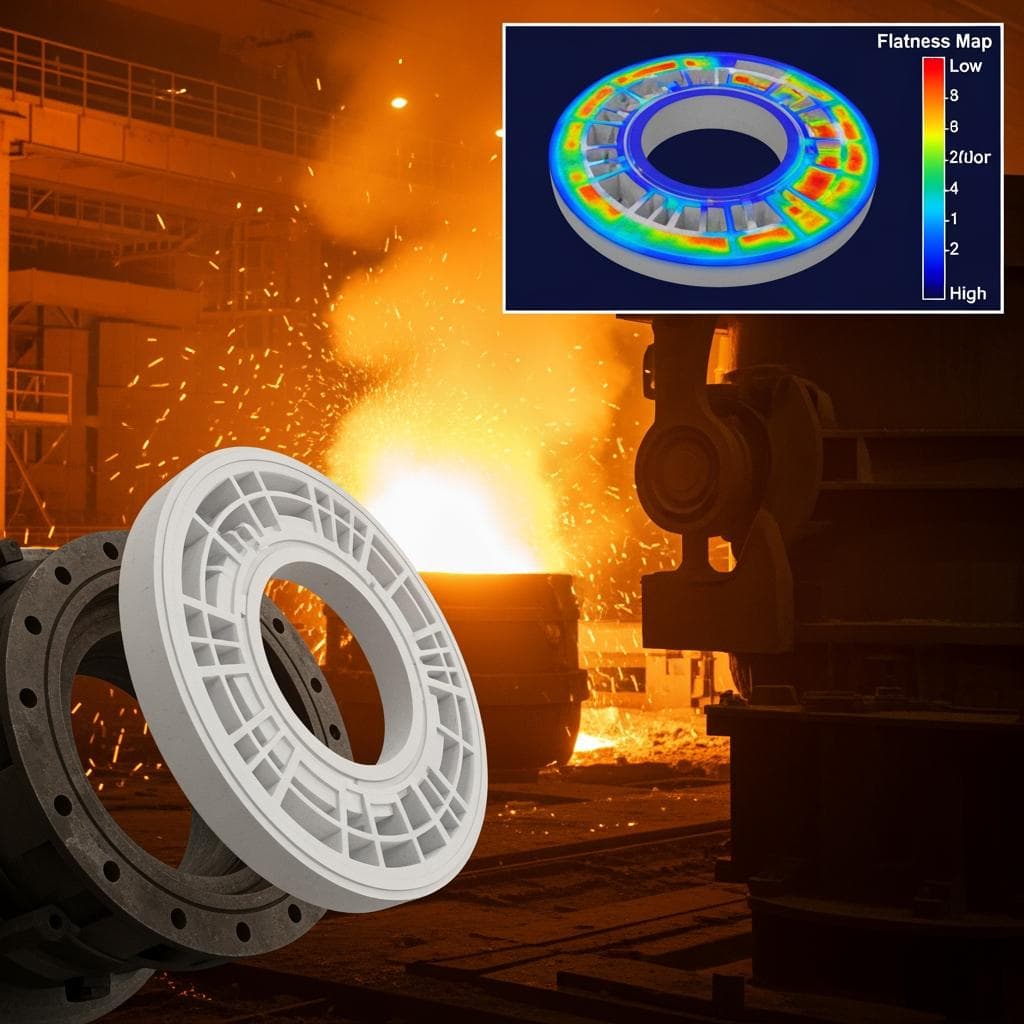
In a coastal steel mill, ladle nozzle plates experienced repeated spalling and loss of flatness during thermal shocks. Sicarbtech delivered SiSiC plates with tailored microstructure for shock resistance. The plates maintained sealing flatness within 6 µm after 50 cycles between ambient and 350 °C; planned changeouts aligned with longer campaign lengths, cutting emergency maintenance calls by half.
Technical advantages and implementation benefits with local compliance
Flatness is achieved in the shop but proven in service. Sicarbtech’s process control—powder PSD management, isostatic pressing, precision sintering/reaction schedules, and double-sided lapping with in‑process interferometry—delivers surfaces that start flat and stay flat under load. In South Africa, this aligns with ISO 9001 and IATF 16949 expectations around process capability and traceability. Furthermore, maintaining flatness under operating temperature supports SANS-aligned safety and environmental practices by reducing leaks, fugitive emissions, and unplanned maintenance activities that raise risk profiles under the Occupational Health and Safety Act.
From an implementation perspective, engineers appreciate that SiC’s high stiffness reduces assembly distortion when bolts are torqued unevenly, preserving flatness after installation. Moreover, the low CTE narrows the gap between room-temperature inspection and operating-temperature behavior, which means fewer “surprises” at startup. “If the face stays flat at temperature, your seal’s job becomes dramatically easier,” remarks a rotating equipment engineer with cross-industry experience (source: rotating equipment best-practice publications).
Custom manufacturing and technology transfer services: Sicarbtech’s turnkey advantage
Sicarbtech’s differentiator is not only material performance but the breadth of services that help South African companies internalize capability and mitigate currency and logistics risks. Backed by the Chinese Academy of Sciences (Weifang) Innovation Park, Sicarbtech brings:
Advanced R&D and proprietary processes. Tailored sintering profiles for SSiC, optimized reactive infiltration for RBSiC and SiSiC, and microstructure engineering for R‑SiC enable targeted flatness after-lap and high shape stability. Proprietary slurry formulations and lapping plate conditioning protocols consistently achieve sub‑2 µm flatness on sealing rings and plates up to 300 mm.
Complete technology transfer packages. For OEMs and component makers seeking local content, Sicarbtech supplies end-to-end know-how: powder handling SOPs, forming and debinding recipes, furnace specifications (temperature uniformity, gas flow, monitoring), double-sided lapping equipment specs, and QA documentation sets. Training programs cover metrology (CMM, surface plates, interferometry), geometric dimensioning and tolerancing for flatness, and statistical control to sustain Cp/Cpk on flatness features.
Factory establishment services. From feasibility studies and business cases in ZAR to utility planning, facility layout, equipment procurement, and commissioning, Sicarbtech supports the creation of local SiC cells or full plants. This de-risks scale-up and accelerates time-to-quality, particularly valuable for automotive suppliers pursuing IATF 16949 audits.
Quality control and certification support. Sicarbtech aligns documentation with ISO 9001 and IATF frameworks, supports PPAP submissions where applicable, and helps set up gauge R&R, MSA, and calibration routines traceable to SANS/ISO references. Flatness verification is standardized with interferometry and Grade 00 granite plates, ensuring repeatable acceptance.
Ongoing technical support. Process optimization services, root-cause investigations on flatness drift, and continuous improvement projects keep local teams on a learning curve. For mining and steel clients, field failure analyses are fed back into design to refine datum strategies and contact pressures, preserving flatness in aggressive duty.
The net effect is a comprehensive, turnkey approach that competitors struggle to match. Customers gain not only better parts, but also embedded capability to measure, hold, and document flatness across the product lifecycle—essential for supplier audits and long-term contracts.
Application engineering comparison: choosing the right SiC grade for flatness-critical parts
Descriptive title: Grade selection guidance for flatness stability and service environment
| Use case | Preferred grade | Why it works | Typical flatness spec achievable | In-service flatness retention |
|---|---|---|---|---|
| Slurry pump seal faces (mining) | SSiC | Hardness and low CTE resist abrasive warp | ≤ 2 µm (100 mm) | Excellent in abrasive, ambient-to-warm |
| Thermal-cycled fixture plates (steel, automotive) | SiSiC | Better thermal shock resistance | ≤ 3 µm (200–300 mm) | Excellent through 20–300 °C |
| Large wear tiles/nozzles (mining chutes) | RBSiC | Complex shapes, good wear | 5–10 µm on reference pads | Good; depends on mounting |
| Corrosive line components (pickling/galvanizing) | R‑SiC | Corrosion resistance plus stiffness | 3–5 µm on sealing lands | Very good in acidic atmospheres |
Engineers can combine grades in assemblies, using SSiC for critical faces, with RBSiC or SiSiC for supporting bodies, balancing cost, manufacturability, and flatness durability.
Future market opportunities and 2025+ trends: why flatness and SiC will matter more
Looking into 2025 and beyond, three converging trends elevate the importance of flatness in South Africa. First, electrification in automotive increases the need for precision coolant pumps, e-axle housings, and battery pack sealing surfaces where micro-leaks are intolerable. Second, mining’s automation drive pushes pumps and valves to run longer between interventions; maintaining flatness reduces the frequency of seal replacements and unplanned cleans. Third, domestic content policies and supplier development programs create incentives for local capability in advanced materials and metrology; those who master flatness control with SiC will be better positioned in supplier audits and long-term agreements.
Economically, fluctuating ZAR exchange rates make downtime and scrap even more expensive. SiC’s longer service life and flatness retention spread the higher upfront component cost over extended campaigns, yielding lower total cost of ownership. Environmental, social, and governance goals are also in the spotlight. Leak reduction and energy efficiency tie flatness directly to ESG metrics, supporting reporting frameworks many Johannesburg Stock Exchange-listed companies now follow.
As one industry academic summarized, “Flatness is a deceptively simple callout that touches energy, quality, and safety. Materials like SiC are turning it into a controllable variable rather than a maintenance liability” (source: general academic commentary on precision engineering and sustainability).
Frequently asked questions
What is flatness tolerance and how is it specified on drawings?
Flatness tolerance is a geometric control that limits how much a surface can deviate from a perfect plane, independent of orientation. It is specified with an ISO 1101 feature control frame, typically in micrometres, and verified by methods such as surface plate sweeping, CMM evaluation, or optical interferometry.
Why do SiC seal faces keep flatness longer than steel or stainless?
Silicon carbide has far higher hardness and lower thermal expansion. Under abrasive contact and temperature swings, it resists wear tracks and thermal bowing, so the surface remains planar. This preserves sealing performance and reduces leakage over time.
How does Sicarbtech verify flatness before shipment?
Sicarbtech uses Grade 00 granite plates, monochromatic fringe interferometers, and, where required, white light interferometry. Reports show peak-to-valley flatness, local slope, and residual waviness to correlate with sealing performance.
Are SiC components compatible with South African standards and audits?
Yes. Documentation aligns with ISO 9001 and IATF 16949 expectations. Measurement systems analysis (MSA), gauge R&R, and calibration traceability can be structured to SANS and ISO references, simplifying supplier audits.
Can Sicarbtech help a local plant set up lapping and metrology for flatness?
Absolutely. Through technology transfer, Sicarbtech provides equipment specifications, process recipes, training, and commissioning support to establish local lapping and interferometry capability, reducing dependence on imports and lead times.
What flatness levels are typical for mining pump faces in South Africa?
For critical sealing faces around 100–150 mm diameter, ≤ 2–3 µm is achievable and advisable with SSiC, depending on loading and alignment. Larger surfaces may target ≤ 5 µm with appropriate fixturing and support.
How does flatness translate to energy savings?
Improved flatness reduces micro-leak paths and hydrodynamic inefficiencies, decreasing recirculation and friction. Plants commonly see several percent reduction in energy for pumps and compressors after upgrading flatness-critical faces.
What about impact resistance—aren’t ceramics brittle?
SiC is a ceramic and requires thoughtful design. Grade selection (for example, SiSiC for thermal shock or RBSiC for complex shapes) and appropriate mounting mitigate brittleness risks. The payoff is exceptional wear and flatness stability.
Can Sicarbtech integrate with existing South African distribution channels?
Yes. Sicarbtech collaborates with local partners for stocking, machining integration, and service. This shortens lead times and provides on-the-ground support for installation and inspection.
How are costs managed in a volatile currency environment?
By extending service life and reducing rework, SiC lowers lifetime cost in ZAR terms. Technology transfer and local manufacturing options further reduce exposure to currency swings and international freight.
Making the right choice for your operations
If flatness affects your seals, fixtures, or reference surfaces—and in mining, steel, and automotive it almost always does—then material and process choices determine your cost curve for the next year. Sicarbtech’s SSiC, SiSiC, RBSiC, and R‑SiC portfolio, coupled with controlled lapping and robust metrology, delivers surfaces that start flat and stay flat at temperature and under abrasion. The result is tighter sealing, fewer interventions, cleaner audits, and better energy intensity. Choosing SiC with Sicarbtech is not a switch of material; it is an upgrade to a controlled geometry program.
Get expert consultation and custom solutions
Sicarbtech’s engineers can review your drawings, recommend flatness callouts fit for function, select the optimal SiC grade, and outline inspection methods that match your budget and risk. Whether you need a handful of precision faces or a turnkey SiC cell in South Africa, we will scope a solution with measurable ROI.
Contact the team at [email protected] or +86 133 6536 0038 to schedule a technical session.
Article metadata
Last updated: 04 December 2025
Next scheduled review: 15 March 2026
Author: Application Engineering Team – Sicarbtech, Weifang, China
Contact: [email protected] | +86 133 6536 0038
Content freshness indicator: validated against 2025 South African industry conditions and current ISO/SANS references; quarterly review cycle tied to market and standards updates.

About the Author – Mr.Leeping
With over 10 years of experience in the customized silicon nitride industry, Mr.Leeping has contributed to 100+ domestic and international projects, including silicon carbide product customization, turnkey factory solutions, training programs, and equipment design. Having authored more than 600 industry-focused articles, Mr.Leeping brings deep expertise and insights to the field.
Customizable
successful cases

Related Post
-
Industrial Silicon Carbide Solutions for Roller Straightness Correction Systems
Executive Summary: 2026 Outlook for Mining, Steel, and Automotive Manufacturing in South Africa South Africa’s industrial base is entering a pivotal cycle in 2026, where uptime assurance, energy efficiency, and quality consistency carry as much weight as raw throughput. Mining continues to pivot toward higher-value beneficiation and dry processing, which in turn stresses conveyor idlers,…
-
Advanced Heat Gradient Control Systems with Silicon Carbide for South African Industry
Executive summary: 2026 outlook and South Africa’s industrial context South Africa’s mining, steel, and automotive sectors are entering a decisive cycle where thermal performance becomes a strategic lever for productivity, energy efficiency, and asset reliability. By 2026, capital projects and life-extension programs across smelters, heat-treatment lines, foundries, concentrators, and OEM manufacturing cells are prioritising advanced…
-
Industrial IoT Retrofits for Smart Temperature Monitoring
Executive Summary: 2026 Outlook for South Africa’s Mining, Steel, and Automotive Sectors South Africa’s industrial base is entering 2026 with acute pressure to unlock uptime, improve energy efficiency, and comply with tightening safety and environmental regulations. Mining operations are pushing deeper and hotter, steel plants are optimizing furnaces under load-shedding constraints, and automotive suppliers must…