High-Performance Scrubber Nozzles for Power Plants
Share
Executive summary: 2025 outlook for South Africa’s FGD systems and wet scrubbing performance
South Africa enters 2025 under intensifying pressure to stabilise power generation while meeting increasingly stringent air-quality obligations. Flue Gas Desulfurization (FGD) and wet scrubbing systems at coal-fired plants are pivotal to SO₂ compliance, yet they operate in environments where slurry abrasion, chloride-rich condensates, and high-temperature gas streams erode conventional nozzles and destabilise spray performance. In parallel, the mining, steel, and automotive sectors, all heavy energy users, depend on reliable power and are themselves deploying scrubbers for process off-gas treatment. Against this backdrop, silicon carbide (SiC) scrubber nozzles—engineered in advanced grades such as R‑SiC, SSiC, RBSiC, and SiSiC—deliver exceptional wear resistance, thermal stability, and chemical durability, maintaining droplet size distribution and spray uniformity even in corrosive slurries.
Sicarbtech, headquartered in Weifang—China’s silicon carbide manufacturing hub and a member of the Chinese Academy of Sciences (Weifang) Innovation Park—brings more than a decade of customization experience and a full-cycle capability from material processing to finished products. Supporting over 19 industrial enterprises, the company has refined proprietary processes for R‑SiC, SSiC, RBSiC, and SiSiC to meet the rigours of South African power stations and heavy industry. Furthermore, with technology transfer and turnkey factory establishment services, Sicarbtech enables localised value creation, shorter lead times, and consistent quality aligned with local standards and the realities of Rand volatility.
“As utilities try to reconcile availability, emission control, and O&M costs, nozzle stability inside FGD absorbers becomes mission-critical,” notes a senior process engineer at Sicarbtech. “SiC nozzles maintain hydraulic performance and resist slurry attack, translating to better SO₂ capture and lower lifecycle cost.”
Industry challenges and pain points: the South African context in focus
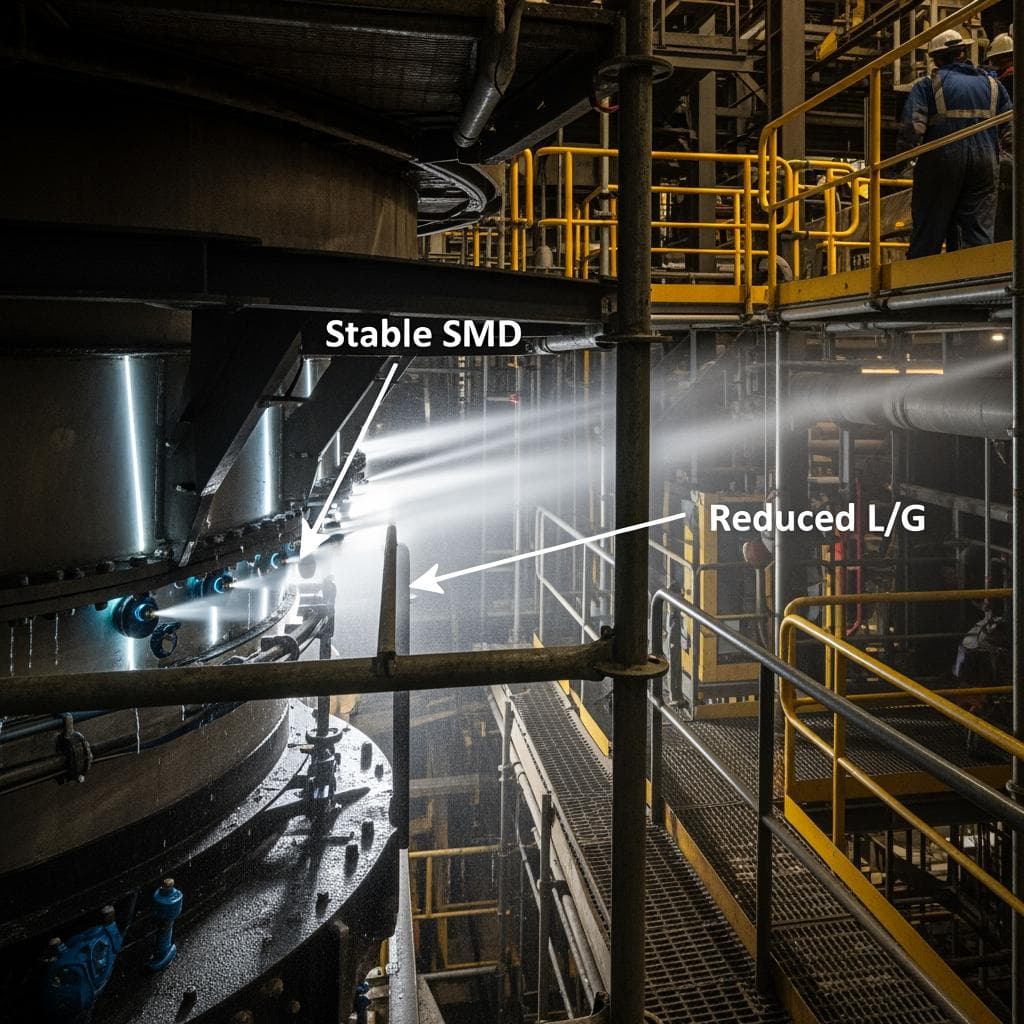
Across South Africa’s coal-fired fleet, plant operators face a convergence of age-related wear, fuel variability, and compliance-driven retrofits. Wet FGD absorbers must operate steadily despite fluctuating gas temperatures and load-following ramps. Traditional metallic or polymeric nozzles suffer from accelerated corrosion when chlorides exceed 20,000 ppm, a not-uncommon scenario in recycling limestone-gypsum slurries. Erosion becomes severe when limestone grind varies or when fly ash carryover increases due to upstream constraints. The result is creeping drift in Sauter Mean Diameter (SMD), distorted spray cones, and dead zones in the absorber where mass transfer is suboptimal. Moreover, nozzles that require frequent replacement force maintenance windows that are difficult to schedule under tight generation targets.
Financially, this manifests in rising OPEX: more frequent spares inventory, scaffold and access costs, and lost energy sales during planned and emergency outages. When nozzle wear leads to poor droplet size control, SO₂ capture efficiency drops, forcing operators to increase reagent ratios or liquid-to-gas (L/G) rates to stay within emission limits. This inflates pumping energy and limestone consumption, increasing operating costs in ZAR terms precisely when exchange-rate swings can make imported spare parts unpredictable. For independent power producers and state-run utilities alike, the total cost of ownership (TCO) becomes the key benchmark rather than first cost.
Additionally, regulatory dynamics are tightening. The National Environmental Management: Air Quality Act (NEMA:AQA) and the Minimum Emission Standards (MES) set clear targets for SO₂, particulate, and other pollutants. As compliance audits become more rigorous, scrubber performance must be consistent, with documented nozzle characteristics and maintenance trails. In automotive and steel off-gas applications, adherence to occupational exposure and environmental discharge limits requires stable atomization, especially where corrosive gases or fine particulates challenge traditional materials. In such contexts, materials with low porosity, strong covalent bonding, and high thermal shock resistance provide not only durability but also traceable, repeatable performance required for quality systems aligned with ISO 9001 and ISO 14001.
Supply chain constraints add another pain point. Lead times for specialty alloys and engineered polymers can fluctuate, and thermal cycling in absorber inlets can exceed nominal design limits during start-ups, pushing conventional nozzles beyond their comfort zone. Local maintenance teams often report that after a few months, cone angles narrow, hollow cones partially collapse, and blockages increase as roughened internal passages trap fines. Furthermore, slurry pH swings during transient operation exacerbate corrosion. In contrast, dense SiC keeps its internal geometry, maintaining pressure drop and spray pattern even after prolonged service.
“There’s a compounding effect,” explains Dr. T. Meyer, an air-quality control systems consultant based in Johannesburg. “As nozzles degrade, atomization worsens, which hurts mass transfer. Plants compensate by cranking up pump power and reagent feed. Costs escalate, and compliance margins shrink.” The implication is clear: durability and hydraulic consistency are not luxury features; they are economic and regulatory necessities.
Advanced Silicon Carbide Solutions Portfolio: R‑SiC, SSiC, RBSiC, SiSiC engineered for FGD and wet scrubbers
Sicarbtech’s portfolio aligns material grade to application severity. For high-chloride, abrasive limestone-gypsum slurries common in South African power plants, SSiC offers ultra-low porosity and exceptional corrosion resistance, preserving throat geometry and discharge orifice integrity. RBSiC (also referred to as SiSiC) combines a robust SiC matrix with free silicon infiltration, delivering high flexural strength and excellent dimensional stability under thermal cycling at absorber inlets. R‑SiC becomes the grade of choice where thermal shock is extreme, such as during fast ramp-ups or in quench zones of steel off-gas treatment, while still offering outstanding abrasion resistance. Across grades, Sicarbtech optimizes surface finish inside flow passages to stabilize boundary layers and reduce fouling.
Beyond material selection, nozzle engineering shapes real-world outcomes. By using CFD-driven flow path design, Sicarbtech fine-tunes swirl vanes, core stabilizers, and impact-pin geometry to achieve target SMD (typically 150–300 μm for FGD, depending on L/G and absorber height) with tight distribution. Cone angles are maintained across pressure ranges, preventing shadowing in packed or spray tower sections. Moreover, proprietary anti-erosion chamfers at inlets distribute shear stress more evenly, slowing wear at the most vulnerable edges. The result is a nozzle family that delivers predictable, repeatable spray patterns, enabling operators to optimize L/G ratios and reagent utilization without sacrificing SO₂ removal.
Technical performance comparison: SiC scrubber nozzles versus traditional materials
Descriptive title: Comparative performance of scrubber nozzle materials in South African FGD service
| Parameter | SSiC / RBSiC (SiSiC) by Sicarbtech | High‑alloy steel (HC alloys) | Engineered polymers (PTFE/PP) | Alumina ceramics |
|---|---|---|---|---|
| Max continuous temperature (°C) | 1,300–1,500 | 600–900 | 110–200 | 1,100–1,300 |
| Slurry abrasion resistance | Excellent (very high) | Moderate | Low | High |
| Chloride corrosion tolerance (ppm Cl⁻) | >50,000 (low porosity) | 5,000–20,000 | <5,000 | 10,000–20,000 |
| Thermal shock resistance | High (R‑SiC best) | Moderate | Low | Moderate |
| Dimensional stability over 4,000 h | Excellent | Fair (creep/corrosion) | Poor (softening/creep) | Good |
| Typical SMD drift over service life | <10% | 15–30% | >30% | 15–25% |
| Maintenance interval (months) | 12–24 | 3–9 | 1–6 | 6–12 |
| TCO over 5 years (relative) | Lowest | Medium | Highest | Medium |
Real-world applications and success stories in South Africa
A coal-fired power station in Mpumalanga retrofitted its absorber banks with Sicarbtech SSiC full-cone nozzles designed for a 90° cone angle and an SMD target of 220 μm at 3 bar. Prior to the retrofit, operators observed erratic SO₂ removal, forcing L/G ratios up by 8–10% during summer load peaks. Six months into operation with SiC nozzles, the plant recorded stable SO₂ capture above 92% at a reduced L/G, saving approximately 3–4% in pump energy and 5–7% in limestone usage. Inspection at the 12‑month mark showed negligible throat erosion and no measurable change in cone angle.
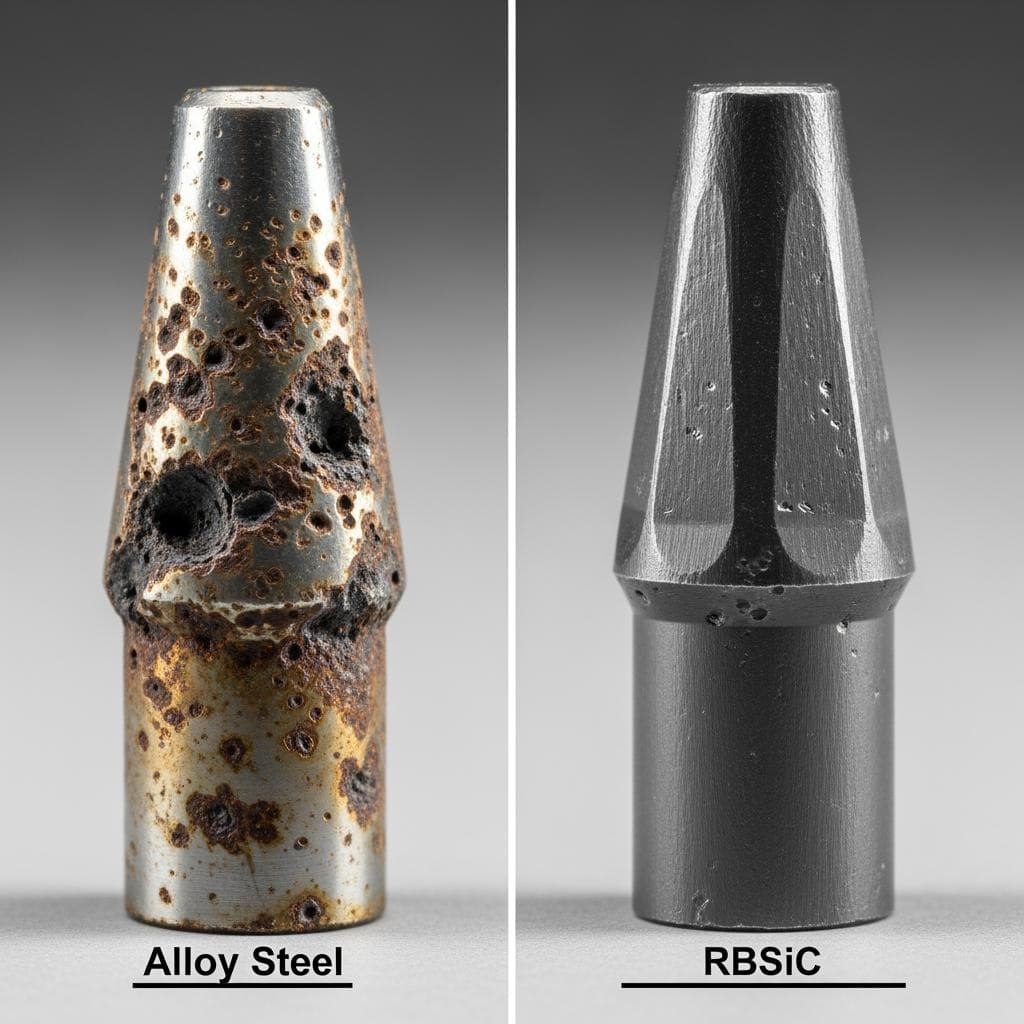
In a steel mill off-gas scrubber near Gauteng, RBSiC hollow-cone nozzles replaced alloy steel units that suffered pitting in acid condensates and rapid edge wear due to scale-laden water. The SiC design incorporated a reinforced impact-pin and a smooth, polished internal bore. Over 14 months, droplet sizing remained within specification, and blockages declined as the smoother SiC passages resisted buildup. The maintenance supervisor reported a halving of nozzle-related outages, allowing the plant to meet tighter emission targets without aggressive chemical dosing.
Automotive paint shop VOC scrubbers in the Eastern Cape adopted compact SSiC misting nozzles to stabilize fine droplet generation for gas absorption. Despite lower thermal loads, solvent carryover and cleaning cycles had damaged polymer nozzles, altering spray patterns. With SiC, the line achieved longer intervals between cleanings and more uniform mass transfer, reducing rework in paint curing due to improved air handling stability.
Technical advantages and implementation benefits with South African compliance
From a process standpoint, SiC nozzles preserve hydraulic consistency over long service periods. Because internal surfaces resist abrasion and corrosion, pressure drop and flow rate curves remain close to design, which stabilizes droplet size and cone geometry. In practice, this reduces the need to overdesign L/G to compensate for unknown drift. Additionally, high thermal shock resistance prevents microcracking during hot restarts—a recurrent feature of South African power operations where grid demands induce frequent cycling. By retaining geometry, SiC nozzles help keep SO₂ removal within the MES thresholds with less reagent variability.
Regarding compliance, stable sprays aid proof of performance under NEMA:AQA enforcement and stack testing. Documentation packages from Sicarbtech include material certificates, dimensional inspection reports, and traceability records that feed directly into ISO 9001 and ISO 14001 systems. Moreover, lower spray drift and more even droplet distribution reduce wall wetting and slurry carryover, contributing to downstream mist eliminator longevity and lower particulate emissions—benefits that support routine compliance audits and limit exceedance events.
From an O&M perspective, longer maintenance intervals translate into fewer scaffold builds and safer work planning. Plants can align nozzle inspection cycles with major absorber or fan overhauls, reducing emergent work that strains budgets. Considering the Rand’s exposure to international currency swings, a lower frequency of imported nozzle purchases helps stabilise OPEX. In short, SiC nozzles are not only a technical upgrade but also a hedge against cost volatility.
Application-focused selection matrix for South African industries
Descriptive title: Recommended SiC grades and nozzle architectures for local applications
| Application | Dominant stressors | Recommended SiC grade | Typical spray pattern | Measured/expected benefit |
|---|---|---|---|---|
| Coal-fired FGD absorber (Mpumalanga) | Chlorides + abrasion + thermal ramps | SSiC or RBSiC | Full cone 60–120° | 5–7% reagent reduction at stable SO₂ removal |
| Steel off-gas wet scrubber | Scale-laden water + acid condensate | RBSiC (SiSiC) | Hollow cone 60–90° | >12 months geometry stability, fewer blockages |
| Automotive VOC scrubbers | Solvent exposure + fine mist stability | SSiC | Fine mist/full cone | Longer cleaning interval, tighter SMD control |
| Mining process gas scrubbing | Dust/abrasion + variable loads | R‑SiC | Full cone robust throat | Extended service life through ramp cycles |
Custom Manufacturing and Technology Transfer Services: Sicarbtech’s turnkey advantage
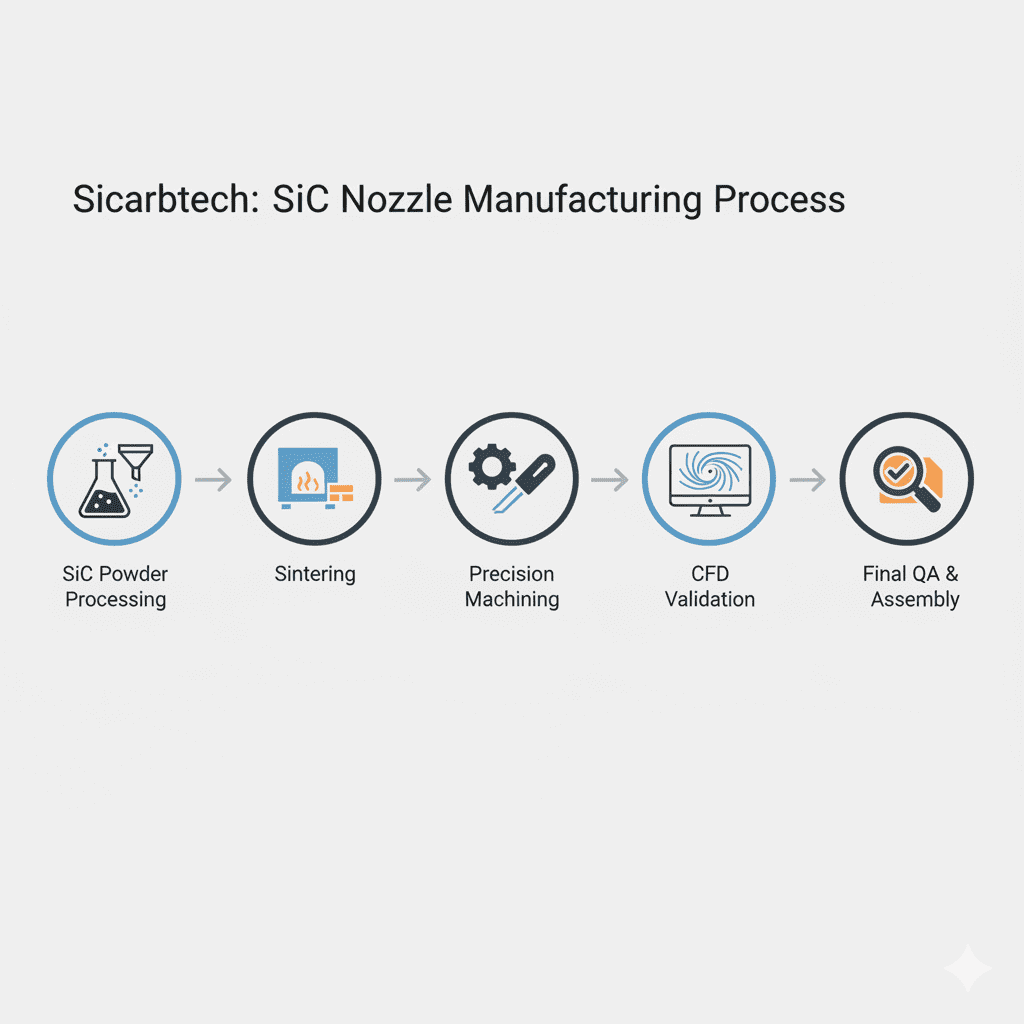
What truly differentiates Sicarbtech in South Africa is the company’s ability to combine advanced R&D with practical deployment pathways. Backed by its partnership within the Chinese Academy of Sciences (Weifang) Innovation Park, Sicarbtech controls the SiC value chain, from powder formulation and sintering profiles to final machining and surface finishing. Proprietary processes for R‑SiC, SSiC, RBSiC, and SiSiC enable ultra-low porosity, consistent grain structures, and tight dimensional tolerances that preserve CFD-derived hydraulic geometry in the finished nozzle.
For utilities and industrial clients seeking local capability, Sicarbtech offers comprehensive technology transfer packages. These include process know-how (powder prep, binder systems, sintering curves), equipment specifications for kilns, mixers, cold isostatic presses, and inspection rigs, as well as operator and engineer training curricula. Quality control frameworks come bundled with test plans, acceptance criteria, and documentation templates aligned to ISO 9001 and environmental management standards. Moreover, Sicarbtech supports feasibility studies, plant layout, commissioning, and ramp-up, ensuring that a greenfield or brownfield site reaches repeatable quality without the typical trial-and-error pitfalls.
Ongoing technical support completes the loop. Field data feeds back into geometry refinements and microstructure tweaks; maintenance observations inform anti-fouling surface finishes; and troubleshooting during seasonal load changes helps lock in performance. This long-term partnership model is evidenced by outcomes across more than 19 enterprises, with measurable gains in absorber efficiency and reductions in nozzle-related downtime. “Turnkey isn’t a buzzword for us,” says a Sicarbtech program manager. “It’s a structured package of people, processes, and hardware that gets you to stable production—and keeps you there.”
Future market opportunities and 2025+ trends: efficiency, resilience, and localisation
Looking ahead, three interlocking trends will shape scrubber nozzle adoption in South Africa. First, the drive for reliable baseload power will coexist with cycling operations, as plants balance variable renewable inputs and grid constraints. Nozzle materials must therefore tolerate frequent temperature transients without loss of geometry. Second, tighter MES enforcement and stakeholder scrutiny will elevate the value of stable atomization—especially as water conservation pushes operators toward reclaimed water with higher chloride and solids content. Third, localisation initiatives and the need to buffer exchange-rate risk will favour suppliers who can provide technology transfer and local manufacturing pathways.
Digitization will reinforce these trends. Plants are deploying online monitoring of differential pressure, spray zone temperatures, and even machine vision to infer spray quality indirectly. SiC nozzles that hold geometry make such analytics more reliable, allowing operators to correlate operating conditions with performance instead of fighting the noise of component degradation. Moreover, as carbon and emissions reporting becomes more sophisticated, the OPEX savings from reduced pump power and reagent consumption will be captured as hard metrics, further validating the business case for SiC.
In the steel and automotive sectors, decarbonisation roadmaps include higher recycling rates and cleaner process off-gases, where robust wet scrubbing plays a supportive role. SiC nozzles, with their chemical and thermal resilience, provide a stable backbone for these transitions. As supply chains mature, Sicarbtech’s ability to seed local production capacity through technology transfer can unlock faster turnaround times and tailored designs for site-specific constraints.
Total cost and performance clarity for South African operators
Descriptive title: Five-year TCO and performance impacts of SiC scrubber nozzles
| Criterion | Sicarbtech SiC nozzles | Conventional metal/polymer nozzles | 5-year effect (ZAR) | Compliance and O&M notes |
|---|---|---|---|---|
| Service life and changeout frequency | 2–4× longer intervals | Frequent replacements | −20–35% TCO | Fewer outages support MES compliance |
| Reagent and water usage | Optimized L/G, stable SMD | Overdosing to compensate wear | −3–8% reagent cost | Supports consistent SO₂ capture |
| Pumping energy | Lower due to stable hydraulics | Higher from drift and fouling | −2–5% energy cost | Reduces auxiliary load |
| Inventory and logistics | Predictable planning | Emergency spares | −10–15% logistics | Mitigates FX exposure |
| Safety and access | Less frequent scaffold work | More work-at-height events | Tangible HSE gains | Aligns with ISO 45001 practices |
Frequently asked questions
Which SiC grade should I choose for a high-chloride FGD absorber?
For chloride-rich and abrasive slurries, SSiC or RBSiC (SiSiC) are typically preferred. SSiC offers ultra-low porosity and outstanding corrosion resistance, while RBSiC provides high strength and dimensional stability under cycling. A site survey and slurry analysis help refine the choice.
Can SiC nozzles retrofit into my existing spray headers?
Yes. Sicarbtech engineers match thread types, flange interfaces, and insertion lengths to existing header layouts. Where needed, adapter sleeves and gaskets are provided to maintain sealing and proper spray plane positioning.
How do SiC nozzles impact SO₂ capture efficiency?
By maintaining droplet size distribution and cone geometry, SiC nozzles enable more uniform gas–liquid contact. Plants often reduce L/G and reagent feed while sustaining or improving removal efficiency, especially after 6–12 months when conventional nozzles would typically drift.
What inspection intervals are recommended in South African service?
Most sites align inspection with major absorber maintenance, typically 12–18 months. Visual checks, pressure drop verification, and occasional SMD testing establish whether nozzles can run another cycle without changeout.
Are there local standards or regulations affecting nozzle choice?
While material standards are project-specific, compliance with NEMA:AQA MES and integration with ISO 9001/14001 systems are common client requirements. Stable nozzle performance simplifies stack testing and audit readiness.
Do SiC nozzles handle thermal shocks during hot restarts?
Yes. R‑SiC and RBSiC grades show excellent thermal shock tolerance, resisting microcracking during rapid temperature changes common in cycling operations.
Can Sicarbtech support local manufacturing or assembly?
Sicarbtech provides full technology transfer—from process know-how and equipment specifications to training and QC frameworks—and can assist in setting up local facilities, including commissioning and ramp-up.
What about spare parts lead times and currency risks?
By planning changeouts on longer intervals and leveraging localised stock or technology transfer, plants reduce exposure to FX volatility and emergency airfreight. Contracted supply programs further stabilise timelines.
How do SiC nozzles affect downstream mist eliminators?
More uniform droplet generation reduces carryover and wall wetting, extending demister life and lowering pressure drop increases over time.
Are custom spray patterns and SMD targets available?
Absolutely. Through CFD and prototyping, Sicarbtech tunes swirl elements and throats to hit defined SMD targets and cone angles aligned with absorber geometry and process KPIs.
Making the right choice for your operations
Selecting scrubber nozzles is ultimately about controlling risk and unlocking predictable performance. In South Africa’s operating reality—cycling loads, chloride-heavy slurries, and stringent emission standards—Sicarbtech’s SiC nozzles deliver durability and hydraulic stability that directly translate to SO₂ compliance and lower TCO. When paired with engineering support and, where strategic, technology transfer, the result is a resilient, locally relevant solution that keeps absorbers performing and plants dispatching.
Get expert consultation and custom solutions
If nozzle wear, drifting droplet sizes, or frequent changeouts are eroding your compliance margins and budget, it’s time for a technical review. Sicarbtech’s engineering team will evaluate slurry chemistry, temperature profiles, and absorber geometry, then propose an SiC nozzle configuration—SSiC, RBSiC, SiSiC, or R‑SiC—tailored to your KPIs. From CFD-backed design and prototyping to commissioning support and ongoing optimization, we provide a clear path to stable emission control and reduced OPEX.
Contact Sicarbtech:
[email protected] | +86 133 6536 0038
Article metadata
Last updated: 2025-12-26
Next scheduled review: 2026-03-31
Content freshness indicators: incorporates 2025 MES compliance context, South African market conditions, recent case observations, and SiC technology advances
Author: Sicarbtech Technical Team — Silicon Carbide Solutions Expert
Technology base: Weifang City, China (SiC manufacturing hub), member of Chinese Academy of Sciences (Weifang) Innovation Park
Sicarbtech: delivering advanced silicon carbide nozzle engineering, comprehensive application support, and technology transfer to power South Africa’s cleaner, more reliable generation and industrial emissions control.

About the Author – Mr.Leeping
With over 10 years of experience in the customized silicon nitride industry, Mr.Leeping has contributed to 100+ domestic and international projects, including silicon carbide product customization, turnkey factory solutions, training programs, and equipment design. Having authored more than 600 industry-focused articles, Mr.Leeping brings deep expertise and insights to the field.
Customizable
successful cases

Related Post
-
South Africa’s Export Fumigation and Packing Compliance
Executive summary: Navigating 2025 export compliance with silicon carbide durability, precision, and traceability South African manufacturers and exporters are entering 2025 under sharper scrutiny from global buyers and port authorities. ISPM 15 heat treatment for wood packaging, phytosanitary compliance for agricultural shipments, and tight labeling/documentation rules are now inseparable from on-time delivery and cost control….
-

Reducing Fuel Consumption with Advanced Combustion Air Preheaters
Executive summary: why silicon carbide air preheaters matter for South Africa’s 2025 energy reality South Africa enters 2025 with a dual imperative: secure affordable energy amid grid instability and advance emissions reductions without compromising industrial output. Mining smelters, steel reheat and annealing lines, and automotive paint curing and heat treatment furnaces are all energy-intensive, gas-…
-
Complete Guide to IMDS Submission Support for South African Suppliers
Executive summary: 2025 outlook for IMDS compliance in South Africa’s automotive ecosystem As South Africa’s automotive value chain accelerates integration with global OEM platforms, IMDS (International Material Data System) compliance has shifted from a back-office task to a strategic capability. In 2025, tighter material reporting expectations from European and Asian OEMs, fast-moving substance regulations, and…