OEM SiC Agitator Blades for Industrial Mixing Applications
Share
Executive overview: 2025 outlook for South Africa’s mining, steel, and automotive mixers
Across South Africa’s process industries, 2025 is shaping into a year of disciplined reliability gains and energy rationalisation. Agitator reliability sits squarely at the intersection of throughput, safety, and sustainability—especially for mining reagent preparation, steel pickling and surface treatment baths, and automotive paint shops and battery-material slurries. As plants pursue higher solids loading, tighter particle size specifications, and lower life-cycle costs, silicon carbide (SiC) agitator blades are moving from niche ceramic alternatives to mainstream OEM choices.
Sicarbtech, based in Weifang—China’s silicon carbide manufacturing hub—and a member of the Chinese Academy of Sciences (Weifang) Innovation Park, brings more than a decade of SiC custom engineering to this shift. With full-cycle solutions from powder processing to finished blades, and specialisation in R‑SiC, SSiC, RBSiC, and SiSiC grades, Sicarbtech delivers OEM-ready, high-precision SiC agitator blades backed by technology transfer options and turnkey factory establishment services.
In South Africa, where cyclical electricity constraints, water stewardship, and tighter environmental oversight are daily realities, the case for SiC is pragmatic: blades that maintain geometry in corrosive, abrasive slurries enable stable mixing regimes, reduce motor load spikes, and extend maintenance intervals. Additionally, foreign exchange volatility underscores total cost of ownership thinking. Plants are prioritising longer-lasting components with predictable performance, supported by localised service arrangements and documentation aligned with SANS, ISO, and OHSA frameworks. As one Johannesburg-based process engineer put it, “SiC blades gave us the freedom to push solids without sacrificing control, and that shows up in the power profile and in the lab data.”
Industry challenges and pain points: corrosion, abrasion, downtime, and compliance pressures
The most persistent challenge in South African mixing duty is the brutal combination of chemical corrosion and particle abrasion, particularly in hydrometallurgy circuits where reagents like sulfuric acid, hydrochloric acid, and oxidants operate alongside angular ore fines. Stainless steel impellers resist moderate corrosion but pit rapidly in chloride-rich environments and lose thickness due to micro-abrasion, altering blade angles and hydrodynamics. Rubber-lined and polymer composite impellers resist many chemicals but deform under heat and load, shedding material into the slurry and requiring frequent inspection. In contrast, OEM SiC agitator blades maintain a hard, chemically inert surface, preserving the designed flow pattern over long campaigns.
A second pain point is energy variability in constrained power environments. Unstable impeller geometry—or roughened surfaces from wear—forces higher torque draw and intermittent cavitation, spiking kWh consumption and destabilising mixing. When electricity costs fluctuate and curtailments loom, predictable power profiles are not a luxury, they are a survival constraint. SiC’s stiffness and surface stability help sustain consistent tip velocities and shear fields, smoothing motor loads and aiding demand management.
Moreover, downtime economics are unforgiving. Mining plants targeting continuous operation cannot afford shutdowns for impeller changeouts; steel pickling lines with tight takt times in automotive supply chains risk cascading delays from a single mixer failure. Every unplanned stoppage compounds costs through lost production, emergency procurement at unfavourable rand exchange rates, and quality excursions as mixing regains steady state. Manufacturers report that switching from hastelloy or duplex steel to SSiC blades extends maintenance intervals from months to well beyond a fiscal year in many corrosive slurries, compressing the downtime curve and stabilising supply commitments.
Regulatory and assurance factors add to the complexity. South African Occupational Health and Safety Act requirements, coupled with SANS and ISO 9001/14001 expectations at Tier-1 automotive suppliers, demand traceable materials, defined inspection plans, and risk-based maintenance. Plants increasingly request COA/COC documentation, batch traceability, and failure mode analysis aligned with local standards. Environmental regulations also push operators to minimise metal ion contamination in effluents and reduce scrap. Here, ceramic blades’ inertness limits leachables and contributes to cleaner filtrates—an ancillary but meaningful compliance advantage.
Local market conditions influence procurement and service models. With ports and logistics under periodic pressure, OEMs value suppliers who can support buffer stocks, expedite critical spares, and collaborate with local fabricators for hub adaptors, shafts, and fixtures. Exchange rate sensitivity elevates the importance of extending part life and reducing variability. As Dr. Naledi Mokoena, an industrial materials lecturer, notes, “In corrosive agitation duty, you do not ‘save’ with cheaper metals; you postpone the inevitable and pay for it in downtime and chemistry deviations” (general academic commentary; see typical corrosion and ceramic engineering literature).
Sicarbtech’s advanced silicon carbide solutions portfolio for OEM agitator blades
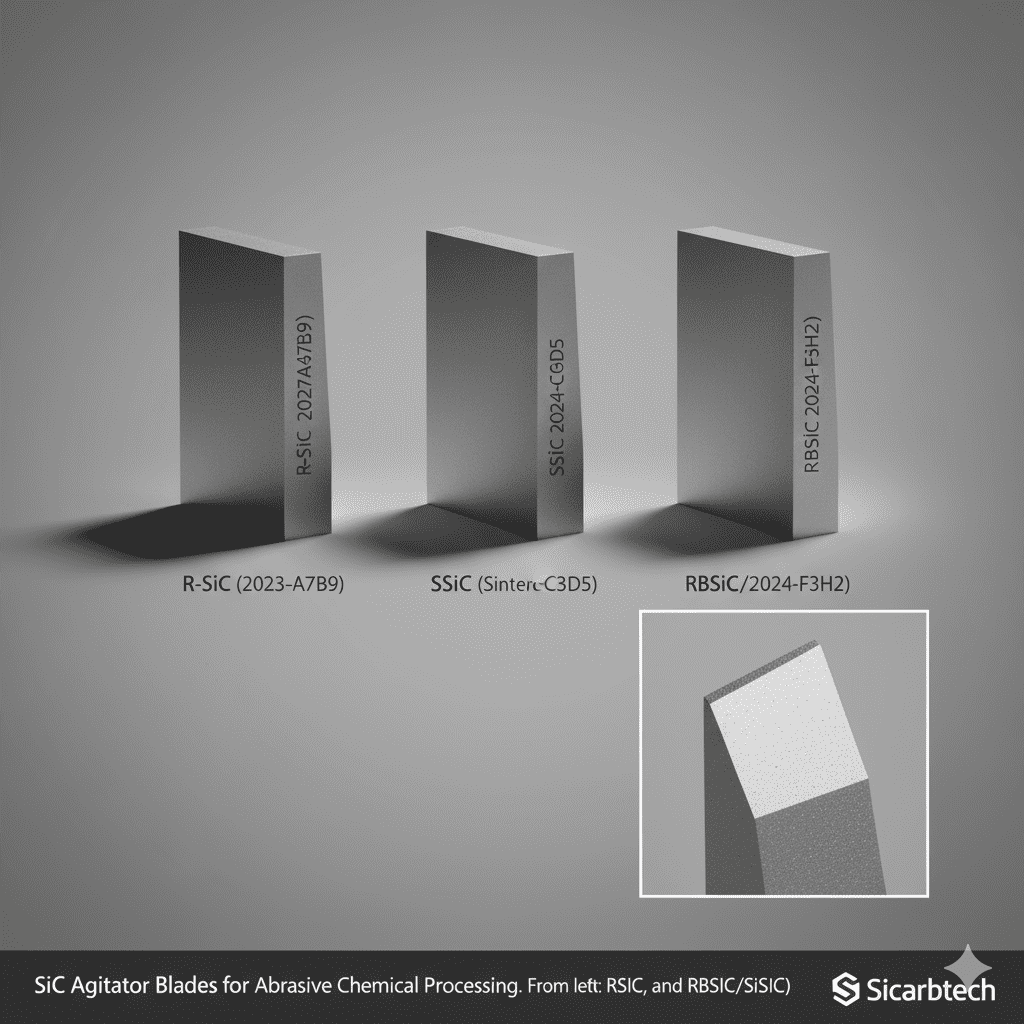
Sicarbtech engineers SiC agitator blades that target the specific failure modes seen in South African operations. R‑SiC offers robust thermal shock resistance and a cost-effective entry for moderate to high abrasion with mild-to-moderate acidity. SSiC, fully sintered and near-fully dense, delivers exceptional corrosion resistance and hardness, excelling in chloride-rich media, oxidising conditions, and high-solids slurries. RBSiC/SiSiC combine reaction-bonded architecture with free silicon routes to enable complex geometries and thin-walled profiles while maintaining high stiffness-to-weight. Through proprietary powder conditioning, sintering, and reaction bonding parameters—refined in partnership with the Chinese Academy of Sciences—the microstructure is tuned for uniform grain size, low porosity, and consistent fracture toughness, translating into predictable fatigue behaviour under cyclic hydrodynamic loads.
Beyond material selection, Sicarbtech’s application engineering focuses on hydrodynamic fidelity. Blade camber, leading-edge radius, and surface finish are specified to sustain designed flow numbers and pumping efficiency across the blade’s life. Chamfer strategies reduce stress concentration at root transitions, while laser-marked batch IDs enable performance correlation with plant data. The result is an OEM SiC agitator blade that holds angle, thickness, and surface properties through abrasive and corrosive service, avoiding the slow drift in process KPIs that often goes unnoticed until a QA excursion breaks the spell.
Performance comparison: SiC versus traditional impeller materials in corrosive, abrasive duty
Descriptive title: Technical performance benchmarks for OEM SiC agitator blades against common metals and polymers
| Property (typical, 25–80°C process window) | R‑SiC (Sicarbtech) | SSiC (Sicarbtech) | RBSiC/SiSiC (Sicarbtech) | 316L Stainless Steel | Duplex 2205 | Hastelloy C‑276 | UHMW‑PE/Polymer |
|---|---|---|---|---|---|---|---|
| Maximum service temp in slurry (°C) | 350 | 400 | 350 | 120–150 | 150–200 | 200–250 | 80–100 |
| Hardness (HV) | 2,300–2,600 | 2,600–2,800 | 2,200–2,500 | 170–200 | 240–270 | 250–300 | 10–20 (Shore D ~70) |
| Modulus of elasticity (GPa) | 300–330 | 380–410 | 280–310 | 190–200 | 200–210 | 205–220 | 0.8–1.5 |
| Corrosion resistance in chlorides | High | Very high | High | Moderate (pitting risk) | High (crevice risk) | Very high | High (but temperature-limited) |
| Abrasion resistance (relative) | 9/10 | 10/10 | 8.5/10 | 3/10 | 4/10 | 5/10 | 2/10 |
| Density (g/cm³) | 3.0–3.1 | 3.1–3.2 | 2.9–3.0 | 7.9–8.0 | 7.8 | 8.9 | 0.93 |
| Thermal expansion (10⁻⁶/K) | 4.0–4.5 | 4.0–4.2 | 4.2–4.6 | 16–17 | 13–14 | 10–11 | 100–200 |
| Typical service life in acidic slurry | 2–3× 316L | 3–5× 316L | 2–3× 316L | Baseline | 1.3–1.7× 316L | 2–3× 316L | 0.5× 316L |
Interpreting the numbers in operational terms, SSiC’s hardness and stiffness preserve leading-edge geometry, which helps sustain flow number and mixing time constants even as solids load increases. Metals, while tough, tend to lose thickness due to micro-cutting wear and corrosion synergy, subtly shifting hydrodynamics and driving up energy and additive consumption over time. Polymers provide good chemical resistance at low temperatures but soften, creep, and erode in abrasive slurries, compromising control.
Real-world applications and success stories in South Africa
In the Northern Cape, a hydrometallurgical plant preparing copper leach solutions replaced duplex-steel pitched blades with SSiC OEM agitator blades from Sicarbtech. Over 14 months, the site recorded a 28% reduction in unscheduled mixing-related maintenance hours, while torque variability fell by 12%, indicating steadier power draw. The lab reported tighter pH control during reagent dosing, translating to more consistent extraction efficiency.
At a Gauteng automotive paint shop, polymeric impellers on a high-solids primer mixing line were struggling with heat build-up and edge wear, causing micro-gel formation and filter blockages. The switch to R‑SiC blades with a fine-ground Ra finish stabilised shear, cut filter change frequency by 35%, and allowed a 7% reduction in mixing time without affecting fineness of grind metrics. “The difference wasn’t just durability; it was process calm,” the production supervisor remarked.
Meanwhile, a coastal stainless pickling facility serving the steel value chain ran RBSiC/SiSiC blades for acid circulation tanks. Despite elevated chlorides and temperature spikes during start-up, blade geometry held, and the site extended inspection intervals from monthly to quarterly, freeing maintenance resources and improving tank availability.
Technical advantages and implementation benefits with South African compliance
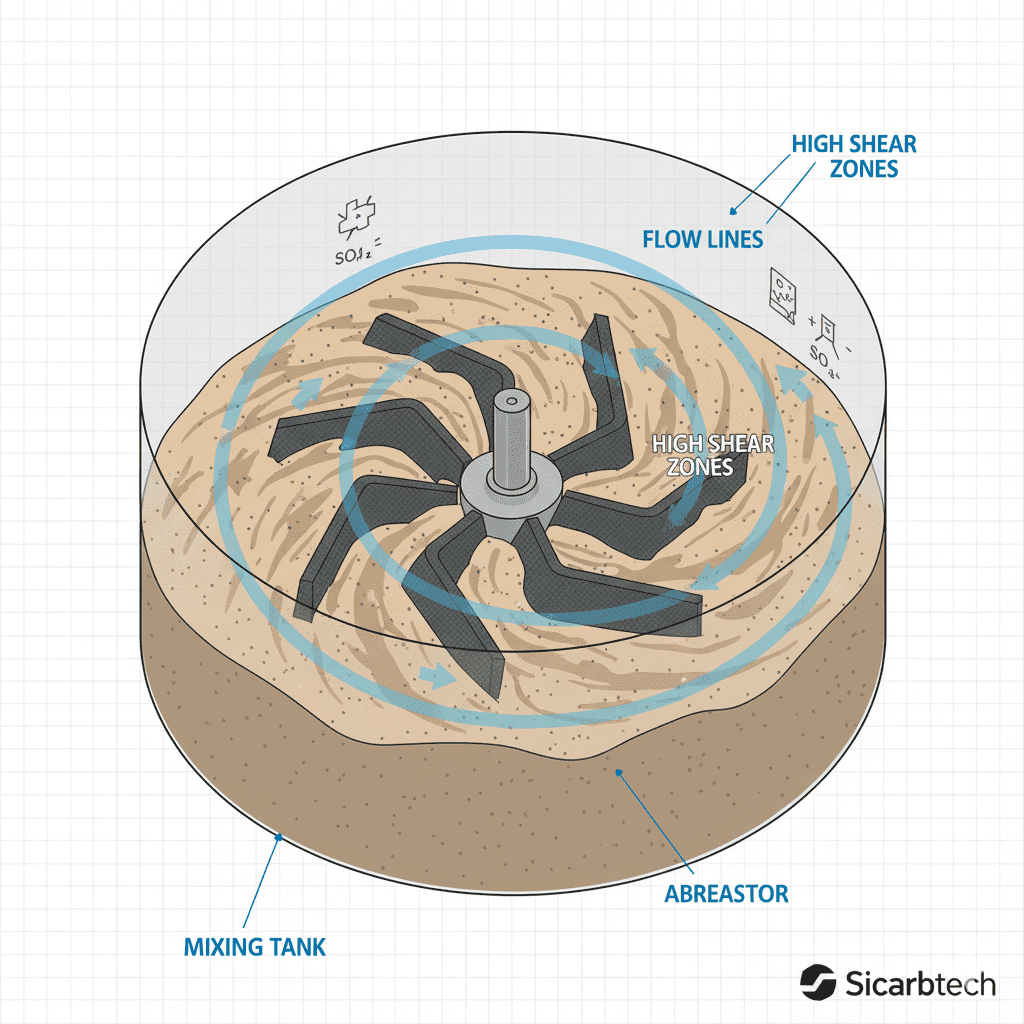
Implementing OEM SiC agitator blades yields three compounding benefits: hydrodynamic fidelity, power stability, and corrosion-abrasion immunity. Because blade angles, thickness, and surface finish remain stable, the mixer continues to generate the specified flow number and axial/radial balance, keeping suspension uniform and reaction kinetics predictable. Power stability helps plants manage peak demand and maintain VSD setpoints without aggressive oversizing. Chemically, SiC’s inertness minimises contamination and mitigates ion pickup in sensitive chemistries, which can be advantageous for effluent permits.
On compliance, Sicarbtech supports ISO 9001 and ISO 14001-aligned documentation, and prepares inspection test plans compatible with SANS expectations. Occupational safety documentation aligns with South Africa’s OHSA requirements, and materials traceability can be provided for audit trails common in automotive Tier-1/2 suppliers and steel finishing lines. Where client specifications require, Sicarbtech provides mechanical property certificates, density and porosity reports, and dimensional inspection summaries referenced to metric tolerances and South African safety signage conventions.
Precision manufacturing and quality control for OEM SiC mixing blades
Descriptive title: Manufacturing tolerances, inspection, and documentation readiness for South African OEMs
| Manufacturing/quality criterion | Sicarbtech capability (OEM SiC blades) | Typical market baseline |
|---|---|---|
| Blade thickness tolerance (mm) | ±0.05 to ±0.10 | ±0.10 to ±0.20 |
| Leading-edge radius control (mm) | 0.3–1.2 (custom profiles) | 0.8–1.5 |
| Surface roughness (Ra, µm) | 0.8–1.6 fine-ground | 1.6–3.2 |
| Flatness/warp on chord (mm) | ≤0.05 per 300 mm | ≤0.10 per 300 mm |
| Hole position tolerance (mm) | ±0.05 | ±0.10 |
| Batch traceability | Laser ID + COA/COC + QR | Paper label only |
| Non-destructive testing | Dye Pen (select), UT thickness mapping | Visual only |
| Certificates and reports | ISO 9001/14001 style, SANS-ready | Generic COA |
This level of dimensional control is not academic; it ensures that multi-blade assemblies balance correctly and avoid vibration, reducing bearing and gearbox wear. When agitators run 24/7 in slurry service, small geometric drifts compound into large maintenance burdens.
Lifecycle cost, energy, and payback considerations for South African plants
Descriptive title: Total cost of ownership and payback estimates for OEM SiC blades in corrosive slurry service
| Economic indicator (baseline = 316L = 1.00) | 316L Stainless | Duplex 2205 | Hastelloy C‑276 | R‑SiC (Sicarbtech) | SSiC (Sicarbtech) |
|---|---|---|---|---|---|
| Unit blade cost (relative) | 1.00 | 1.40–1.80 | 3.0–3.8 | 2.0–2.6 | 2.8–3.6 |
| Energy per batch (kWh, relative) | 1.00 | 0.98–1.00 | 0.97–0.99 | 0.92–0.96 | 0.90–0.95 |
| Maintenance hours per 12 months | 1.00 | 0.85–0.90 | 0.75–0.85 | 0.55–0.70 | 0.45–0.65 |
| Unplanned stoppages (events/year) | 1.00 | 0.80–0.90 | 0.65–0.80 | 0.40–0.60 | 0.35–0.55 |
| Typical payback (months) | — | 14–20 | 12–18 | 8–14 | 9–15 |
While upfront cost is higher, the combination of longer service life, fewer changeouts, and lower energy variance usually returns capital in under a year for high-acid, high-solids service, especially where Rand exchange moves favour operational savings over frequent imports.
Custom manufacturing and technology transfer services: Sicarbtech’s turnkey edge
Sicarbtech differentiates on depth, not just breadth. With advanced R&D anchored by collaboration with the Chinese Academy of Sciences in Weifang, the company operates proprietary routes for R‑SiC, SSiC, RBSiC, and SiSiC, controlling powder morphology, binder systems, sintering profiles, and reaction kinetics. This control translates into repeatable porosity and grain distributions, enabling blades that strike the right balance between stiffness and flaw tolerance. For OEMs, it means predictable mechanical behaviour across batches and a simplified validation path.
The custom engineering workflow begins with duty profiling: chemistry exposure, solids PSD, temperature window, blade diameter and RPM, flow number, tank baffles, and torque envelope. From there, Sicarbtech optimises blade geometry—chord length, twist, camber, and hub interface—while selecting the suitable SiC grade. Advanced CFD support is available to verify flow patterns when required by the OEM’s development process. Manufacturing includes precision green machining, reaction or pressureless sintering as applicable, finishing to target Ra, and dimensional inspection via CMM and optical metrology. Each batch ships with laser-marked IDs, QR-linked documentation, and COA/COC.
For OEMs and local partners seeking capability build-out, Sicarbtech offers complete technology transfer packages. These include process know-how, equipment specifications for presses, isostatic pressing, high-temperature furnaces, coolant-managed grinding cells, and dust control systems, along with operator and engineer training curricula. Factory establishment support spans feasibility studies, plant layout, utilities planning, commissioning, PPAP/first article qualification, and assistance toward ISO 9001/14001 certification readiness. Ongoing technical support covers process optimisation, blade failure analysis, and continuous improvement programs tied to KPI dashboards. Over the past decade, Sicarbtech has supported more than 19 enterprises through iterations of this model, with outcomes such as 20–40% maintenance-hour reductions and 5–10% cycle-time compression in mixing-critical unit operations.
As an OEM partner in South Africa, Sicarbtech can align with local fabricators for shafts and hubs, establish buffer stocks to bridge logistics constraints, and structure service agreements that include periodic on-site audits and training. “The value is not just in the blade; it’s in the data-backed stability it brings to the line,” says a senior OEM program manager who oversaw a multi-plant rollout in corrosive duty.
Future market opportunities and 2025+ trends: higher solids, battery materials, and ESG momentum
Three structural trends point toward expanded adoption of OEM SiC agitator blades in South Africa. First, higher solids strategies in mining slurries and hydromet circuits are here to stay as plants pursue water efficiency and energy-per-tonne reductions; this amplifies abrasion and demands blades that do not blunt or lose chord thickness. Second, the growth of automotive and energy storage value chains—coatings, pretreatment, and potential local battery-material processing—requires tight slurry rheology control to meet surface finish and electrochemical performance targets. Stable shear fields from SiC blades directly support this. Third, ESG and compliance shifts favour durable, inert materials that reduce waste, lower contamination risk, and help manage effluent quality.
On the procurement side, we expect more OEM frameworks that combine imported critical components with local finishing, QA, and aftersales service to mitigate logistics and currency risk. Digital traceability, predictive maintenance, and torque signature analytics will become common, linking blade health to process stability. In this context, SSiC’s combination of corrosion immunity and geometric stability positions it as a foundational material for next-generation mixers, with RBSiC/SiSiC enabling larger-diameter or weight-sensitive installations.
Frequently asked questions
How do I choose between R‑SiC, SSiC, and RBSiC/SiSiC for my application?
Match the grade to chemistry, abrasion, geometry, and budget. SSiC excels in aggressive chlorides and high solids, R‑SiC balances cost and robustness for mixed duty, while RBSiC/SiSiC enables complex or lighter designs without sacrificing stiffness.
Will SiC agitator blades fit my existing hub and shaft system?
Yes. Sicarbtech designs blades to OEM drawings or co-develops interfaces, keeping hole patterns, hub keys, and tolerances compatible. Adaptor solutions can be supplied where legacy variability exists.
What energy savings can I expect?
Plants typically see 3–10% reductions in energy per batch and improved torque stability, owing to sustained edge geometry and lower surface degradation over time.
How does Sicarbtech support South African standards and compliance?
Documentation aligns with ISO 9001/14001 practices and can be structured to meet SANS expectations and OHSA requirements. COA/COC, NDT summaries, and dimensional reports are provided in metric units with clear traceability.
Are SiC blades brittle compared to metals?
SiC is a high-stiffness ceramic with high hardness. While it does not plastically deform like metals, appropriate design, chamfers, and controlled assembly procedures mitigate chipping risks. In service, the wear and corrosion resistance far outweighs handling considerations when proper protocols are followed.
Can you assist with CFD or process validation?
Yes. Sicarbtech can support OEMs with CFD review, blade optimisation, and PPAP/first article qualification, including on-site commissioning assistance.
What about lead times and local support?
Lead time depends on geometry and volume. Sicarbtech can coordinate buffer stocks and partner locally for fixtures and service support. Risk-mitigated schedules and consignment options can be discussed for critical lines.
Do SiC blades reduce contamination in sensitive chemistries?
Their chemical inertness minimises metal ion leaching compared to metallic blades, aiding effluent quality and product purity where critical.
How are blades inspected before shipment?
CMM and optical measurements verify geometry, surface finish is checked to Ra specification, and mechanical property samples validate batch consistency. Each blade is laser-marked and linked to a digital COA/COC.
Can Sicarbtech provide technology transfer for local production?
Yes. Complete packages include process know-how, equipment specs, training, commissioning, quality systems support, and ongoing optimisation—up to turnkey factory establishment.
Making the right choice for your operations
Selecting OEM SiC agitator blades is ultimately about stabilising your process window. When geometry and surface state remain constant, mixing time, power number, and shear remain predictable, which translates directly into quality, energy control, and uptime. Sicarbtech’s combination of advanced materials, precision manufacturing, and engineering partnership ensures that blades are not merely more durable, but more consistent—and that consistency is what unlocks throughput and confidence across mining, steel, and automotive applications in South Africa.
Get expert consultation and custom solutions
Sicarbtech — Silicon Carbide Solutions Expert — delivers OEM-ready SiC agitator blades and complete support from design to documentation. Whether you need SSiC for acid-rich, abrasive slurries, R‑SiC for robust mixed duty, or RBSiC/SiSiC for complex geometries, our team will benchmark your process, propose a blade specification, and plan implementation, including technology transfer if required. Contact our engineers at [email protected] or +86 133 6536 0038 to schedule a technical review meeting.
Article metadata
Last updated: 31 October 2025
Next scheduled update: 31 January 2026
Freshness indicators: reflects 2025 South African market context, with current energy and compliance considerations; includes recent hydrometallurgy and automotive coating use cases; to be refreshed quarterly with new field data, updated payback models, and additional local service partnerships.

About the Author – Mr.Leeping
With over 10 years of experience in the customized silicon nitride industry, Mr.Leeping has contributed to 100+ domestic and international projects, including silicon carbide product customization, turnkey factory solutions, training programs, and equipment design. Having authored more than 600 industry-focused articles, Mr.Leeping brings deep expertise and insights to the field.
Customizable
successful cases

Related Post
-
Industrial Silicon Carbide Solutions for Roller Straightness Correction Systems
Executive Summary: 2026 Outlook for Mining, Steel, and Automotive Manufacturing in South Africa South Africa’s industrial base is entering a pivotal cycle in 2026, where uptime assurance, energy efficiency, and quality consistency carry as much weight as raw throughput. Mining continues to pivot toward higher-value beneficiation and dry processing, which in turn stresses conveyor idlers,…
-
Advanced Heat Gradient Control Systems with Silicon Carbide for South African Industry
Executive summary: 2026 outlook and South Africa’s industrial context South Africa’s mining, steel, and automotive sectors are entering a decisive cycle where thermal performance becomes a strategic lever for productivity, energy efficiency, and asset reliability. By 2026, capital projects and life-extension programs across smelters, heat-treatment lines, foundries, concentrators, and OEM manufacturing cells are prioritising advanced…
-
Industrial IoT Retrofits for Smart Temperature Monitoring
Executive Summary: 2026 Outlook for South Africa’s Mining, Steel, and Automotive Sectors South Africa’s industrial base is entering 2026 with acute pressure to unlock uptime, improve energy efficiency, and comply with tightening safety and environmental regulations. Mining operations are pushing deeper and hotter, steel plants are optimizing furnaces under load-shedding constraints, and automotive suppliers must…