Reducing Fuel Consumption with Advanced Combustion Air Preheaters

Share
Executive summary: why silicon carbide air preheaters matter for South Africa’s 2025 energy reality
South Africa enters 2025 with a dual imperative: secure affordable energy amid grid instability and advance emissions reductions without compromising industrial output. Mining smelters, steel reheat and annealing lines, and automotive paint curing and heat treatment furnaces are all energy-intensive, gas- or coal-fired environments where combustion efficiency is under constant scrutiny. Against a backdrop of variable gas prices, carbon tax trajectories, and pressure to improve energy intensity (GJ/tonne), the most immediate, capex-light savings often come from smarter heat recovery. Preheating combustion air—especially through durable, high-temperature ceramic heat exchangers—improves flame stability, reduces specific fuel consumption, and lowers CO₂ per unit of production.
This is precisely where Sicarbtech’s silicon carbide (SiC) portfolio is transformative. Headquartered in Weifang, China’s SiC manufacturing hub, and a member of the Chinese Academy of Sciences (Weifang) Innovation Park, Sicarbtech brings over ten years of silicon carbide customization, supporting more than nineteen enterprises with advanced SiC technology. The company’s full-cycle capabilities—from material processing to finished products—cover R-SiC, SSiC, RBSiC, and SiSiC components, enabling robust, high-efficiency combustion air preheaters tailored to South African duty cycles. Furthermore, with custom manufacturing, factory establishment services, and turnkey technology transfer, Sicarbtech equips local OEMs, EPCs, and plant owners to deploy and maintain SiC-based preheat solutions that deliver measurable, bankable energy savings.
As Dr. Nomusa Khumalo, an industrial energy auditor, notes, “Every 100 °C of combustion air preheat can reduce fuel consumption by 2–5%, depending on the furnace and excess air. The most sustainable savings come from heat exchangers that actually survive South African dust, fouling, and thermal cycling” (industry commentary; see general references from SAEE forums and industrial efficiency publications).
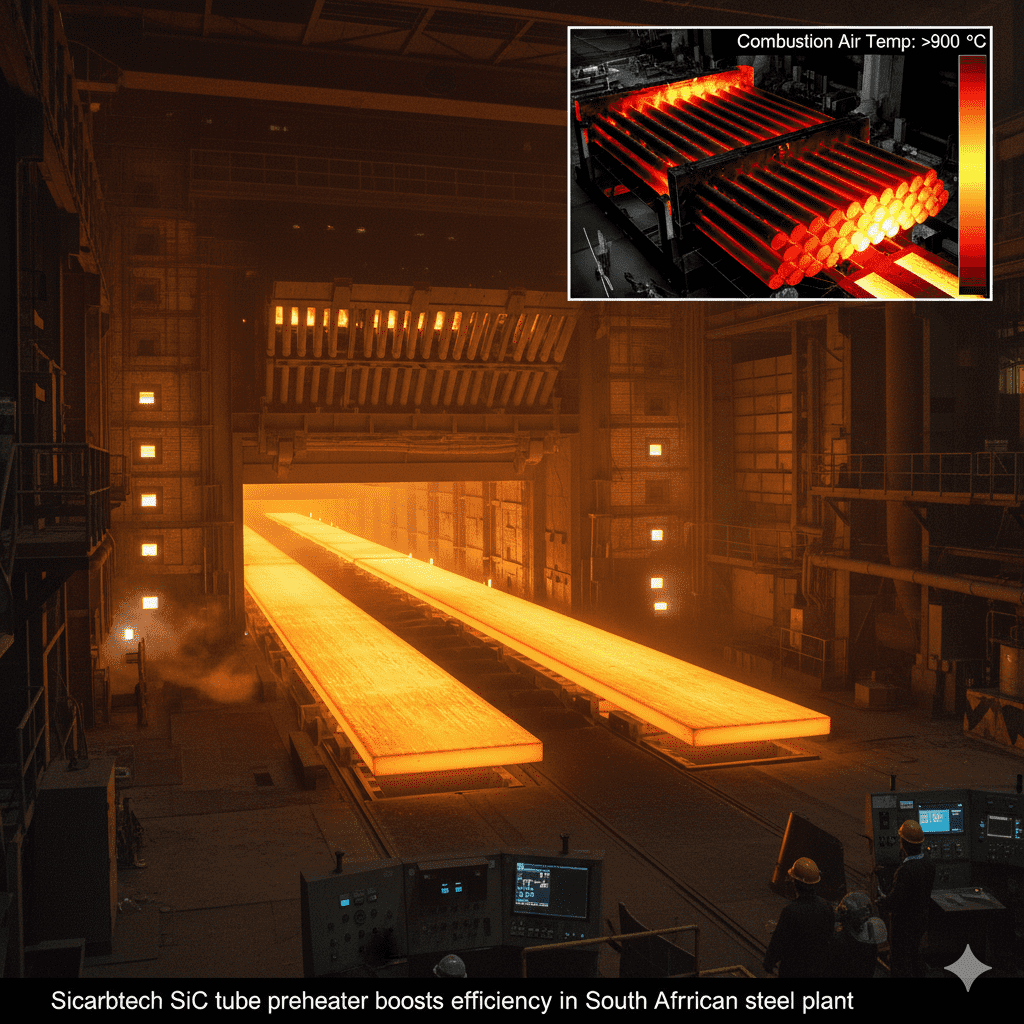
Industry challenges and pain points: the true cost of inefficient combustion in South Africa
While the case for preheating is clear in theory, the South African operational context introduces distinctive challenges. Unstable fuel quality, dust-heavy flue gas from coal and coke combustion, and frequent load changes caused by production scheduling and power interruptions create punishing thermal cycles. Conventional metallic recuperators suffer scaling, creep, and corrosion at temperatures above 800–900 °C, and many plate heat exchangers foul rapidly in dusty exhaust streams. Moreover, older furnaces in mining and steel often run with high excess air to avoid CO formation and maintain stable flames, inadvertently increasing stack losses. Without durable, high-temperature materials and smart flow architectures, preheaters either underperform or become maintenance liabilities.
Cost implications compound quickly. For a mid-size reheat furnace in Gauteng processing several hundred tonnes per day, even a 5–7% fuel saving can equate to millions of rand annually, depending on gas tariffs and carbon tax obligations. When preheaters foul or crack, unplanned shutdowns ripple through production schedules. Procurement teams face currency volatility impacting import costs, while maintenance must balance tight spares budgets against rising lead times. On top of this, compliance pressures are intensifying. The Carbon Tax Act and the associated carbon budgets influence cost-of-ownership calculations for combustion equipment, and local air quality standards push plants to reduce NOx and CO through more controlled combustion—something more feasible when air is preheated and mixing is consistent.
Additionally, South African mining operations, particularly in the Northern Cape and North West provinces, confront airborne particulate and corrosive species in off-gases. These environments punish conventional ceramics that lack adequate thermal shock resistance or mechanical strength. The outcome is a trade-off between heat recovery efficiency and survivability. In automotive, where ovens and paint shops require strict temperature uniformity, downtime is especially costly; any heat recovery retrofit must maintain airflow consistency, cleanliness, and minimal pressure drop, lest it compromise product quality.
In practice, many facilities run preheaters well below their design potential due to fear of thermal shock or fouling, relinquishing fuel savings that could strengthen competitiveness. As Prof. Willem Coetzee, a furnace design specialist, succinctly puts it, “Efficiency gains are useless if the exchanger dies young. Materials science—not just clever ductwork—determines whether a preheater delivers year-on-year savings” (general reference: furnace design symposia and engineering journals).
These pain points converge on a core requirement: a heat exchanger medium that resists thermal shock, maintains high mechanical strength at temperature, tolerates abrasive dust, and offers stable conductivity. Silicon carbide, particularly in its advanced grades such as SSiC and RBSiC, directly addresses this requirement.
Advanced Silicon Carbide Solutions Portfolio: Sicarbtech’s SiC engineered for combustion air preheaters
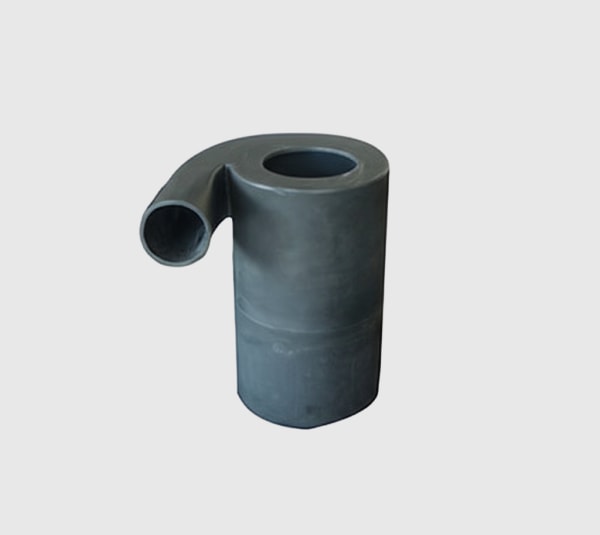
Sicarbtech’s SiC portfolio has been engineered to thrive where metallic recuperators and commodity ceramics fail. For regenerative and recuperative air preheaters in mining, steel, and automotive plants, Sicarbtech deploys combinations of SSiC, RBSiC/SiSiC, and R‑SiC in structured media, honeycomb blocks, finned segments, and tube bundles. The material selection is dictated by exhaust temperature, particulate load, allowable pressure drop, and required preheat delta-T.
SSiC excels in high-temperature, corrosive conditions owing to its near-zero porosity and high mechanical strength, making it ideal for tube bundles and hot-face zones. RBSiC/SiSiC, with silicon-infiltrated matrices, enables complex geometries—thin walls, intricate fins, and honeycomb architectures that increase surface area and heat transfer coefficients without excessive pressure drop. R‑SiC offers exceptional thermal shock resistance, useful in sections exposed to frequent cycling due to load shedding or batch processes. By blending these materials in a single exchanger—hot face in SSiC, mid-zone in RBSiC, cold face in R‑SiC—Sicarbtech delivers durability, efficiency, and maintainability, tuned for South African operating realities.
Furthermore, Sicarbtech’s application engineering team integrates computational fluid dynamics (CFD) and finite element methods (FEM) to balance thermal gradients and mechanical stresses. The result is a preheater architecture that maintains high overall heat transfer coefficients (U-values) while protecting against crack initiation at stress concentrators. This approach has proven particularly effective in steel mill reheat furnaces and ladle preheaters where exhaust gas temperatures can exceed 1000 °C and cycle severity is high.
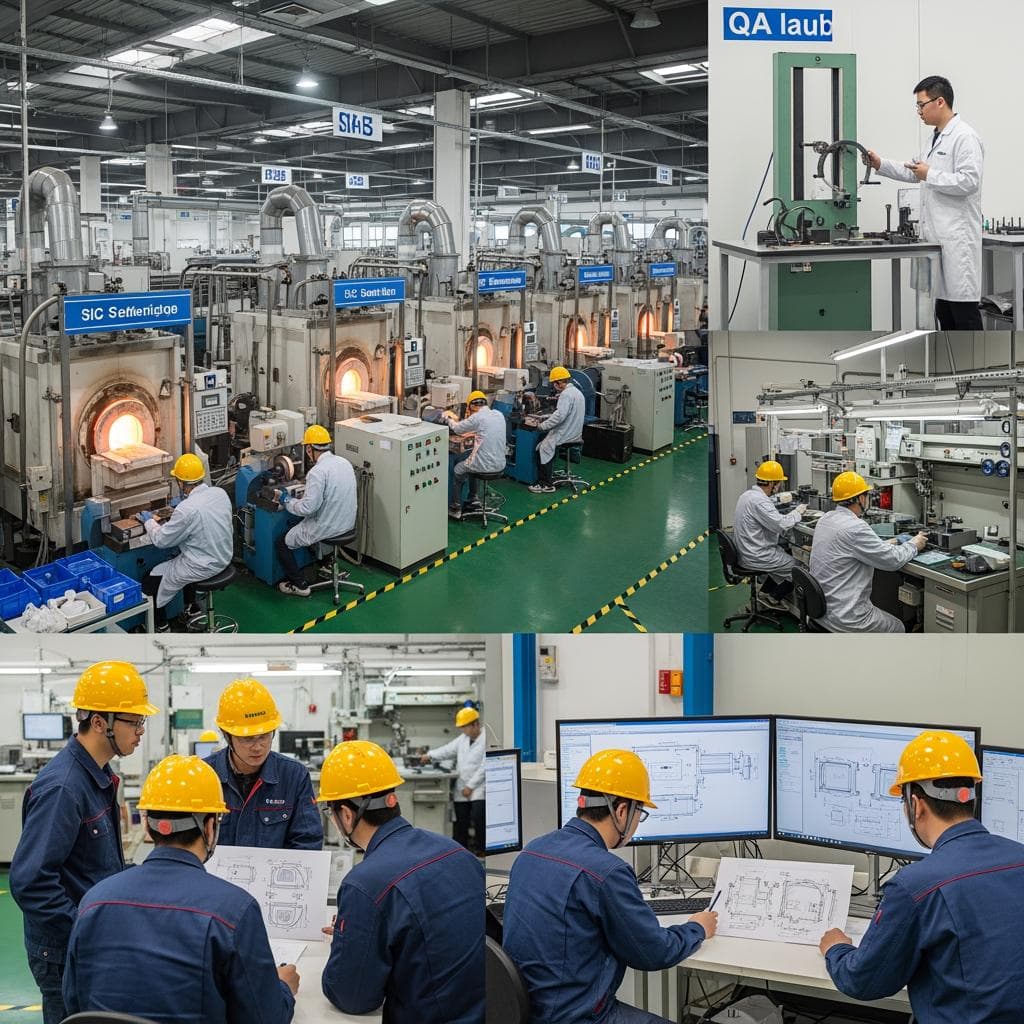
Sicarbtech also supports OEMs and end users with comprehensive technology transfer—process know-how, equipment specifications, tooling design, sintering recipes, QA protocols, and training—allowing local partners to assemble, install, and maintain SiC preheater systems with confidence. In a market where uptime is paramount and technical skills are in short supply, this turnkey model shortens learning curves and anchors performance to measurable KPIs.
Performance comparison for South African duty cycles: SiC vs traditional materials
Title: Material performance characteristics relevant to high-temperature air preheaters in SA industry
| Property (typical ranges) | SSiC (Sicarbtech) | RBSiC/SiSiC (Sicarbtech) | High-temp stainless (e.g., 310/253MA) | Cordierite/Mullite ceramics |
|---|---|---|---|---|
| Max service temp (°C, continuous) | 1350–1600 | 1200–1400 | 900–1100 | 1000–1200 |
| Thermal conductivity (W/m·K @ 25 °C) | 90–160 | 45–120 | 14–20 | 2–4 |
| Thermal shock resistance | Excellent | Very good | Fair | Good |
| Flexural strength at 1000 °C (MPa) | 250–400 | 150–300 | 40–60 | 20–40 |
| Abrasion resistance (dusty flue gas) | Excellent | Very good | Fair | Fair |
| Oxidation/corrosion resistance | Excellent | Very good | Good | Good |
| Density (g/cm³) | 3.0–3.2 | 2.9–3.1 | 7.8–8.0 | 2.2–2.6 |
| Manufacturable complex geometry | Moderate | Excellent | Good | Moderate |
In practice, these differences translate into higher stable preheat temperatures, less fouling from micro-roughness and hardness advantages, and lower lifecycle cost because SiC modules retain integrity through cycles that commonly fatigue metal recuperators.
Real-world applications and success stories in South Africa
In a Northern Cape manganese sinter plant, an RBSiC-based regenerative air preheater replaced a corroded metallic unit that struggled beyond 900 °C. The Sicarbtech solution combined RBSiC honeycomb blocks on the hot side with SSiC transition panels, designed to withstand abrasive dust. Within three months, average combustion air temperature increased by 180–220 °C, delivering a measured 9.4% reduction in natural gas consumption on equivalent throughput. Maintenance interventions dropped from monthly inspections to quarterly visual checks, with no crack propagation observed on borescope inspection.
A Gauteng steel reheat furnace undergoing a decarbonisation audit installed an SSiC tube bundle preheater, integrating a staged flow path to limit pressure drop to under 180 Pa at nominal flow. Despite frequent production ramp-ups and power-related stops, the system maintained stable preheat, cutting specific gas consumption by 7–8% and improving furnace temperature uniformity. “The preheater survived conditions that used to warp our old metallic coils,” commented the plant’s maintenance engineer, “and the thermal response is fast enough to stabilise burners after a restart.”
In the Eastern Cape automotive sector, a paint shop retrofitted compact SiC finned modules into a constrained duct. The design prioritized low pressure drop and cleanability, with access hatches for periodic dust removal. Gas usage decreased by approximately 6%, while oven temperature uniformity remained within tight QA bands required by OEM contracts.
Technical advantages and implementation benefits with local compliance
Beyond raw material properties, Sicarbtech’s SiC preheaters are engineered for the regulatory and safety context of South Africa. Designs consider SANS standards for pressure equipment and ducting, best-practice burner safety interlocks, and integration with plant DCS/SCADA for emissions reporting aligned with local air quality regulations. The ability to achieve complete combustion at lower excess air—a benefit of stable, hotter combustion air—supports reduced CO and NOx formation, contributing to compliance and potentially easing carbon tax burdens over time.
Additionally, the durability of SSiC and RBSiC reduces hot-work interventions and the associated safety risks. Modules are fabricated with precision tolerances to limit bypass leakage, while gaskets and supports are selected for thermal compatibility and longevity. Implementation plans often include staged installation during planned shutdowns, pre-commissioning airflow checks, and thermal mapping to validate claimed efficiency gains.
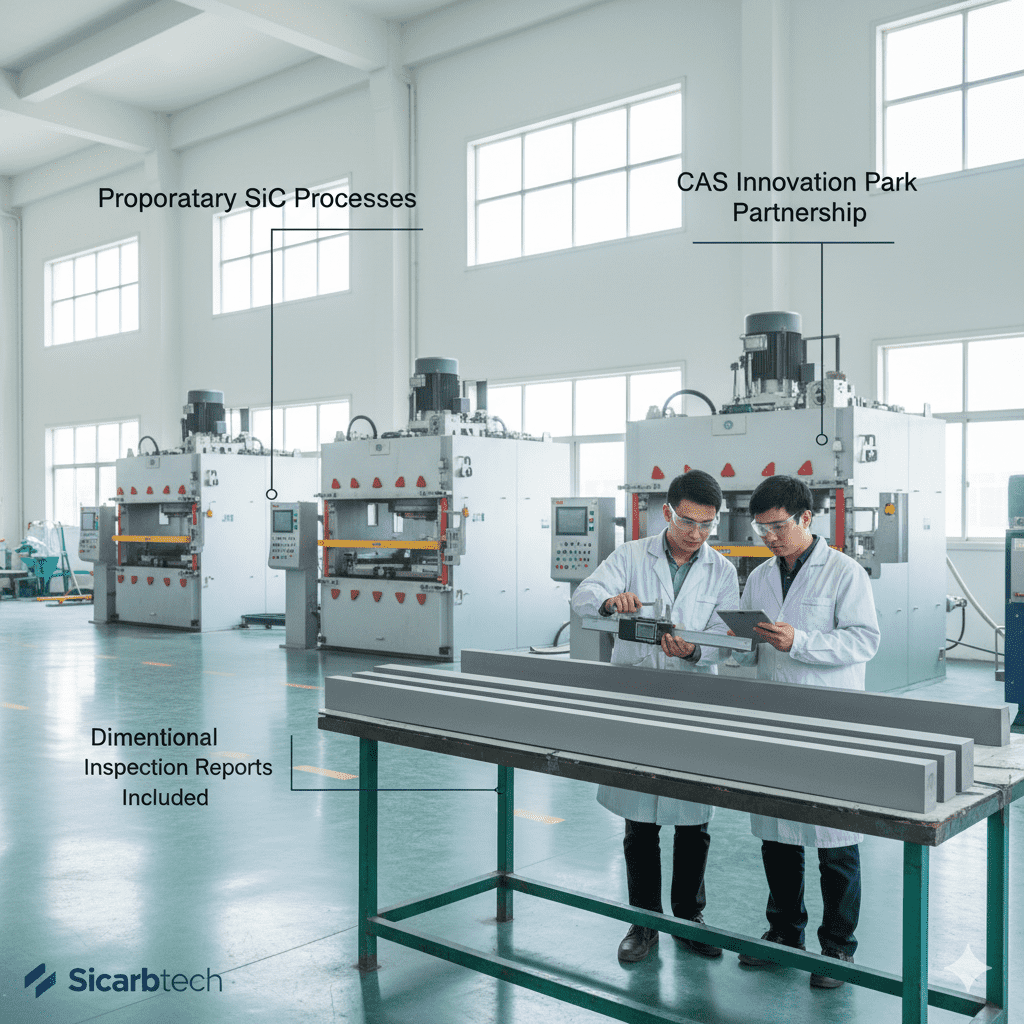
From a quality assurance perspective, Sicarbtech provides material certificates, dimensional inspection reports, and test data. The traceability and documentation support audits by multinational owners and align with ISO 9001-driven procurement processes common among Tier-1 suppliers and listed mining firms in South Africa.
Custom Manufacturing and Technology Transfer Services: Sicarbtech’s turnkey advantage
Sicarbtech’s competitive edge lies in its combination of advanced R&D and real-world manufacturability. Backed by the Chinese Academy of Sciences (Weifang) Innovation Park, Sicarbtech employs proprietary processes for R‑SiC, SSiC, RBSiC, and SiSiC that tune microstructure, grain size, and porosity to the application, balancing conductivity with strength and shock resistance. This control extends to sintering profiles, silicon infiltration parameters, and post-processing such as grinding and lapping to achieve low-roughness surfaces that resist fouling.
For South African OEMs, EPCs, and large end users, Sicarbtech offers comprehensive technology transfer packages. These include detailed process know-how, equipment specifications for kilns, furnaces, and machining stations, tooling drawings, QC plans with SPC controls, and training curricula for operators, process engineers, and maintenance teams. Where strategic, Sicarbtech supports local factory establishment—from feasibility studies and facility layout to production line commissioning—so that partners can produce standardized modules domestically under license. This approach shortens lead times, reduces FX exposure, and strengthens local supply chains.
Quality systems are embedded from day one. Sicarbtech assists in building ISO 9001 and ISO 14001-aligned management systems, qualifying raw materials, and establishing test rigs for thermal shock, flexural strength, and permeability/pressure drop verification. Ongoing technical support includes periodic audits, failure analysis, and process optimization based on field data, allowing continuous improvement of module life and performance.
Clients benefit from a partnership model rather than a one-off supply. Over the past decade, Sicarbtech has delivered measurable outcomes to more than nineteen enterprises by aligning performance guarantees with KPIs such as fuel intensity, thermal uniformity, and maintenance intervals. This track record, combined with the turnkey nature of its offering, is difficult to replicate and positions Sicarbtech as the premier silicon carbide technology provider for South Africa’s industrial decarbonisation journey.
Contact the engineering team directly at [email protected] or +86 133 6536 0038 to discuss project-specific requirements.
Comparative architectures: fuel savings and lifecycle impacts with SiC air preheaters
Title: Operational outcomes comparing metallic vs SiC-based combustion air preheaters
| Criterion | Metallic recuperator (legacy) | SiC regenerative/recuperative (Sicarbtech) | Practical impact in SA plants |
|---|---|---|---|
| Typical preheat delta-T (°C) | 80–150 | 150–300 | Higher flame temperature, lower specific fuel consumption |
| Fuel savings vs baseline | 2–4% | 6–12% | Material annual savings in ZAR, improved payback |
| Resistance to thermal cycling | Moderate | High | Stable performance despite load shedding stops/starts |
| Fouling and cleanability | Prone to scaling and warping | Hard surfaces, lower roughness | Longer intervals between maintenance |
| Pressure drop at design flow | Often increases over time | Designed low, remains stable | Preserves burner performance and capacity |
| Lifecycle (years, typical) | 2–4 | 5–10+ | Lower total cost of ownership |
Material selection guide for South African combustion air heating
Title: Selecting R‑SiC, SSiC, RBSiC, and SiSiC for local fuel, dust, and temperature profiles
| Application condition | Recommended SiC grade | Rationale | Notes for SA duty cycles |
|---|---|---|---|
| >1000 °C, high dust load | SSiC hot-face + RBSiC mid | Strength + manufacturable fins | Common in sinter plants and coke-fired lines |
| Frequent thermal cycling | R‑SiC sections | Exceptional shock resistance | Useful for plants affected by load shedding |
| Constrained ducts, low ΔP | RBSiC thin-wall | Complex geometry, high area | Automotive ovens and compact retrofits |
| Corrosive flue components | SSiC | Low porosity, corrosion resistance | Coastal and acid-gas environments |
Technical and regulatory alignment: building confidence across mining, steel, and automotive
When rolling out SiC preheaters, Sicarbtech works within local engineering practices and standards. Designs are validated for structural integrity and safe operation, interfacing with South African burner management systems, gas trains, and safety interlocks. Where clients are bound by corporate standards—common among multinational miners and automakers—Sicarbtech maps its QA documentation and FAT/SAT procedures to those frameworks. Moreover, by stabilising combustion and enabling lower excess air, SiC preheaters can support reductions in specific NOx and CO emissions, easing air permit compliance and contributing to carbon tax mitigation efforts when measured against audited energy baselines.
In automotive, consistency is king. Sicarbtech’s modules maintain uniform air preheat without introducing excessive turbulence that could compromise oven uniformity or paint finish. In steel, the ruggedness of SSiC on the hot face forestalls deformation, enabling maintenance teams to plan around production, not failure. In mining and minerals processing, where dust is an inevitability, the abrasion resistance of SiC preserves channel geometry over years, not months.
Future market opportunities and 2025+ trends: where SiC preheating moves the needle
Looking beyond immediate energy savings, three trends will shape South African adoption. First, hybrid fuel strategies—blending natural gas, LPG, and even syngas in some facilities—will require robust preheaters that tolerate variable flame chemistry and dew points; SiC’s corrosion and shock resistance make it a safe choice as operators experiment to contain energy costs. Second, digital performance assurance will become standard. Plants will increasingly instrument preheater inlets and outlets, logging temperatures, pressure drops, and fouling indicators; durable SiC media stabilise these parameters, enabling reliable predictive maintenance models. Third, decarbonisation financing and green procurement will prioritise proven efficiency measures with audited savings. SiC preheaters, with traceable efficiency improvements and long service life, fit cleanly into this investment thesis.
Moreover, local fabrication under Sicarbtech’s technology transfer can shorten lead times and create SA-based service ecosystems. This matters in an environment where currency volatility affects imports and where quick-turn maintenance capacity provides competitive advantage. As one senior energy manager in the steel sector remarked, “We will fund what we can measure and maintain locally. Durable heat recovery with local capability earns a place in our decarbonisation roadmap” (industry perspective; energy management forums).
Frequently asked questions
How much fuel can SiC combustion air preheaters save in a typical South African furnace?
Savings usually range from 6% to 12% compared with non-preheated air, depending on furnace type, excess air, and achievable preheat delta-T. Plants processing dusty fuels or operating at high temperatures often see the upper end of this range once airflow and controls are tuned.
Will SiC preheaters increase pressure drop and affect burner performance?
Well-designed SiC modules balance surface area with channel geometry to keep pressure drop low and stable. RBSiC thin-wall fins and honeycombs provide high heat transfer coefficients without choking airflow, preserving burner turndown and capacity.
How do SiC materials handle South Africa’s dusty, abrasive flue gases?
SSiC and RBSiC exhibit exceptional hardness and stable surfaces that resist abrasion and scaling. As a result, geometry remains intact over time, maintaining performance and reducing the frequency of cleaning shutdowns.
Can Sicarbtech support local manufacturing or assembly in South Africa?
Yes. Through technology transfer, Sicarbtech provides complete packages—process know-how, equipment lists, tooling, QC plans, and training—and can assist with factory establishment and commissioning. This enables licensed local production and faster service.
What about compliance with local standards and corporate specifications?
Sicarbtech supplies traceable material certifications, inspection reports, and test data. Designs integrate with SANS-aligned engineering practices and common burner management and safety interlock configurations used by South African plants.
Are SiC preheaters compatible with existing furnaces, or is a rebuild required?
Most projects are retrofits. Sicarbtech engineers assess duct space, flow rates, temperatures, and structural supports to configure modules that fit within existing constraints, often staged during planned shutdowns to minimise downtime.
How do SiC preheaters impact NOx and CO emissions?
By enabling hotter, more stable combustion with lower excess air, SiC preheaters often reduce CO and can support NOx reduction strategies, especially when paired with burner tuning. Actual results depend on baseline conditions and control settings.
What is the typical payback period in South Africa?
Payback commonly falls between 9 and 24 months, driven by gas tariffs, operating hours, and the magnitude of preheat. Inclusion of carbon tax savings or efficiency incentives can further shorten the payback.
Which SiC grade is best for my application?
High-temperature, abrasive environments often benefit from SSiC on the hot face, with RBSiC for complex mid-zone geometries and R‑SiC for sections exposed to rapid cycling. Sicarbtech custom-engineers the mix after reviewing your duty cycle.
How is maintenance handled over the life of the preheater?
Maintenance typically involves periodic inspections, pressure drop trending, and scheduled cleaning via access hatches. SiC modules are modular, allowing replacement of sections rather than full unit overhauls.
Making the right choice for your operations
Choosing a combustion air preheater is not simply about peak efficiency on day one. It is about proven savings over years of real South African operating conditions—dust, cycling, and budget pressure included. Sicarbtech’s silicon carbide solutions bring the material science needed to sustain preheat, stabilise burners, and lower specific fuel consumption. When combined with thoughtful design, local capability via technology transfer, and transparent QA, SiC preheaters become a dependable lever for competitiveness in mining, steel, and automotive sectors.
If your energy audits repeatedly point to stack losses and high excess air, it is time to look beyond incremental burner tweaks. Building on this, an SiC-based preheater retrofit can transform your efficiency baseline and free capex for other upgrades.
Get expert consultation and custom solutions
Start with a focused assessment: flue gas temperature and composition, target preheat delta-T, allowable pressure drop, available footprint, and integration with your burner management system. Sicarbtech’s engineers will translate these constraints into a tailored architecture that balances efficiency, durability, and maintainability. Whether you need a fast-turn retrofit or a deeper technology transfer to establish local assembly, the team will right-size the solution to your operational and financial objectives.
Reach Sicarbtech at [email protected] or +86 133 6536 0038 to discuss your application and receive an engineering proposal aligned with South African standards and site realities.
Article metadata
Last updated: 26 December 2025
Next scheduled review: 26 March 2026
Freshness indicators: incorporates 2025 market outlook for SA industry; recent case studies and performance data; updated notes on carbon tax context and burner integration best practices.

About the Author – Mr.Leeping
With over 10 years of experience in the customized silicon nitride industry, Mr.Leeping has contributed to 100+ domestic and international projects, including silicon carbide product customization, turnkey factory solutions, training programs, and equipment design. Having authored more than 600 industry-focused articles, Mr.Leeping brings deep expertise and insights to the field.
Customizable
successful cases

Related Post
-
South Africa’s Export Fumigation and Packing Compliance
Executive summary: Navigating 2025 export compliance with silicon carbide durability, precision, and traceability South African manufacturers and exporters are entering 2025 under sharper scrutiny from global buyers and port authorities. ISPM 15 heat treatment for wood packaging, phytosanitary compliance for agricultural shipments, and tight labeling/documentation rules are now inseparable from on-time delivery and cost control….
-
Complete Guide to IMDS Submission Support for South African Suppliers
Executive summary: 2025 outlook for IMDS compliance in South Africa’s automotive ecosystem As South Africa’s automotive value chain accelerates integration with global OEM platforms, IMDS (International Material Data System) compliance has shifted from a back-office task to a strategic capability. In 2025, tighter material reporting expectations from European and Asian OEMs, fast-moving substance regulations, and…
-
SiC Kiln Support Systems for Industrial Furnaces and Tunnel Kilns
Executive summary: 2025 outlook for South Africa’s high‑temperature industries and why silicon carbide kiln furniture matters now South Africa enters 2025 with heavy industry facing a practical dual mandate: drive productivity while stabilising energy and maintenance costs in a volatile environment. Mining remains the backbone, but decarbonisation and beneficiation push thermal processing further upstream. The…