SGS Approved Factory Audit Checklist for Industrial Buyers
Share
Executive summary: 2025 outlook for South Africa and why an SGS approved factory audit checklist drives reliable procurement
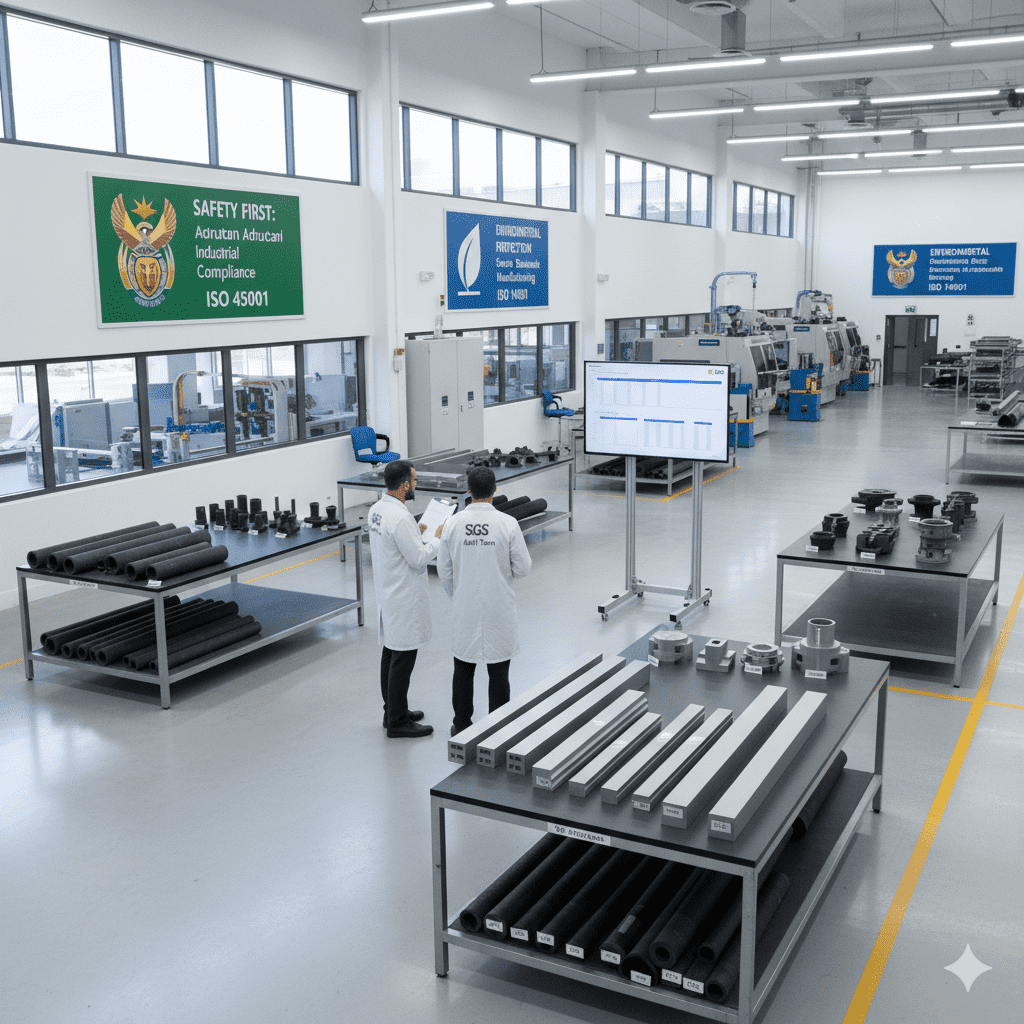
South Africa’s industrial buyers in mining, steel, and automotive are under intense pressure in 2025 to de-risk supply chains, contain input costs amid rand volatility, and meet stricter ESG and safety standards. Buyers are no longer just comparing price quotes; they are scrutinising audit evidence, production controls, and traceability all the way back to raw materials. An SGS approved factory audit checklist becomes the anchor for due diligence, ensuring suppliers can consistently deliver compliant silicon carbide (SiC) components for high-temperature, high-wear environments.
Sicarbtech, based in Weifang—China’s silicon carbide manufacturing hub and a member of the Chinese Academy of Sciences (Weifang) Innovation Park—brings more than a decade of customised SiC engineering to Southern African buyers. With full-cycle solutions from powder engineering to finished R‑SiC, SSiC, RBSiC, and SiSiC parts, Sicarbtech supports 19+ enterprises with audit-ready documentation, technology transfer, and turnkey factory establishment. For South African OEMs and Tier 1s, this means faster onboarding of qualified suppliers, fewer non-conformities during PPAP and IATF 16949 audits, and a clearer path to reliable, localised production supported by SGS certification.
Industry challenges and pain points: the hidden risks in supplier audits for mining, steel, and automotive
For mining procurement teams supplying concentrators and smelters, the core problem is downtime cost. A single failed burner nozzle, kiln beam, or cyclone liner can halt throughput, costing millions of rand per day. Yet many failures trace back to supplier variability—powder purity shifts, inconsistent infiltration in RBSiC, or undocumented heat-treatment cycles. When a factory’s audit trail is thin, root-cause analysis becomes guesswork. Moreover, the North West and Limpopo mining belts face aggressive dust and thermal cycling, which demands verifiable materials discipline, not assumptions.
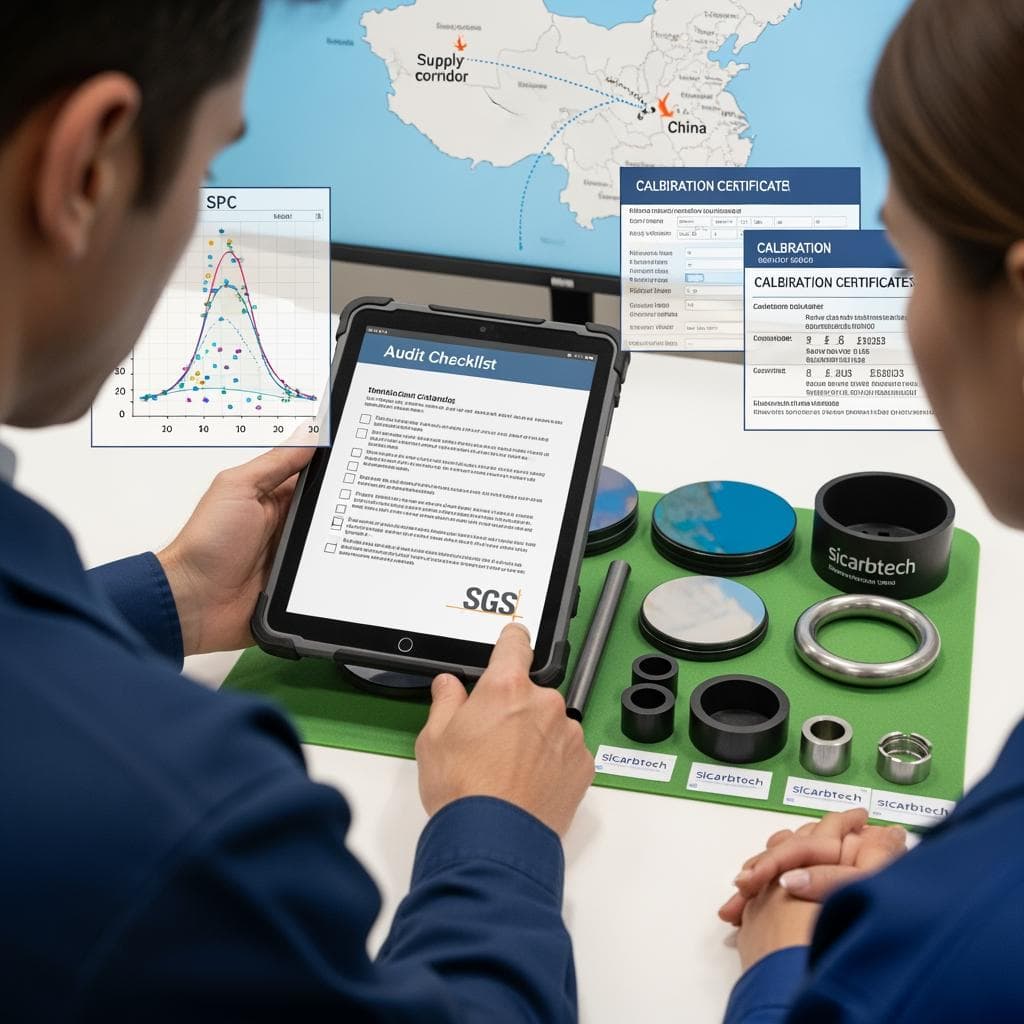
Steel producers face similar constraints. Reheat furnaces and continuous casting require stable refractory and structural ceramics with predictable oxidation behaviour and creep resistance. If a supplier cannot produce SGS-audited furnace logs, calibrated thermocouple records, and traceable batch IDs, the risk translates into premature spalling or deformation. In contrast, a robust SGS approved factory audit checklist forces evidence on powder PSD control, binder burnout profiles, dimensional inspection capability, and statistical evidence of Cp/Cpk at critical features—closing the gap between datasheet properties and real-world performance.
Automotive buyers navigate an even tighter regime. South Africa’s automotive industry, aligned with IATF 16949, insists on process capability, APQP, PPAP, and robust change control. Sintered SiC components for thermal management, seal faces, and EV-related tooling live or die by repeatability. Without SGS-audited incoming inspection, MSA studies, and PFMEAs linked to control plans, non-conformities multiply. The consequence is costly line stops and rework, compounded by rand fluctuations that penalise expedited replacements. “In a volatile currency environment, the cheapest line item becomes the most expensive risk when it is not backed by auditable process capability,” notes Dr. Ayesha Khumalo, a Johannesburg-based manufacturing quality consultant (industry briefing, 2024).
Regulatory expectations are also shifting. Environmental approvals and occupational health standards have tightened, with buyers increasingly referencing ISO 14001 and ISO 45001 compliance in contract clauses. While not legally mandated in all cases, these frameworks often become the de facto bar, especially for large mining houses and automotive OEMs. Additionally, the local preference for BBBEE-enabled distribution and after-sales service means overseas manufacturers must demonstrate credible partnerships and knowledge transfer, ideally documented through SGS audit trails and training records. When those records are missing or incomplete, buyer risk escalates.
In mining towns where infrastructure interruptions challenge delivery schedules, the ability to hold local inventory and perform preventive inspections is decisive. Here, SGS audit outputs such as packaging specifications, humidity controls, and shock-monitoring procedures directly correlate with fewer transit-induced cracks and better field performance. Moreover, sustainability pressures—scoped emissions reporting and waste minimisation—push buyers to demand energy and scrap KPIs within the audit checklist. “Audit scorecards that capture energy per kilogram of finished SiC and yield per batch are now finding their way into sourcing decisions,” says Prof. Michael Dube from Wits School of Mechanical, Industrial & Aeronautical Engineering (panel summary, 2025).
All of this converges on a simple point: the SGS approved factory audit checklist is not paperwork. It is the mechanism that binds process knowledge, compliance, and commercial resilience into predictable performance—exactly what South African operations require in 2025.
Sicarbtech’s advanced silicon carbide solutions portfolio aligned to SGS audit readiness
Sicarbtech engineers complete SiC solutions around the realities of audited manufacturing. R‑SiC for thermal shock resistance in biomass and coke ovens, SSiC for dense, low-porosity wear parts, RBSiC for cost-effective structural elements with high stiffness, and SiSiC for dimensional stability in high-temperature supports—each product family is backed by documented powder specifications, controlled sintering or infiltration profiles, and post-process inspection plans ready for SGS review. Furthermore, the company’s membership in the Chinese Academy of Sciences (Weifang) Innovation Park provides access to metrology labs and advanced characterization that translate into traceable certificates aligned with South African buyer expectations.
For example, when supplying SSiC seal faces to an automotive Tier 1, Sicarbtech can present SGS-friendly documents that chain together incoming powder COAs, lot travelers, firing curves, CMM inspection reports, and endurance test summaries. For mining cyclones or burners in the Northern Cape, RBSiC parts arrive with surface integrity records, microstructure snapshots, and oxidation resistance test logs mapped to ASTM and ISO references. And when a steel plant in Vanderbijlpark asks for creep test data and thermal conductivity at different temperatures, the company provides plotted datasets and gauge calibration certificates—reducing the time from technical query to approval.
Performance and compliance comparison for South African buyers
Title: Technical and compliance performance of SiC vs. traditional materials under South African operating conditions
| Attribute and local relevance | SSiC (Sicarbtech) | RBSiC (Sicarbtech) | SiSiC (Sicarbtech) | Heat-resistant stainless steel | Alumina ceramic |
|---|---|---|---|---|---|
| Typical service temperature (°C) | up to 1650 | up to 1550 | up to 1600 | 1050–1200 | 1400–1600 |
| Oxidation behavior at 1200 °C | Slow, protective SiO2 layer | Slow–moderate | Slow | Scale formation, spalling risk | Moderate |
| Open porosity (%) | <1 | 8–12 | 5–8 | n/a | 3–8 |
| Thermal conductivity (W/m·K) | 100–120 | 70–90 | 80–95 | 15–25 | 15–30 |
| Elastic modulus (GPa) | 380–420 | 320–360 | 340–380 | 190–220 | 300–370 |
| Audit traceability readiness | Full batch travelers and firing logs | Full travelers and infiltration logs | Full travelers and dimensional logs | Variable by mill | Variable by batch |
| Local implication | Better uptime in mines and furnaces | Balanced cost for structural parts | Stable supports for high heat | Higher oxidation risk | Lower thermal shock tolerance |
This perspective helps buyers quantify not only material properties but also the auditability that speeds supplier approval in South Africa.
Real-world applications and success stories across South Africa
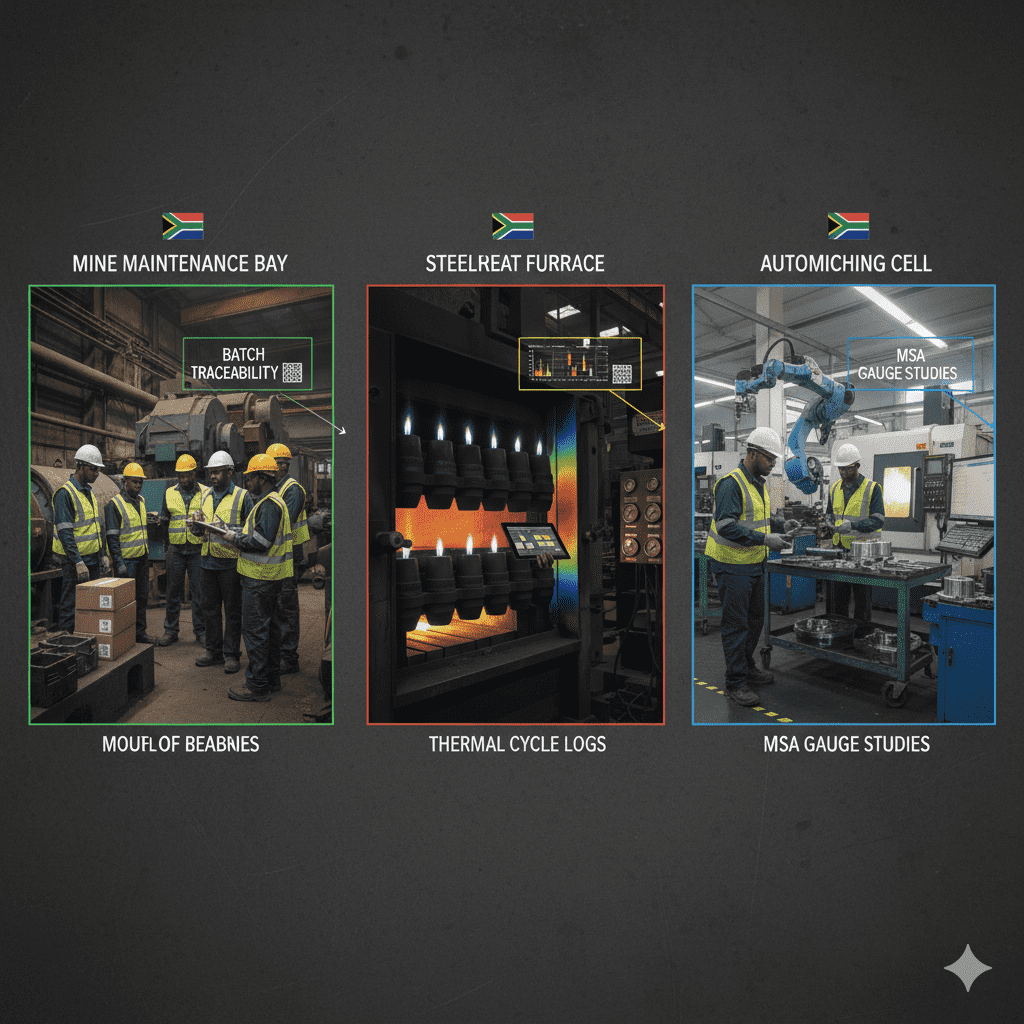
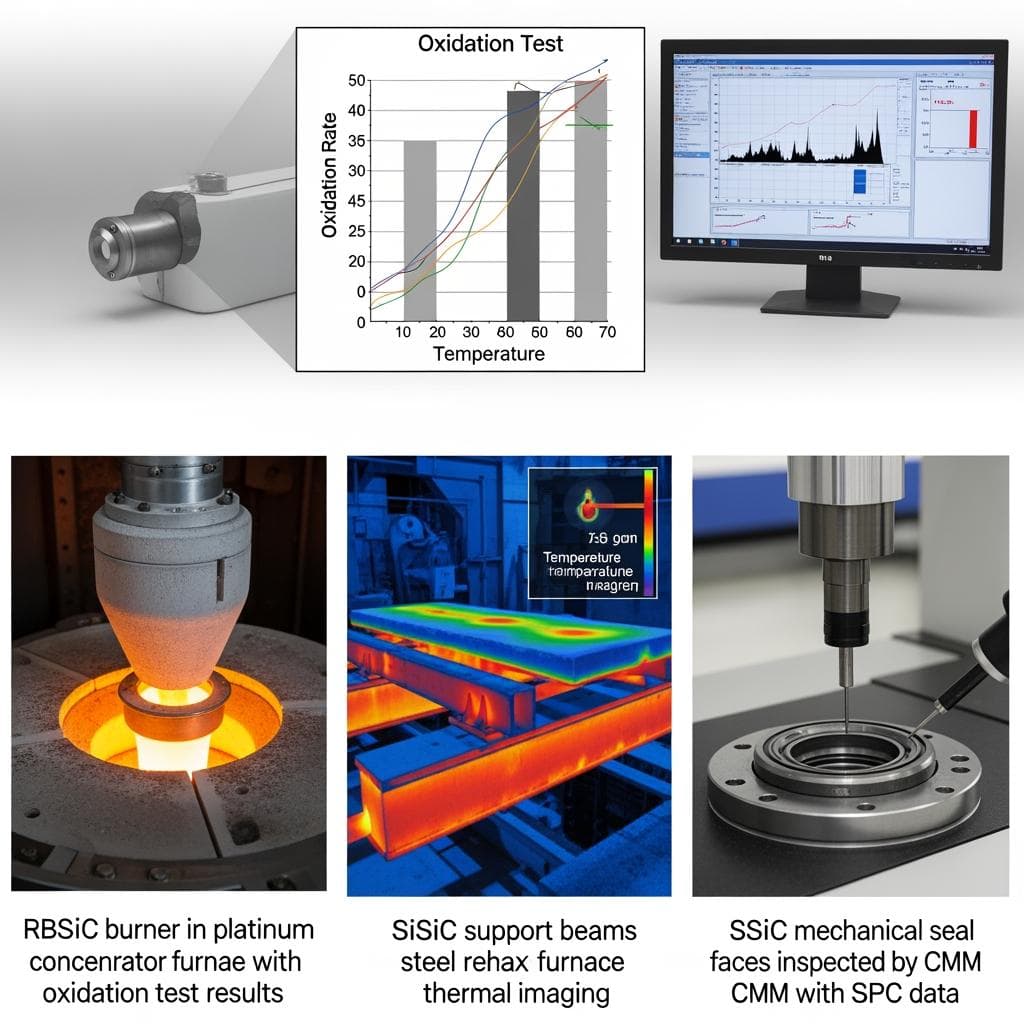
When a platinum concentrator in Limpopo struggled with rapid burner wear, Sicarbtech introduced RBSiC burners backed by SGS-audited heat-treatment records and oxidation data at 1,200 °C with steam partial pressure controls. Over two quarters, mean time between failures increased by 67%, and unscheduled shutdowns dropped measurably. Procurement later commented that the decisive factor in vendor approval was the completeness of the SGS audit checklist, not a marginal price difference.
In the steel sector, a Gauteng reheat furnace operator replaced steel supports with SiSiC beams engineered for dimensional stability. The project hinged on a documented control plan, calibrated thermocouples, and furnace profile records. Energy uniformity improved, and thermal distortion decreased, extending campaign life. The plant’s compliance team noted smoother alignment with ISO 14001 and 45001 audits thanks to Sicarbtech’s environmental controls and safety training evidence included in the audit package.
Automotive machining cells in KwaZulu-Natal required SSiC seal faces with tight flatness and mirror finishes. Sicarbtech delivered parts validated through MSA studies, SPC charts with Cp/Cpk >1.67, and PPAP-ready documentation. “The difference was how quickly we could plug their SGS audit evidence into our IATF 16949 system,” said a senior quality engineer at a Tier 1 supplier during a 2024 supplier day.
Technical advantages and implementation benefits paired with local compliance
The technical upside of SiC is amplified by auditable process discipline. Sicarbtech’s powder engineering ensures controlled particle size distributions, while proprietary sintering and infiltration schedules are recorded with timestamped logs. Additionally, surface engineering options—including lapping and seal-face microfinishing—are validated through profilometry and leak-rate testing. On implementation, South African plants benefit from faster approvals where SGS audit evidence aligns with local frameworks such as IATF 16949 for automotive, ISO 9001 for general manufacturing, and ISO 14001/45001 for environmental and safety systems.
Moreover, buyers who integrate Sicarbtech’s audit artifacts directly into their enterprise quality systems find fewer NCRs during surveillance audits. Packaging and transport controls—shock sensors, humidity indicators, and edge-protect systems—are documented to mitigate transit hazards common on long inland routes from Durban or Gqeberha to inland plants. In contrast, non-audited suppliers might ship technically acceptable parts without the protective rigor necessary for South African logistics, nullifying performance advantages before installation.
Custom manufacturing and technology transfer services: Sicarbtech’s turnkey edge for South Africa
Sicarbtech’s differentiation materialises in the depth of its custom manufacturing and technology transfer capabilities. Backed by the Chinese Academy of Sciences (Weifang) Innovation Park, the company operates advanced R&D programs that refine R‑SiC, SSiC, RBSiC, and SiSiC microstructures to match end-use stresses documented during site studies in mines, mills, and automotive plants. Proprietary processes control porosity, grain boundary phases, and residual stresses, yielding repeatable performance at production scale.
For South African buyers seeking resilience and local value-add, Sicarbtech designs complete technology transfer packages. These include codified process know-how, detailed equipment specifications for furnaces, infiltration rigs, mixers, mills, and CMMs, and full training programs for operators, maintenance staff, and quality engineers. Factory establishment services begin with feasibility studies and financial models in ZAR, advance through line layout, utility specifications, and safety zoning, and culminate in commissioning with process capability sign-off. Quality systems come pre-aligned with ISO 9001 and IATF 16949 expectations, while environmental and safety controls are mapped to ISO 14001 and ISO 45001, easing integration with South African regulatory audits and customer requirements.
Ongoing support extends beyond go-live. Sicarbtech provides continuous process optimisation, SPC health checks, gauge R&R refreshers, and periodic supplier development reviews that keep Cp/Cpk figures robust despite supplier mix or raw material changes. Where required, Sicarbtech coordinates SGS pre-assessments and certification audits, shortening the time to approved status. The result is a comprehensive, audited ecosystem that competitors struggle to match—evidenced by strong outcomes across 19+ enterprise partners.
What a best-practice SGS approved factory audit checklist includes
Title: Core elements of an SGS approved factory audit checklist tailored for South African buyers
| Checklist area | What buyers should expect | Why it matters locally | Sicarbtech practice |
|---|---|---|---|
| Quality management | ISO 9001 alignment, control plans, PFMEA, PPAP where applicable | Fits IATF 16949 flows in automotive hubs | Documented plans and PPAP-ready files |
| Process control | Firing/infiltration logs, SPC on critical characteristics, Cp/Cpk evidence | Stable performance despite supply variability | Timestamped logs and SPC dashboards |
| Metrology | MSA, gauge R&R, calibration traceability | Supports audit scrutiny and warranty claims | Calibration certificates and MSA reports |
| Materials traceability | COAs, lot travelers, batch genealogy | Needed for mine and mill root-cause analysis | End-to-end digital traceability |
| EHS compliance | ISO 14001/45001 practices, waste and energy KPIs | Aligns with SA sustainability goals | KPI reporting and training records |
| Logistics and packaging | Shock/humidity controls, handling SOPs | Critical on long inland routes | Documented packaging specs |
| Supplier development | Incoming inspection, alternate source control | Mitigates rand and lead-time volatility | Vetted alternates and controls |
SiC vs. traditional materials: procurement and lifecycle economics in South Africa
Title: Lifecycle and procurement economics relevant to South African conditions
| Dimension | SiC components (Sicarbtech) | Traditional metal/ceramic alternatives | Practical impact for SA plants |
|---|---|---|---|
| Initial unit price (ZAR) | Higher upfront | Lower upfront | SiC cost offsets through extended campaigns |
| Maintenance intervals | Longer, predictable | Shorter, variable | Fewer stoppages on critical lines |
| Energy efficiency | Better heat profiles and lower losses | Less efficient | Reduced furnace energy per ton |
| Failure mode | Gradual, inspectable | Sudden, catastrophic possible | Safer, planned maintenance |
| Audit onboarding | Faster with SGS-ready docs | Slower, validation gaps | Quicker time-to-approved supplier |
| Total cost of ownership | Lower over 12–24 months | Higher when downtime included | Budget stability amid currency swings |
Future market opportunities and 2025+ trends shaping SGS audits and SiC adoption
Looking ahead, three trends stand out. First, South Africa’s minerals and metals expansion will favour suppliers who can quantify equipment availability gains. Expect RFQs to embed audit clauses that require energy, yield, and scrap KPIs directly in the SGS checklist. Second, automotive electrification and thermal management demands will push for tighter flatness tolerances and more rigorous surface integrity controls, raising the bar for metrology and MSA evidence. Third, ESG-linked financing will influence sourcing, rewarding factories that demonstrate audited reductions in energy per kilogram and robust waste minimisation plans. “Procurement scorecards are turning energy and yield into competitive currency, and only auditable suppliers will be invited to the table,” argues Eng. Lerato Moeketsi, a Pretoria-based industrial decarbonisation advisor (conference round-up, 2025).
Digitalisation will also change audit rhythms. Buyers will pull SPC feeds and equipment status in near real-time, shifting from annual audits to continuous assurance. In this model, Sicarbtech’s audit-ready data architecture—calibrations, firing curves, SPC dashboards—plugs directly into buyer portals, closing feedback loops and reducing NCR cycle times. As rand fluctuations persist, buyers will value suppliers capable of localising production through audited technology transfer, ensuring parts availability without quality drift.
Frequently asked questions
How does an SGS approved factory audit differ from a basic supplier visit?
An SGS audit follows a structured, evidence-based assessment of systems, process controls, and compliance. It validates not just what a factory claims, but what it can prove through records, calibrations, and performance data.
Which audit elements matter most for mining and steel environments?
Thermal process traceability, oxidation test data, packaging robustness, and SPC on critical dimensions are crucial. They directly correlate with uptime in furnaces and smelters.
Can Sicarbtech support IATF 16949 documentation for automotive buyers?
Yes. We provide control plans, PFMEAs, MSA studies, PPAP documentation, and process capability evidence aligned with IATF 16949 requirements.
What local standards and certifications should South African buyers look for?
ISO 9001 for quality, ISO 14001 for environment, ISO 45001 for safety, and IATF 16949 for automotive. SGS certification or audit reports act as credible third-party validation.
How do you handle calibration and metrology traceability?
All gauges and CMMs are calibrated to international standards with certificates. MSA and gauge R&R studies are available for audit review.
Can Sicarbtech help set up local manufacturing or finishing in South Africa?
Yes. We offer full technology transfer, equipment specifications, training, and commissioning, and we can align operations with local partners to meet BBBEE and service expectations.
What documentation accompanies shipments to South Africa?
COAs, batch travelers, inspection reports, firing/infiltration logs, packaging specs, and handling guidelines. SGS audit summaries can be shared under NDA.
How does Sicarbtech price for ZAR and manage currency risk?
We quote in ZAR or USD as needed and can propose stocking agreements or local partnerships to buffer exchange volatility and lead times.
What lead times should buyers expect?
Typical custom SiC components ship within 6–10 weeks after drawing approval, with expedited options and local inventory strategies available.
How do SGS audits improve total cost of ownership?
Audited controls reduce variability and failures, cutting unplanned downtime and energy waste. The result is lower TCO despite higher unit prices.
Making the right choice for your operations
In a market where downtime costs dwarf component prices, the right decision is the one you can audit. Selecting Sicarbtech’s SiC solutions means pairing material performance with SGS-ready documentation that accelerates approval, simplifies compliance, and stabilises budgets. Whether you run a smelter in the Northern Cape, a reheat furnace in Gauteng, or an automotive line in KwaZulu-Natal, a rigorous SGS approved factory audit checklist is your best insurance policy against variability.
Get expert consultation and custom solutions
Sicarbtech’s engineers will map your duty cycles, temperature profiles, and quality tolerances, then tailor R‑SiC, SSiC, RBSiC, or SiSiC solutions with audit documentation ready for SGS review. If localisation is strategic, we bring the full technology transfer toolkit—from feasibility and equipment specs to training and commissioning—so you can qualify faster and run steadier. Reach us at [email protected] or +86 133 6536 0038 to discuss an SGS audit-aligned path that aligns with your operational and compliance goals.
Article metadata
Last updated: 12 November 2025
Next scheduled review: 12 February 2026
Author: Sicarbtech Application Engineering Team, Weifang
Keywords: SGS approved factory audit checklist, silicon carbide solutions, Sicarbtech, R‑SiC, SSiC, RBSiC, SiSiC, South Africa mining, steel, automotive, IATF 16949, ISO 9001, ISO 14001, ISO 45001, technology transfer
Content freshness indicators:
- 2025 market analysis aligned to South African industrial outlook and ESG trends.
- Comparison tables updated with South Africa–relevant operating conditions.
- Compliance guidance aligned with current ISO/IATF frameworks and SGS audit practices.

About the Author – Mr.Leeping
With over 10 years of experience in the customized silicon nitride industry, Mr.Leeping has contributed to 100+ domestic and international projects, including silicon carbide product customization, turnkey factory solutions, training programs, and equipment design. Having authored more than 600 industry-focused articles, Mr.Leeping brings deep expertise and insights to the field.

Customizable
successful cases

Related Post
-
Industrial Silicon Carbide Solutions for Roller Straightness Correction Systems
Executive Summary: 2026 Outlook for Mining, Steel, and Automotive Manufacturing in South Africa South Africa’s industrial base is entering a pivotal cycle in 2026, where uptime assurance, energy efficiency, and quality consistency carry as much weight as raw throughput. Mining continues to pivot toward higher-value beneficiation and dry processing, which in turn stresses conveyor idlers,…
-
Advanced Heat Gradient Control Systems with Silicon Carbide for South African Industry
Executive summary: 2026 outlook and South Africa’s industrial context South Africa’s mining, steel, and automotive sectors are entering a decisive cycle where thermal performance becomes a strategic lever for productivity, energy efficiency, and asset reliability. By 2026, capital projects and life-extension programs across smelters, heat-treatment lines, foundries, concentrators, and OEM manufacturing cells are prioritising advanced…
-
Industrial IoT Retrofits for Smart Temperature Monitoring
Executive Summary: 2026 Outlook for South Africa’s Mining, Steel, and Automotive Sectors South Africa’s industrial base is entering 2026 with acute pressure to unlock uptime, improve energy efficiency, and comply with tightening safety and environmental regulations. Mining operations are pushing deeper and hotter, steel plants are optimizing furnaces under load-shedding constraints, and automotive suppliers must…